The 1994 Crime Bill turns 30 with a mixed legacy


Add Axios as your preferred source to
see more of our stories on Google.
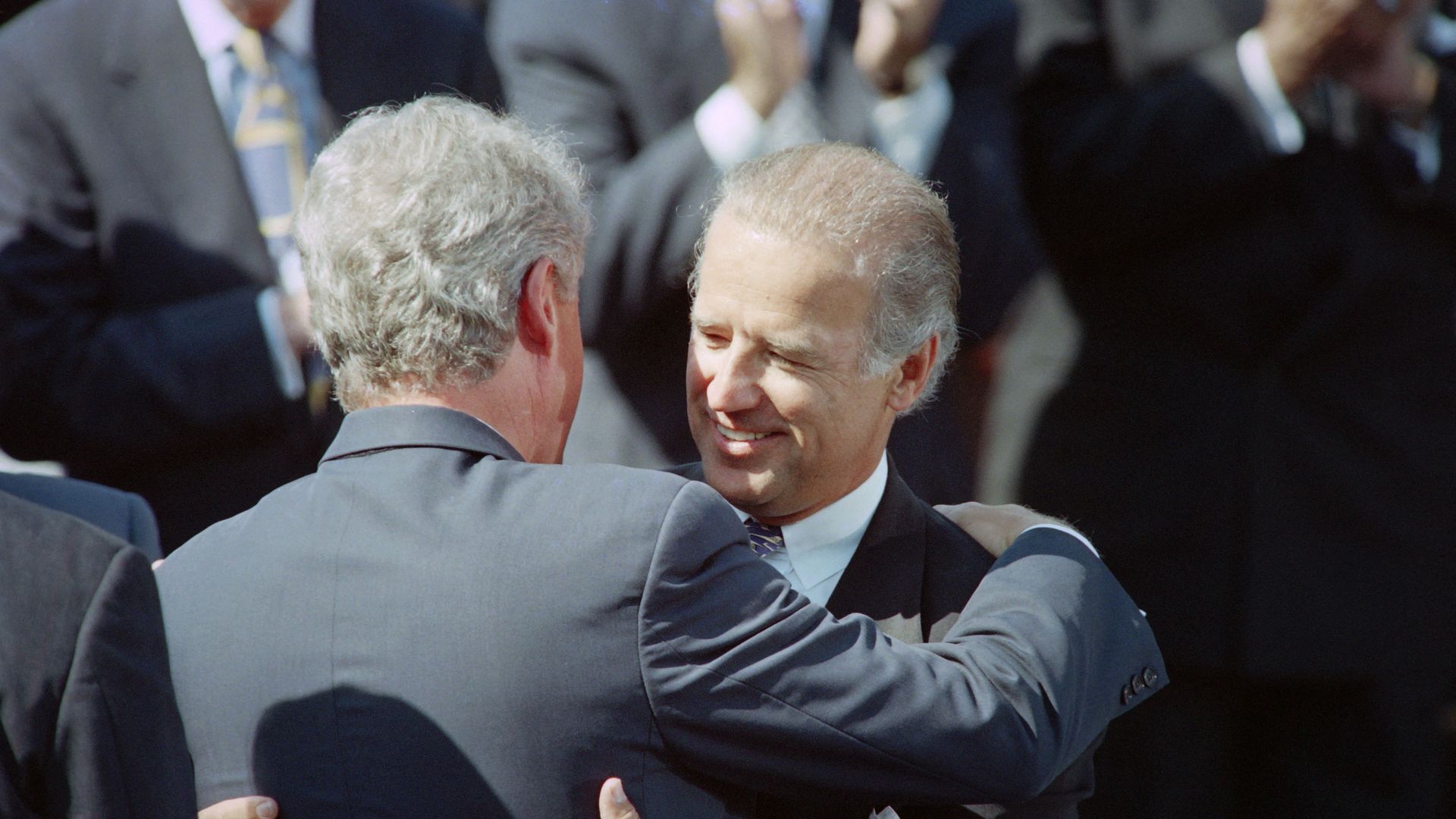
President Bill Clinton hugs then-U.S. Sen. Joseph Biden on September 13, 1994, during a signing ceremony for the crime bill outside the White House. Clinton said the crime bill would "roll back this awful tide of violence." Photo: Paul J. Richards/AFP via Getty Images
The most far-reaching crime bill ever passed by Congress has left a complicated history three decades later, with President Biden being called to acknowledge and repair for damage some feel it caused.
The big picture: The 1994 Crime Bill, signed 30 years ago on Friday, is credited with helping reduce crime during a massive surge in the U.S. But it also resulted in more mass incarcerations of young Black and Latino men.
- Now advocates want Biden, then a U.S. senator from Delaware and vocal proponent of the bill, to use his final days in office to push for repeal on some parts.
- The People's Coalition for Safety and Freedom held events this week in Washington, D.C., and will meet with others Saturday to plan the next steps in urging President Biden and lawmakers to revisit the crime bill.
State of play: During the late 1980s and early 1990s, cities across the country saw historic spikes in violent crimes connected to the crack epidemic, gang wars, drive-by shootings and economic upheaval.
- Biden led senators on the tough-on-crime approach with the massive bill that authorized the death penalty for dozens of existing and new federal crimes.
- By the 2020 Democratic presidential primaries, few Democrats were embracing the 1994 Crime Bill as the Black Lives Matter movement prompted widespread condemnation of systemic racism.
Zoom in: The bill mandated life imprisonment for people who committed a third violent felony, known as the "three strikes law" or "Three Strikes and You're Out."
- The measure banned 19 types of semiautomatic assault weapons, and it created the Violence Against Women Act (VAWA), which was designed to protect domestic violence survivors.
- It provided $12.5 billion in grants to fund incarceration, with nearly 50% allocated for states adopting strict "truth-in-sentencing" laws that reduced parole.
Background: Between the end of the 1960s and the early 1990s, the overall rate of violent crime more than doubled before peaking in 1991, according to the Brookings Institution.
- By 1991, the violent crime rate per 100,000 residents in the U.S. was 758.2 (it was 380.7 in 2023).
- A group of 10 black mayors from big cities, including Atlanta and Detroit, urged Congress to pass the 1994 Crime Bill as a 1994 Gallup survey found that 58% of Black Americans supported the proposal.
Yes, but: Thirty years later, the bill is "a double-edged sword," especially among the Black Americans today who it was designed to support, Sunny Slaughter, law enforcement expert and CourtTV legal analyst, tells Axios.
- That's because many advocates believe it helped expand incarceration rates of men of color, though others dispute that.
- "While aiming to address public safety, it has instead exacerbated generational trauma, impacting lives, families, and communities more deeply than the issues it sought to solve," Slaughter says.
What he's saying: On Thursday, Biden touted his role in passing VAWA as part of the 1994 Crime Bill.
- "Back then, society largely turned a blind eye, dismissed cries for help, or blamed the victims. It was wrong. I have long believed that ending violence against women requires a wholesale cultural change," he said in a statement.
- Biden then announced new funding for survivor services and expanding housing protections.
Context: As a senator, Biden opposed the three strikes provisions in the bill, which were included as part of a compromise.
- FBI numbers showed that violent crime dramatically fell in the decades that followed and reached 30-year lows in the 2010s.
Between the lines: Kumar Rao, a lawyer and advocate who's long sought to repeal the 1994 Crime Bill, tells Axios the law was a misguided approach to public safety that prioritized policing and incarceration over community-based solutions.
- "At the core of the 1994 Crime Bill is this false notion that we can have safe communities through the carceral system — prisons, policing, prosecution."
- We have to be clear: the way we are doing things in our country, particularly around safety and criminal justice, is just not working," Rao said. "It's an immoral blight that we incarcerate the most people in the world, and yet we have widespread gun violence, drug overdoses, homelessness."
What we're watching: Vonne Martin, deputy chief of campaigns for Center for Popular Democracy, says their group is launching a campaign called "Before you go, Joe" to repair the harm of the 30-year law.
- They want an independent clemency review board and the president to commute more sentences.
- "We know our folks can talk about the harms that this bill has caused across the country; they have the proof and the stories that are tied to the increased over-policing in communities," Martin said. "Those stories alongside the demand … we're optimistic this will come to fruition before he leaves office."
Editor's note: This article has been updated with context that Biden, as senator, opposed the 3 strikes provisions, which were included as part of a compromise.
