Maxar's Smoot: "Predictive types of intelligence" are the future

Add Axios as your preferred source to
see more of our stories on Google.
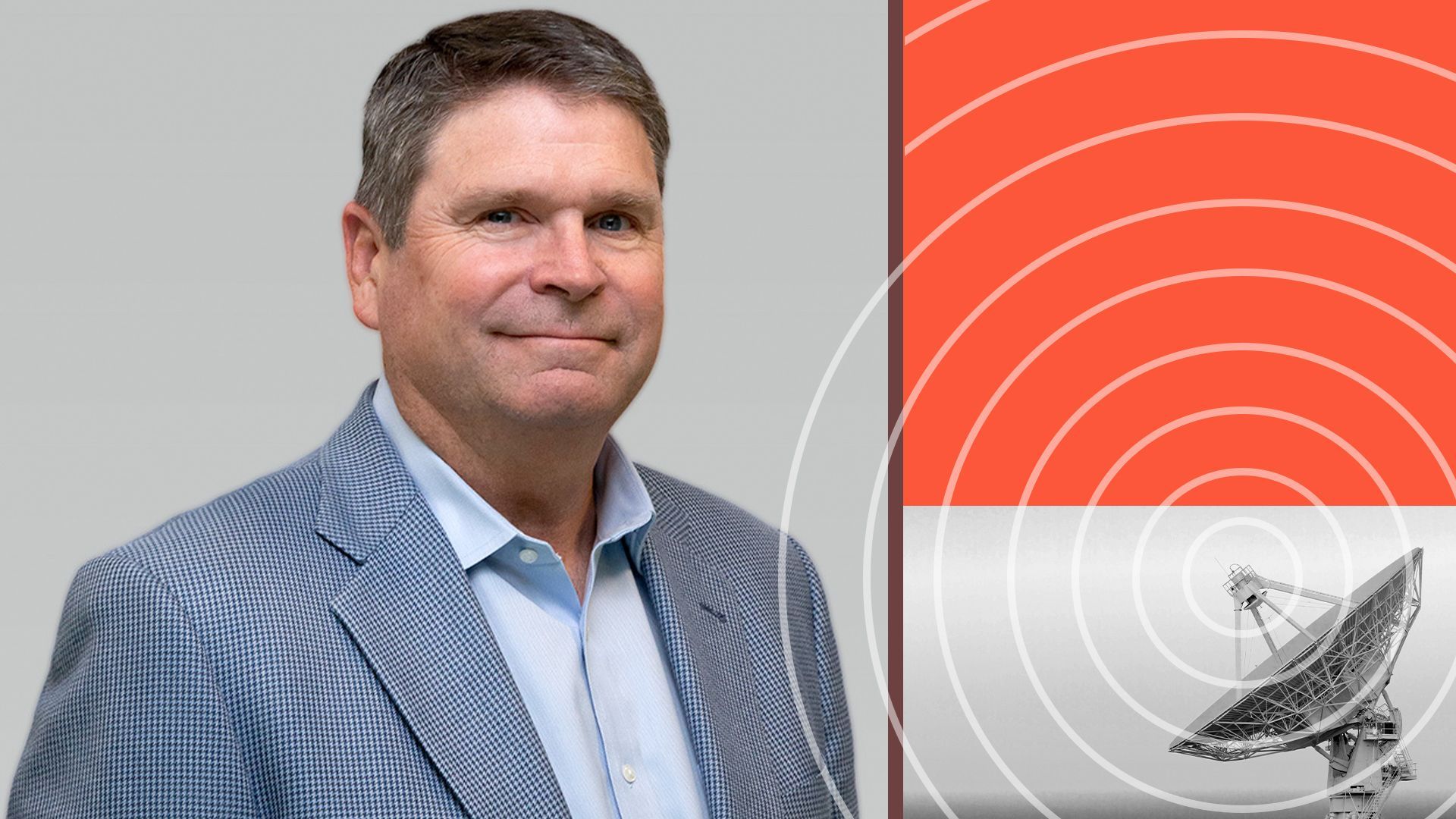
Photo illustration: Axios Visuals. Photo: Maxar
Dan Smoot, the chief executive at Maxar Intelligence, wants to predict the future, or at least come real close.
Why it matters: Maxar is a leading provider of overhead imagery and intelligence to governments around the world, and its insights aid responses to humanitarian disasters.
- "If we just are an imaging company that is passively providing information, that's not where the imminent threat-prevention is going to be," he told Axios.
Q: When you hear "future of defense," what comes to mind?
A: When we hear future of defense, we think about more intelligent systems, more leverage in regard to artificial intelligence and machine learning to advance our capabilities, to modernize, unfortunately, how we fight wars and think about it going forward.
Q: When will wars be waged solely by robots?
A: I wish I knew the answer that question. Unfortunately, we're not in the robotics industry.
- But clearly, artificial intelligence, machine learning capabilities, doing predictive types of intelligence are going to be incredibly important moving forward. I think we'll see that play into the arena more and more as it advances over the next couple of years.
Q: What's the biggest challenge the defense industry faces at the moment? What can be done to alleviate it?
A: Utilizing commercial even more effectively than we are today. Commercial advances its technology capabilities much faster than the government can. The government relies on large, bespoke, long-term programs, while industry is moving very fast to be on a competitive front.
- How the defense industry can actually leverage these capabilities, in a much faster method, is going to be incredibly important. That also includes the massive consumption of data.
Q: How many emails do you get a day, and how do you deal with them?
A: Too many — probably hundreds of emails a day. I have a definite behavior about filtering information. I have to have everything in nice, clean informational boxes.
- But seriously, I have a critical list of people and, more importantly, topics that I will always filter to the top.
- I also have a belief that if the emails get to too many exchanges, you stop the email immediately and you get everyone on a phone call.
Q: What's your secret to a successful overnight flight?
A: I have been traveling incessantly, internationally, for probably 25 years now. I've had to train myself how to literally land and be in productive mode.
- First and foremost, you just try to get on their schedule. Second is: I never go to bed right when I get off a plane. If you do, you're dead; the jet lag is going to kill you. You have to muscle through those first couple hours, where you're just feeling awkward.
Q: What's a piece of gear or tech you can't go without?
A: I think I'm a millennial because I can't go without my phone, and unfortunately I carry two, which is even worse.
- It's not necessarily all about work. It's more contact. It's information.
- My father was a CEO for many, many years, and I remember when he got a fax machine. Now, I'm going to age myself. That was in the 80s, and I was like, "That's really cool," because in the middle of the night, you'd hear the fax machine going off. He said it was the most miserable thing that ever happened to him.
