The globe just had its hottest summer on record

Add Axios as your preferred source to
see more of our stories on Google.
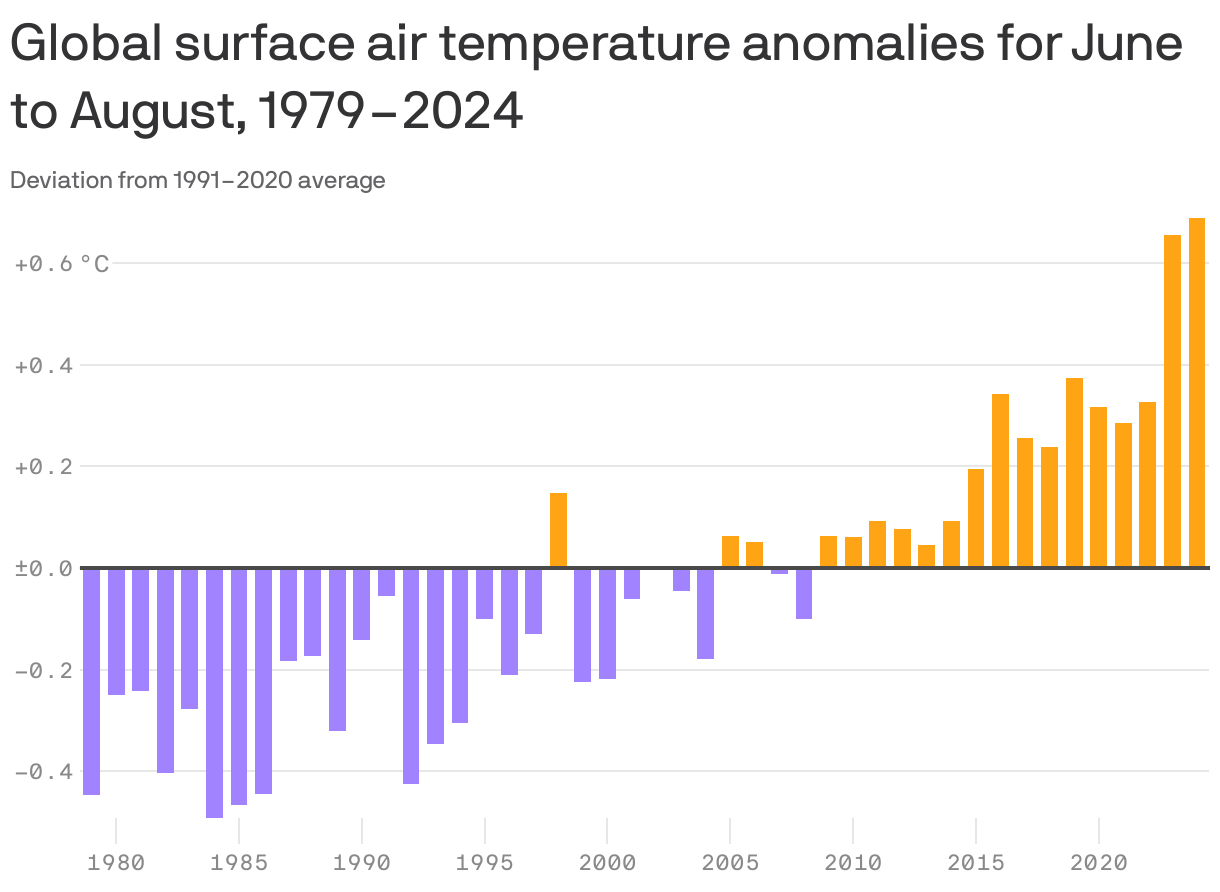
The global average surface temperatures from June through August were the hottest on record, according to the Copernicus Climate Change Service.
Why it matters: The period, which comprises summer in the Northern Hemisphere, brought a spate of extreme heat, wildfires and other extreme events.
- Europe had its hottest summer on record, with deadly heat events repeatedly affecting Greece, Italy and Spain, along with wildfires.
Zoom in: Copernicus, an EU science center, now projects that 2024 will surpass 2023 as the globe's hottest year on record.
- The planet had its hottest August on record, tied with the same month the year before.
- Thirteen of the past 14 months have seen global average surface temperatures that exceeded 1.5°C above preindustrial levels, which is a key warming target under the Paris Agreement.
- In July, the globe recorded a string of the four hottest days on record stretching back for at least 100,000 years.
Yes, but: That pact referred to long-term averages, on the timescale of several decades, rather than a far shorter timespan of 13 months.
By the numbers: The difference between the year-to-date and the previous hottest year in 2023 is 0.23°C (0.4°F) above the 1991-2020 average, Copernicus scientists found.
- This effectively seals the deal for a warmest year in their books. "The average anomaly for the remaining months of this year would need to drop by at least 0.3°C for 2024 not to be warmer than 2023," Copernicus said in a statement.
- "This has never happened in the entire ERA5 data set, making it increasingly likely that 2024 is going to be the warmest year on record," the center stated, referring to the temperature data set it maintains, which is distinct from others at NASA, NOAA and elsewhere.
- During the summer, wildfires encroached on Greece's capital of Athens, and tourists wilted in withering heat.
- The heat was not confined to the Mediterranean region. In Longyearbyen, on the Arctic island of Svalbard, Norway, August was the hottest month on record, crushing previous records, with an average temperature of 11°C (51.8°F).
- Japan saw some of its hottest temperatures on record during the late summer, and Mexico also had a record shattering, long duration heat wave.
What they're saying: "During the past three months of 2024, the globe has experienced the hottest June and August, the hottest day on record, and the hottest boreal summer on record," Samantha Burgess, deputy director of the Copernicus Climate Change Service, said in a statement.
- "The temperature-related extreme events witnessed this summer will only become more intense, with more devastating consequences for people and the planet unless we take urgent action to reduce greenhouse gas emissions."
