Health shrinkflation: Patients wait more for less

Add Axios as your preferred source to
see more of our stories on Google.
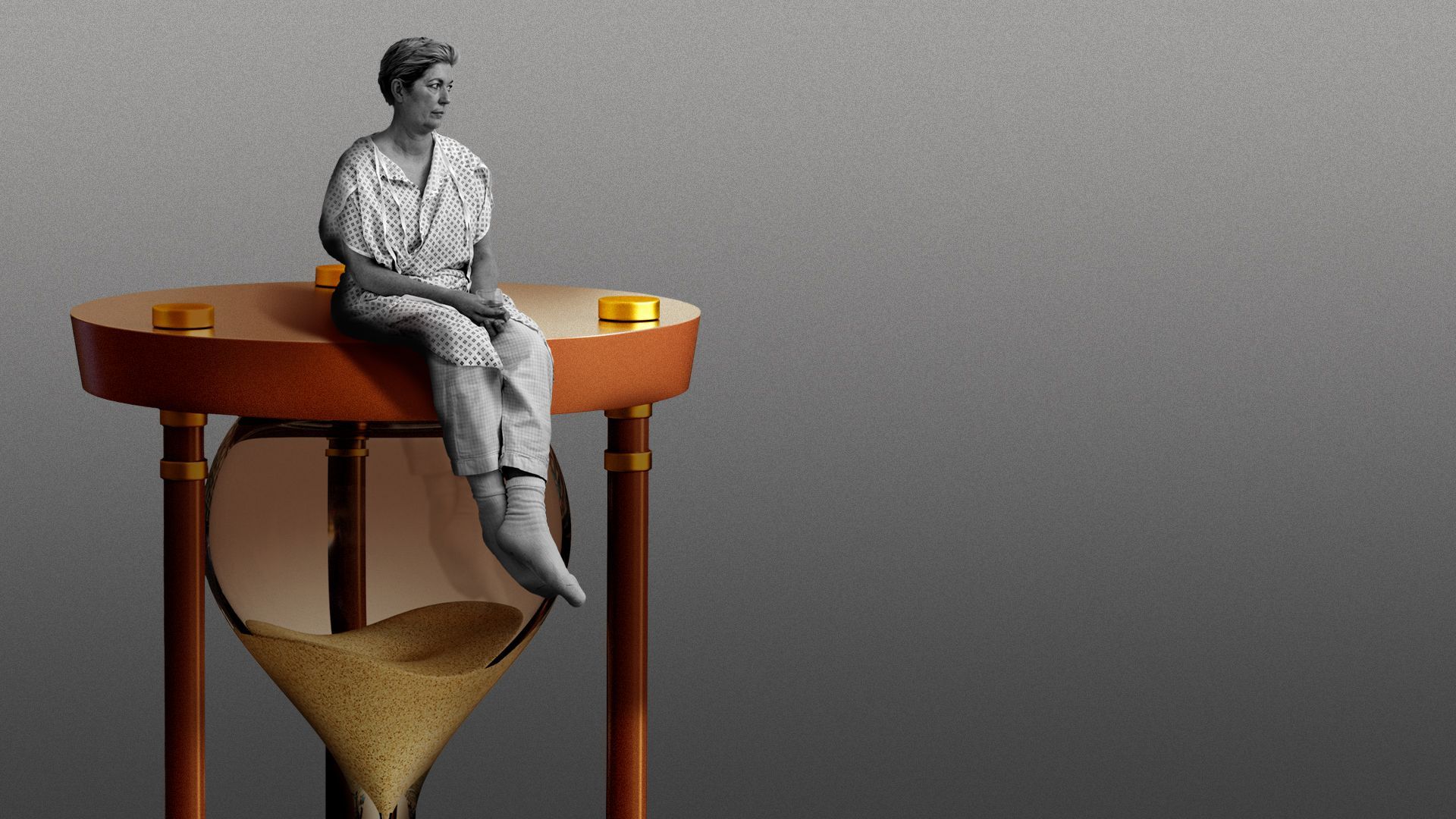
Illustration: Sarah Grillo/Axios
The U.S. spends more on health care than almost anywhere else. But increasingly patients are getting less in return, and enduring long waits to get not as much face-time with their clinician.
Why it matters: Shrinkflation is hitting a sector that accounts for almost one-fifth of the economy, eroding the doctor-patient relationship and leaving many turning to urgent care clinics or telehealth services.
- Some who can afford it are gravitating to concierge practices that offer fewer hoop jumps and more add-on services with office visits.
The latest: The trend is being felt especially in primary care, but also in many specialties.
- An Axios-Ipsos survey last month found that nearly one in five respondents said they had to wait more than two months to see a primary care physician or specialist, with waits trending longest in the Midwest.
- NYC Health + Hospitals recently told primary care doctors to cut appointment times in half to 20 minutes, in order to squeeze in more patients, Gothamist reported.
- A spokesperson told Axios that the public health system is grappling with 50,000 more primary care patients who've been added since 2021. The average number of days to the third next available appointment jumped from 12 days to 22 days.
By the numbers: 17% of patients had to wait one to three months for their latest doctor's appointment, per electronic health records company Tebra.
- The most frequently cited specialties with long wait times included neurology (26%), ear, nose, and throat (26%), psychiatry (20%), and OB/GYN (17%). Primary care stood at 19%.
- 43% of patients reported experiencing longer wait times for appointments since the pandemic, per the Tebra survey.
- The surge in demand for in-person care since the crisis has been well-documented. AMN/Merritt Hawkins found that the average wait time for a physician appointment in 15 large metro markets surveyed in 2022 was 26 days, up from roughly 24 days in 2017, and about 21 days in 2004.
The big picture: This is what shrinkflation in healthcare looks like as the industry struggles with supply and demand issues, Robert Pearl, a Stanford University professor and former CEO of The Permanente Medical Group, told Axios.
- There's been across-the-board growth in patient volumes largely from pent-up demand for services many put off during the pandemic.
- At the same time, tens of thousands of doctors have left the field due to burnout and other factors, and surveys indicate even more plan to retire early.
- Red tape around insurance and rising out-of-pocket costs are leaving patients frustrated and confused, and in some cases burdened by more medical debt.
"You're paying actually more for your health coverage, but you're not getting more. You're actually getting less," Pearl said.
What they're saying: Health systems say they are doing what they can to ramp up training, recruitment, and retention of doctors, but say that can only do so much.
- "I think we're seeing some improvement, but not a lot, even though we've hired a lot of new clinicians. I think there's just tremendous demand out there," Warner Thomas, CEO of Sacramento-based Sutter Health told Axios.
- The health system hired 732 physicians and advanced practice clinicians in 2023 and plans to exceed that this year, already hiring 626 physicians and APCs through August 21. It is also expanding its graduate medical education to train new doctors, Thomas said.
- But there still are big gaps, especially in primary care, which tends to pay less, and in outlying areas with smaller patient populations and bigger pools of uninsured people.
Technology and at-home care could fill in some of the holes, experts say.
- Sutter is investing in digital scheduling and other tools to speed up wait times for both appointments and referrals, Thomas added.
- Renton, Washington-based Providence is also investing in technology to identify scheduling gaps and, for example, ensure that its surgical suites are running at full capacity, said chief financial officer Greg Hoffman.
What to watch: How much worse things will get. Studies have suggested patients who've had negative experiences with the health system are likelier to avoid coming back — a trend especially prevalent among minority groups.
- Concierge arrangements that charge a monthly retainer fee for more timely access are becoming more attractive to patients and doctors, Pearl said.
- But that exacerbates inequities, creating "a vicious cycle, where each year the demand grows and the care becomes skimpier. As a result of that, the demand grows even faster."
