From "Brat" to "Espresso": Pop's new guard emerges

Add Axios as your preferred source to
see more of our stories on Google.
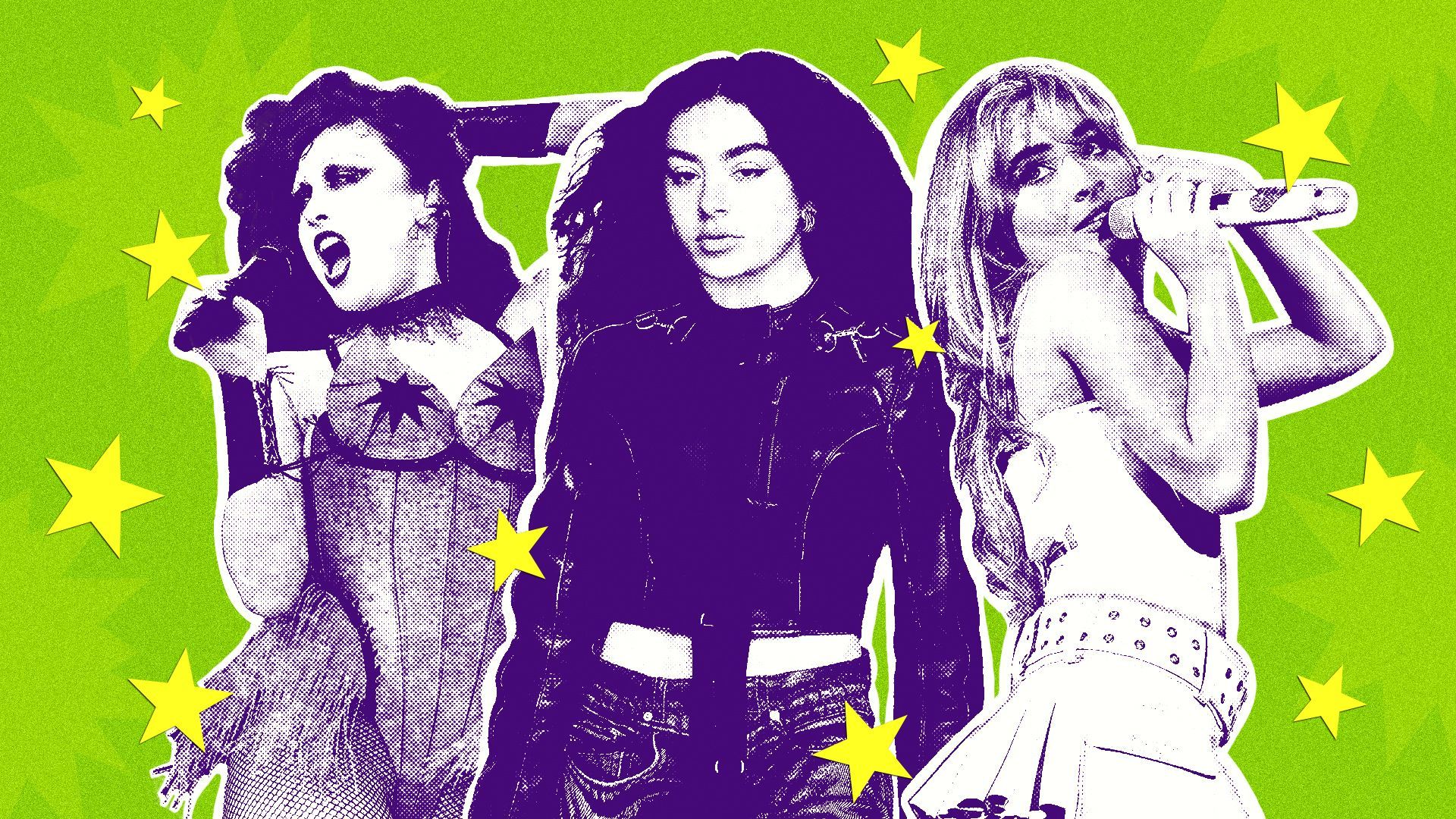
Photo illustration: Tiffany Herring/Axios; Photos: Astrida Valigorsky/Getty Images; Neil Mockford/GC Images; Marcelo Endelli/TAS23/Getty Images
This summer's buzziest pop singers — including Charli XCX, Chappell Roan and Sabrina Carpenter — have ascended at a time when it's much harder for newcomers to break through on the Billboard Hot 100 than TikTok.
Why it matters: Pop's new guard is breaking down the traditional album-to-arena tour career track. It's not exclusively about Billboard chart-toppers (and their associated radio plays) anymore. The new metrics of success include the dedication of your fanbase and your virality.
- Carpenter, a 25-year-old former Disney star, owned the algorithm and cultural discourse this summer with the highly memeable "Espresso" and "Please Please Please," which charted week after week since their respective May and June releases.
- Roan's "Good Luck, Babe!" was streamed more than all but one song on Beyonce's "Cowboy Carter," per music data analytics company Chartmetric. Kamala Harris' campaign re-branded her X account a la "Brat" shortly after Charli's affirmative tweet.
The old "model of pop stardom just doesn't exist anymore," said Shaad D'Souza, music critic and writer who endearingly outlined "pop's middle class" last year in the New York Times. "Taylor Swift is the last remaining person of that old guard who's still like a real, genuine hit maker."
- "I think pop was getting boring for a while; we were getting a little bit oversaturated with Taylor Swift," said Nicki Camberg, a data journalist at Chartmetric. "I think people were just ready for something new."
State of play: Carpenter and Charli, 31, have both been in the public eye for a decade-plus before reaching apexes this summer.
- Carpenter opened for more than two dozen shows on Swift's "Eras Tour" — not a bad pedigree to become this summer's queen of pop. Roan, 26, has also been working for years before her breakout — and opened for pop-punk star Olivia Rodrigo's tour.
- Charli's British club circuit roots shine through on a confessional, reflective party album that stands out from her past work.
- By injecting drag into a genre that was becoming overtaken by (the very best) sad girls, Roan has captivated fans with her persona and widely shared choreographed dances to her song "Hot to Go."
"People have their own kind of pop mega stars in their head these days," D'Souza said.
- "The fact that every social media algorithm is so well-catered to you now, means people can forge these very, very intimate connections with the people they love."
Between the lines: Even artists who previously championed the pop zeitgeist haven't moved the needle as much this year.
- Dua Lipa's "Radical Optimism," released in May, did not have the same distinctive cultural impact as her 2020 cool, contemporary spin on disco, "Future Nostalgia."
- While the album's lead single "Houdini" debuted at No. 2 on the Billboard 100 chart, it dropped steeply in only weeks and did not sustain a top position over time as her past single, "Don't Start Now," did for some 30 plus weeks.
- Ariana Grande's "Eternal Sunshine," released in March, wasn't the agenda-setter like her 2019 album "thank u, next," though she's also been focused on movie musical "Wicked." The album's lead single "Yes, And?" debuted at No. 1 and then plummeted off the chart by week 15, whereas "Positions" from her last album was still ranking 31st after 26 weeks.
Flashback: Obama-era pop stars like Rihanna and Katy Perry were once the hitmakers that set a uniform cultural understanding of what was hot.
- Perry's first single in four years, "Woman's World," released in July, did not seem to be what America needed in 2024. She has defensively described it as "satire" following negative reactions that it was out of touch. (She was also criticized for working with controversial, longtime producer Dr. Luke on her upcoming album.)
The big picture: As with everything in our polarized country — media consumption, campus protest response, even Bud Light — seemingly universal bangers like "Brat" are popular among a subgroup: likely perpetually online women or queer people.
- Monoculture is over, and in its place rabid fandoms have emerged.
Editor's note: Axios' Erin Davis contributed to this report.
