A reality check on the greenest Olympic Games

Add Axios as your preferred source to
see more of our stories on Google.
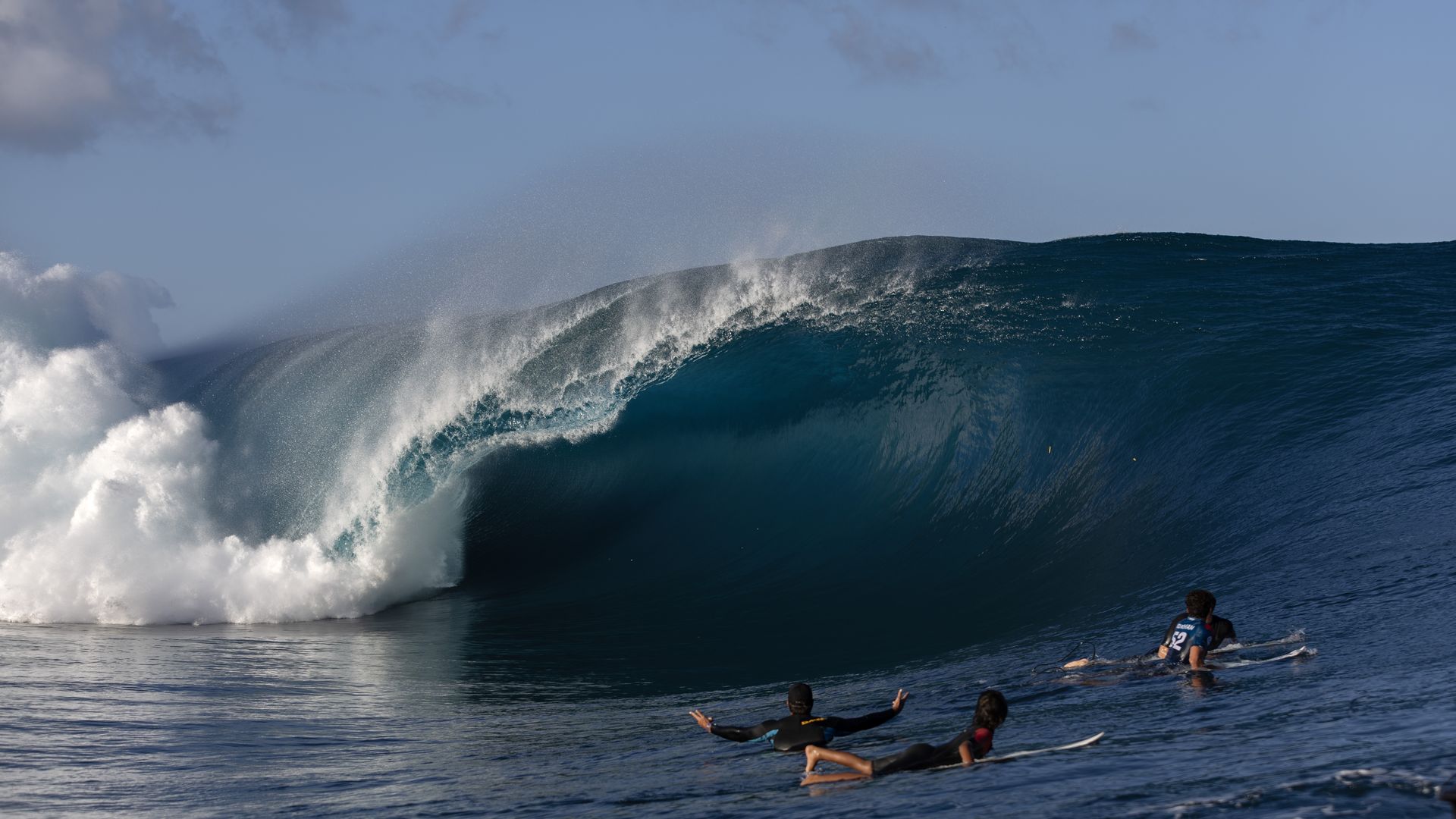
Surfers watch an unridden wave during the SHISEIDO Tahiti Pro on May 30, 2024, in Teahupo'o, French Polynesia. Photo: Sean M. Haffey/Getty Images
Organizers behind the Paris 2024 Olympic Games have touted their ambitious goal of slashing the international gathering's carbon footprint as a new standard for the event.
Why it matters: The realities of mass gatherings threaten to overshadow that goal, and experts and protesters alike suggest the Paris Games will hardly be the greenest.
- The International Olympic Committee vowed in April to make the 2024 Olympics "more responsible, more sustainable and more inclusive" than ever before, but one study measuring the Games' ecological, economic and social footprints found that sustainability of the Olympics has decreased from 1992 to 2020.
Context: France's previous Games (Albertville, 1992) scored in the top two of the study's sustainability measurement, but despite earning points for its relatively small scale, the winter Games' environmental legacy was tarnished by rampant deforestation.
- Dr. Sven Daniel Wolfe, an urban and political geographer who helped craft that Olympic sustainability measurement, called for the IOC to conduct an independent analysis in the wake of the Games and for media attention to persist once the Olympic torch has been extinguished.
The bottom line: The Paris Games, Wolfe said, have succeeded in reducing the scale of infrastructure development, but he contended it's not realistic to call them "the greenest Games ever — because they're not."
Zoom out: Though the Winter Games often displace fewer people, they generally have a higher environmental impact and are less successful financially.
- In 2022, Beijing used millions of gallons of water to create artificial snow — an emerging need in winter sports driven by climate change.
- "An entirely different sort of winter sport is about to come into play because of smaller seasons and a different climate," Wolfe said.
- "What we're seeing is this conflict between an ecological reality and a political ambition," he added.
Zoom in: "It's rare and special and important to have something we can rally around and watch in peaceful competition," Wolfe said.
- But he added: "One of the problems is that that tends to happen on the expense of local communities and the natural environment."
Case in point: Over 9,000 miles away from the Eiffel Tower, the construction of a new aluminum surfing judges' tower at Teahupo'o — home to unbeatable tubes shaped by a unique coral landscape — stirred local and scientific uproar.
- The wooden tower used to judge competitions at the site for two decades was "subject to the passage of time and natural degradation" and no longer met safety standards, Paris organizers said.
The intrigue: Locals and lovers of Teahupo'o's famous offshore surf break organized peaceful protests and started a petition in October of last year that amassed over 250,000 signatures opposing the new tower.
- The MEGA Lab, an ocean research group based in Hawaii, collaborated with the Teahupo'o community to map the reef where the tower was set to be built and the surrounding lagoon area, identifying over 1,000 corals in a space about the size of a tennis court.
- The initial construction plan and dredging path, researchers concluded, could cause $1.3 million in total potential damage to the area's marine ecosystem.
What they're saying: John Burns, a co-founder of the MEGA Lab and an associate professor at the University of Hawai'i at Hilo, said folks were "unhappy that this event was sort of pushed into their backyards."
- "At what point are we going to really value the opinions of these people that have been not just protecting but sustaining thriving environments for generations?" he asked.
- Pro surfer Matahi Drollet called the risks of new construction for the Olympics "simple and nasty" in a video shared by a group protesting the work.
- "Just because they want air conditioning, toilets, this new construction is going to destroy a big part of the reef," Drollet said.
- Filipe Toledo and Carissa Moore, both of whom will surf in the 2024 Games, echoed concerns on social media.
Olympic organizers scaled back original blueprints for a "more moderate" tower, which has since been erected.
Yes, but: Burns worries organizers could set "a problematic precedent" by putting the burden of infrastructure on smaller territories, noting that mainland France is home to world-famous surf breaks.
The bottom line: Protests have plagued the weeks leading up to the Games, raising questions about sacrifices being made in the name of sustainability.
- A viral social media protest over the $1.5 billion project to clean the filthy River Seine encouraged people to defecate in the water and threatened to make the iconic river even less swimmable.
- Athletes have expressed concern about the carbon-friendly water-cooling system in the Olympic Village — prompting them to pack AC units.
- And Teahupo'o was not selected just because of its adrenaline-inspiring swell, the AP reported. Organizers said that hosting the competition in Tahiti rather than other metropolitan areas would be produce "less impact" in terms of carbon emissions.
Go deeper: Seine remains too polluted to host swimming events at Paris Olympics
