A police drone might respond to your next 911 call


Add Axios as your preferred source to
see more of our stories on Google.
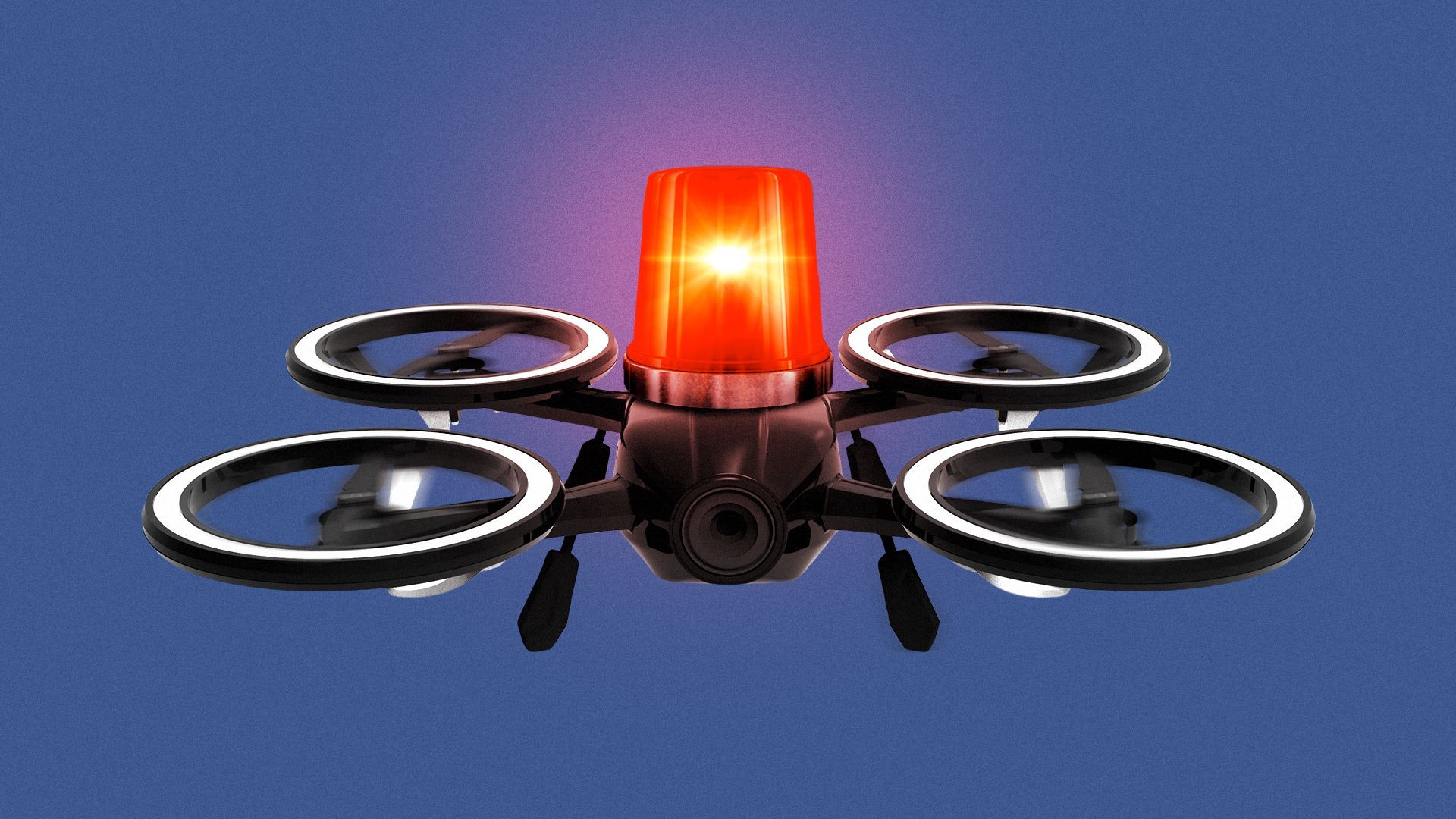
Illustration: Lindsey Bailey/Axios
A new generation of crime-fighting drones is about to take flight, starting in Arizona.
Why it matters: Drones are the ultimate first responder.
- They can be dispatched quickly in an emergency, flying above traffic to assess the situation even before police or firefighters arrive on the scene.
- But they come with serious privacy concerns that have yet to be addressed.
Driving the news: Flock Safety, whose cameras and gunshot detection systems are used by police departments nationwide, is integrating first-responder drones from a startup called Aerodome into its crime-solving platform, Axios is first to report.
- Scottsdale, Arizona police will get the drones first, the companies said, but other cities are expected to follow.
- Flock already supplies thousands of police agencies in 49 states with license plate readers, gunshot sensors and analytics software.
- Adding autonomous drones to the mix will help police respond to incidents in real time, the company says.
How it works: When a Flock camera detects a stolen vehicle or a car associated with an AMBER alert, for example, an officer or dispatcher can push a button to automatically send a rooftop drone to the location in less than 90 seconds.
- A drone can also serve as a "force multiplier:" If only one officer is available when two 911 calls come in, for example, the dispatcher can send the drone to silently track a suspect.
- Drones can also protect officers and bystanders by replacing high-speed car chases, Flock says.
What they're saying: "By layering in a drone-as-a-first-responder (DFR) program, we add another way to empower first responders to protect lives, keep Scottsdale safe, reduce response times and drive down crime," Scottsdale Police Chief Jeff Walther said in a statement.
Where it stands: About two dozen agencies currently have DFR programs, with more planned, according to Charles Werner, director of the nonprofit DroneResponders Public Safety Alliance.
The other side: The extra eyes in the sky may prove helpful to first responders, but they also raise privacy and Fourth Amendment concerns.
- The Phoenix Police Department only recently began using drones, in part because of pushback from residents who feared they could be employed for illegal surveillance.
- "We're very concerned that we may be moving toward a future where we find ourselves constantly scanning the skies, seeing drones overhead, and feeling like the eyes of law enforcement are always upon us," American Civil Liberties Union policy analyst Jay Stanley wrote last year.
- "That's no way for anybody to have to live."
The big picture: More than 1,500 police departments nationwide already use drones for search and rescue operations, crowd monitoring, crime scene investigations and more.
- Officers typically deploy drones from their vehicle to provide an extra set of eyes or a different perspective.
- Their use has been limited, however, by Federal Aviation Administration rules requiring police departments to fly them only within operators' line of sight.
- That means each drone requires two officers — a pilot and an observer — which is too costly and impractical for most departments.
Yes, but: The FAA in 2019 began offering BVLOS ("beyond visual line of sight") waivers, opening the door to larger, remotely operated fleets.
- Aerodome says its pilots can operate three or four drones simultaneously from one computer.
- Plus they don't have to lose time charging the drones, which can swap their batteries automatically.
What's next: Drones are also beginning to deliver lifesaving supplies like defibrillators, Narcan and tourniquets to emergency scenes.
