Venezuelans wary of more Maduro interference in presidential elections

Add Axios as your preferred source to
see more of our stories on Google.
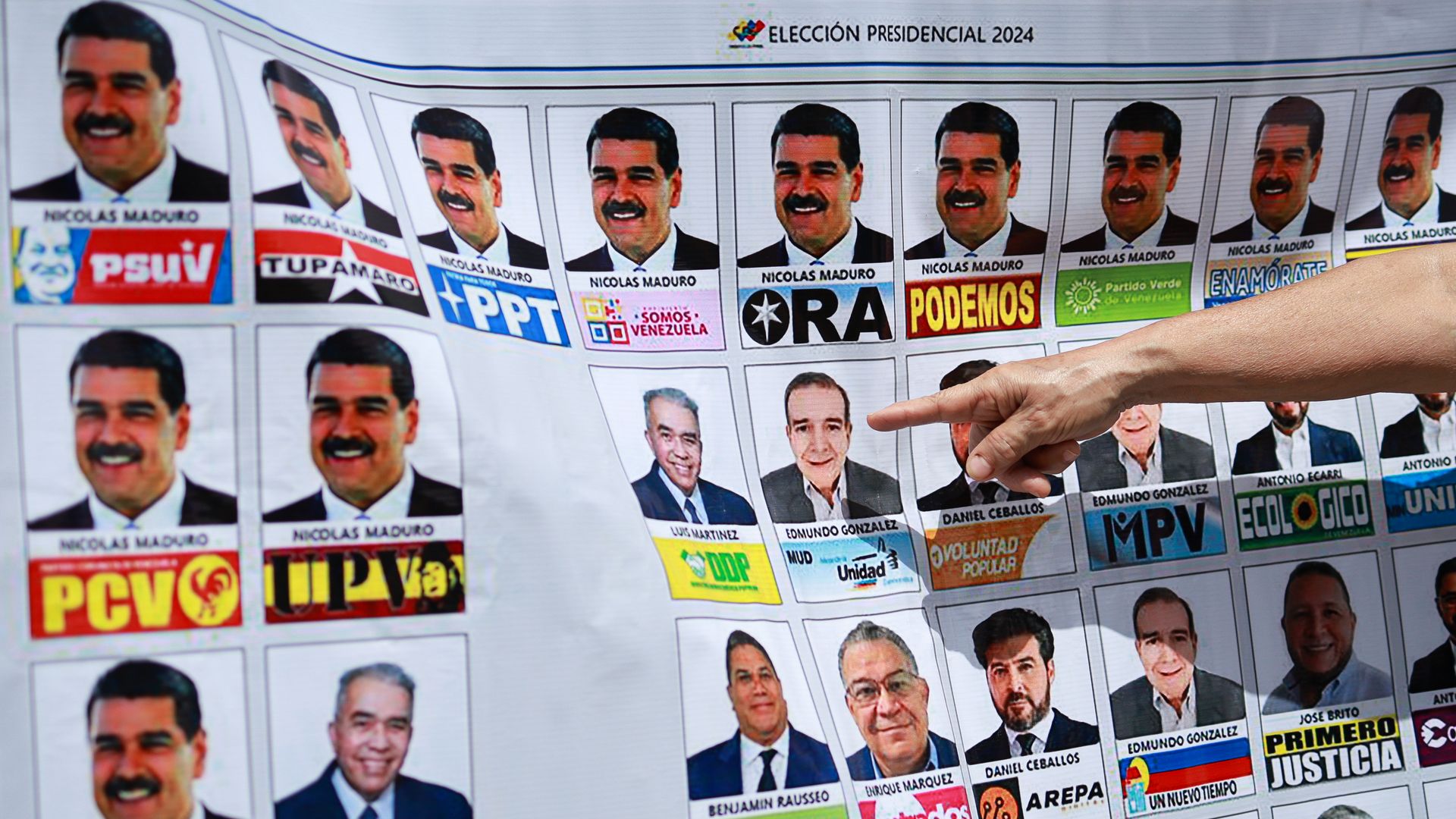
A person points to opposition candidate Edmundo González Urrutia's card from a ballot printed on a banner during a rally at the Central University of Venezuela on July 14 in Caracas, Venezuela. Photo: Jesús Vargas/Getty Images
A few days out from Venezuela's July 28 presidential elections, many Venezuelans fear the Maduro government will find more ways to undermine the election — and what might happen then.
Why it matters: As a yearslong economic crisis that has forced millions to emigrate persists, recent polling shows that about 74% of Venezuelans want the elections to result in a change in government.
State of play: Opposition coalition candidate Edmundo González Urrutia has a comfortable lead over President Nicolás Maduro, who has been in power since 2013 and is seeking a third term.
- Almost 9 in 10 Venezuelans polled said they will cast a ballot. About 13 million people are registered to vote.
Yes, but: Political experts are warning Maduro's regime could still annul the opposition's ticket by next week or even postpone the election at the last minute.
What they're saying: "I see the regime resorting to the bag of tricks it's used before to steal elections … and making every effort at driving up abstention rates," says Ryan C. Berg, director of the Americas Program at the Center for Strategic and International Studies.
- Berg says that while the Maduro-aligned electoral body, CNE, has said it's held meetings to finalize details for next week's vote, "they have not actively publicized what they're doing or discussing."
- That opens the door to "last minute rule or eligibility changes that affect the electoral landscape," Berg adds.
Zoom in: The ruling United Socialist Party of Venezuela, the policies of which are widely known as chavismo, has been accused of interfering in past elections and of stifling the opposition again this year.
- This month, at least 71 opposition campaign workers have been arbitrarily arrested, per a tally from local NGO Laboratorio de Paz.
- That includes the head of the opposition's security detail, Milciades Ávila, who was reportedly detained early yesterday.
- The regime also annulled the candidacy of former lawmaker María Corina Machado, who was supposed to be the opposition coalition's candidate for president. (González Urrutia is running in her place.)
- Maduro's government has also recently revoked invitations for some international electoral observers, and kicked out the UN's Human Rights office.
The other side: Maduro, who has in the past denied the opposition's accusations about electoral unfairness, late last month signed a pledge written by the CNE to uphold a "responsibility to democracy."
- González Urrutia refused to sign it, arguing the document offered no guarantees as the government has already walked back promises made in other agreements.
What we're watching: Over the next week, the U.S. and other countries could try to put more pressure on Venezuela to hold fair elections or mediate in some capacity.
- Experts say that even if the opposition wins with a high turnout, there's no certainty that the CNE or Maduro will acknowledge the results.
- "...There would need to be someone within the regime that realizes denying the results could produce chaos and discontent or uprising, and they have to feel that's a scenario to avoid," Javier Corrales, political science professor at Amherst College, said during a panel organized by Chatham House last week"
Subscribe to Axios Latino to get vital news about Latinos and Latin America, delivered to your inbox on Tuesdays and Thursdays.
