Tech's billionaires warm to Trump


Add Axios as your preferred source to
see more of our stories on Google.
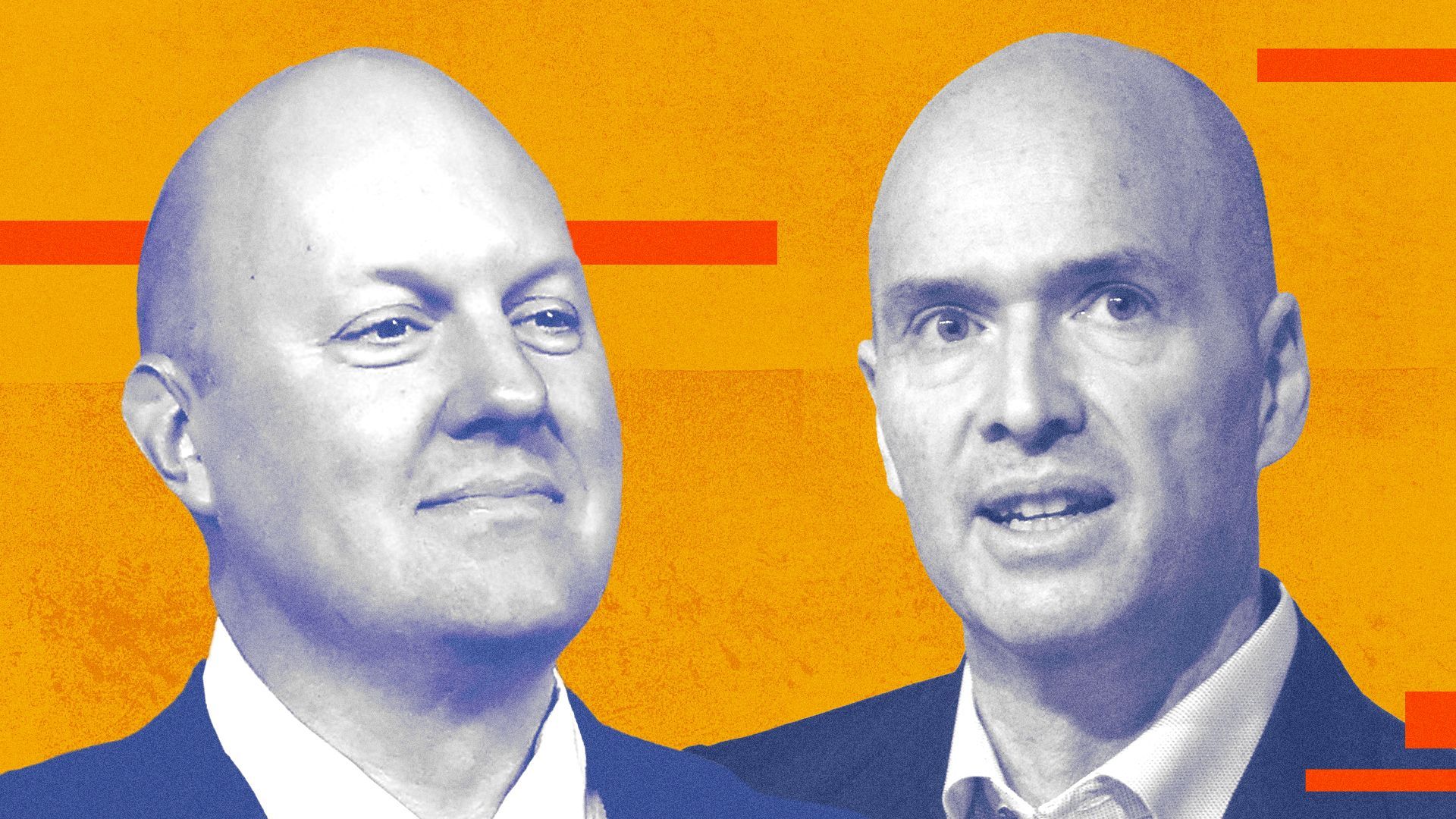
Photo illustration: Shoshana Gordon/Axios. Photos: Taylor Hill, Brad Barket/Getty Images for Fast Company
A significant chunk of Silicon Valley money and power is lining up behind Donald Trump just as he has chosen a former venture capitalist as his running mate.
Why it matters: The tech investor class was once solidly Democratic, with just a handful of Republican outliers — but now its red camp is growing, and throwing around its weight.
Driving the news: Venture capital billionaires Marc Andreessen and Ben Horowitz each will make donations to former President Trump's election effort, Axios has learned.
- The "techno-optimists" Andreessen and Horowitz are following hot on the heels of Elon Musk's announcement that he would endorse Trump and form a PAC to aid his campaign.
Between the lines: Andreessen Horowitz, the VC firm the pair co-founded in 2009, said late last year that its partners would begin making donations to political candidates they saw as "advancing technology."
- In a podcast released Tuesday, the two men said the Biden administration's moves in areas like AI and crypto have benefited incumbents at the expense of startups.
- "For little tech, we think Donald Trump is actually the right choice," Horowitz said.
- In their "Little Tech Agenda," Andreessen and Horowitz criticize a Biden proposal to tax a portion of billionaires' unrealized capital gains, saying it "would absolutely kill both startups and the venture capital industry that funds them."
Yes, but: Andreessen sits on the board of Facebook, and Andreessen Horowitz has invested in Microsoft-affiliated OpenAI — whose leaders have pressed the federal government to regulate AI more aggressively.
The big picture: Silicon Valley first emerged thanks to tons of Pentagon funding and proximity to the conservative bastion of Stanford University.
- But it also lies near the heart of the ultra-liberal San Francisco Bay Area, and has always been home to both Democrats and Republicans.
- The tech workforce has typically been more liberal than conservative. It's also full of skilled workers on visas who flock from around the globe to get a slice of tech wealth, making the industry historically supportive of less restrictive immigration policies.
- Leaders of the industry's giants — from Microsoft and Apple to Google and Facebook — have sought to thrive under presidents from both parties, and rarely taken sides.
- Trump's first-term anti-immigration policies tested that resolve, with Google co-founder Sergey Brin joining a 2017 protest at San Francisco Airport.
State of play: When it comes to rules for AI and crypto, Trump and his allies have so far taken a traditional conservative approach, wanting government to stay hands-off.
- But they have a longstanding beef with social media platforms, whose restrictions on hate speech and misinformation they view as censorship. That's made them eager to see lawmakers and regulators crack down on Google and Facebook.
- Trump himself first proposed banning TikTok in the U.S. in 2020 as an anti-China move, although he has reversed his position.
- Trump's VP pick, Ohio Sen. J.D. Vance — who once worked for Peter Thiel's VC firm — has praised Biden's FTC chair, Lina Khan, for her efforts to crack down on Big Tech power.
- Vance and other Republicans, along with some Democrats, have also taken aim at Section 230, the longstanding law that protects online platforms from being sued over the content of users' posts.
Friction point: Vance is an investor in Rumble, a free-speech-oriented social network embraced by the right, and Trump has his own Truth Social network.
- Without Section 230 protection, all these platforms — along with Musk's X — would likely face a costly, paralyzing flood of lawsuits (though many proposals try to strip the protection only from companies above a certain size).
Our thought bubble: Government interventions in the tech marketplace are full of unintended consequences and pitfalls.
- Trump's reshaping of GOP politics could open the door to unpredictable disruptions of the tech economy — particularly if a Trump victory in November were matched with Republican control of Congress.
The bottom line: With Trump's fortunes at a high ebb right now, don't be surprised to see more tech execs join his corner.
