Health care warms to reusable PPE

Add Axios as your preferred source to
see more of our stories on Google.
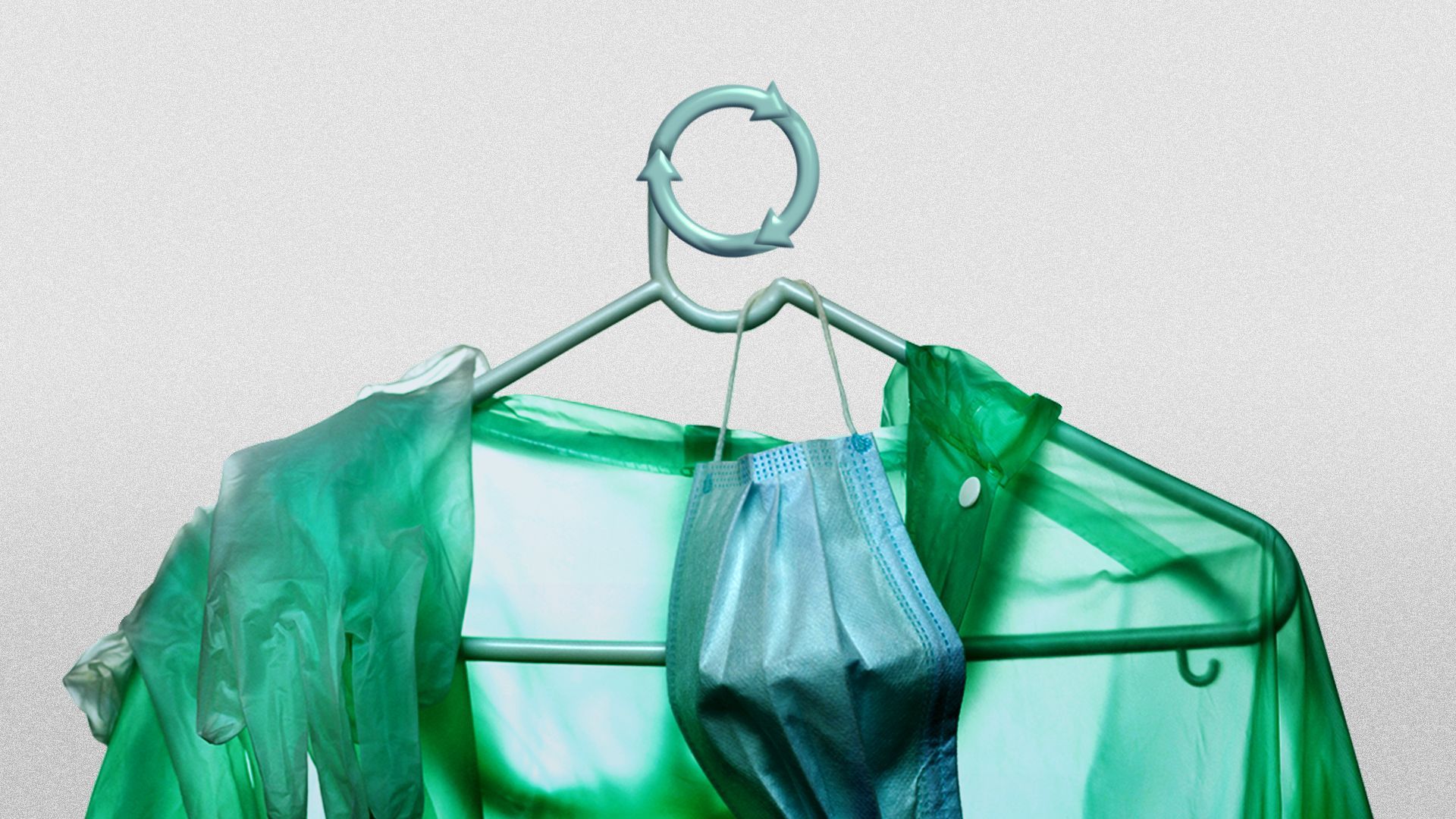
Illustration: Annelise Capossela/Axios
Four years after health workers were forced to reuse masks and other supplies to get through the dark days of the pandemic, the idea of recycling personal protective equipment is going mainstream.
Why it matters: It's evidence of a push to find a more environmentally sensitive and cost-effective medical supply chain that won't buckle in future emergencies and still protects patients and health workers.
Driving the news: The Department of Health and Human Services, states and individual health systems are driving efforts to replace single-use hospital gowns and other gear with PPE that's created to be reused.
- Reusable gowns are made of polyester and contain tracking technology to ensure they're laundered and reused a specified number of times before being taken out of circulation.
- New York is weighing whether to mandate the use of more reusable textiles in health settings: A state Senate bill introduced there earlier this year would require health care facilities to use at least 50% for certain PPE products.
Yes, but: For all its virtues, it's unclear whether providers will warm to the idea, Maryann D'Alessandro, director of the Centers for Disease Control and Prevention's National Personal Protective Technology Laboratory, told Axios in an email.
- And the pandemic demonstrated there was resistance to reusable PPE in health care settings, she added.
- Health care workers often wrongly assume that plastic is always more protective than cloth and that products that come straight out of a package are safest, so more education is needed to dispel PPE myths, infection control experts said during a March workshop sponsored by HHS.
The big picture: PPE is a big expense for health care facilities, and leaves a major environmental footprint.
- Health care workers in the United States use an estimated 44 million disposable PPE items each day, generating 15,000 tons of landfill waste, the Office of the United States Trade Representative said during the HHS workshop.
- Reusing gowns led to a 52% cost savings for hospitals in 2021, according to data shared during the HHS workshop from six laundry facilities serving 179 hospitals.
- There's "tremendous" room to expand reusable gowns in health care facilities, said Carol McLay, president-elect of the Association for Professionals in Infection Control and Epidemiology. She noted that more research is needed on other reusable gear, like gloves.
Participants at the HHS workshop aimed to develop a framework for when and how to incorporate reusable PPE in health care facilities, said Sundaresan Jayaraman, a materials science and engineering professor at Georgia Tech who chaired the workshop.
- Potential approaches range from developing best-practices standards to reducing the cost of biodegradable materials.
- "The elements are there. The question is, how do we go about doing it, and what can health care facilities do" to make the transition to reusable PPE easy and safe, Jayaraman said.
Virginia's Inova Health System started using recycled isolation gowns at the height of the pandemic because of tight supplies and over time worked with a sports apparel manufacturer to design a custom reusable gown using input from frontline health workers, said Amanda Campanaro, strategic sourcing manager at the health system.
- Some health care workers at Inova questioned the gowns' cleanliness during initial demos, said Lucy Yao, director of infection prevention and control.
- But once staff explained that the gowns go through hospital-grade laundering just like the facilities' pillowcases, bed sheets and scrubs, "it wasn't a hard sell at all," she said.
What's next: HHS's National Institute for Occupational Safety and Health plans to issue a report to Congress on reusable PPE this fall, D'Alessandro told Axios.
- "I absolutely think there should be a national standard" for reusable gowns, said McLay of the infection control trade group. "We have no penalties right now for any kind of excessive environmental waste by hospitals, but perhaps that's something we could consider."
