World leaders react to attempt on Trump's life at Pennsylvania rally

Add Axios as your preferred source to
see more of our stories on Google.
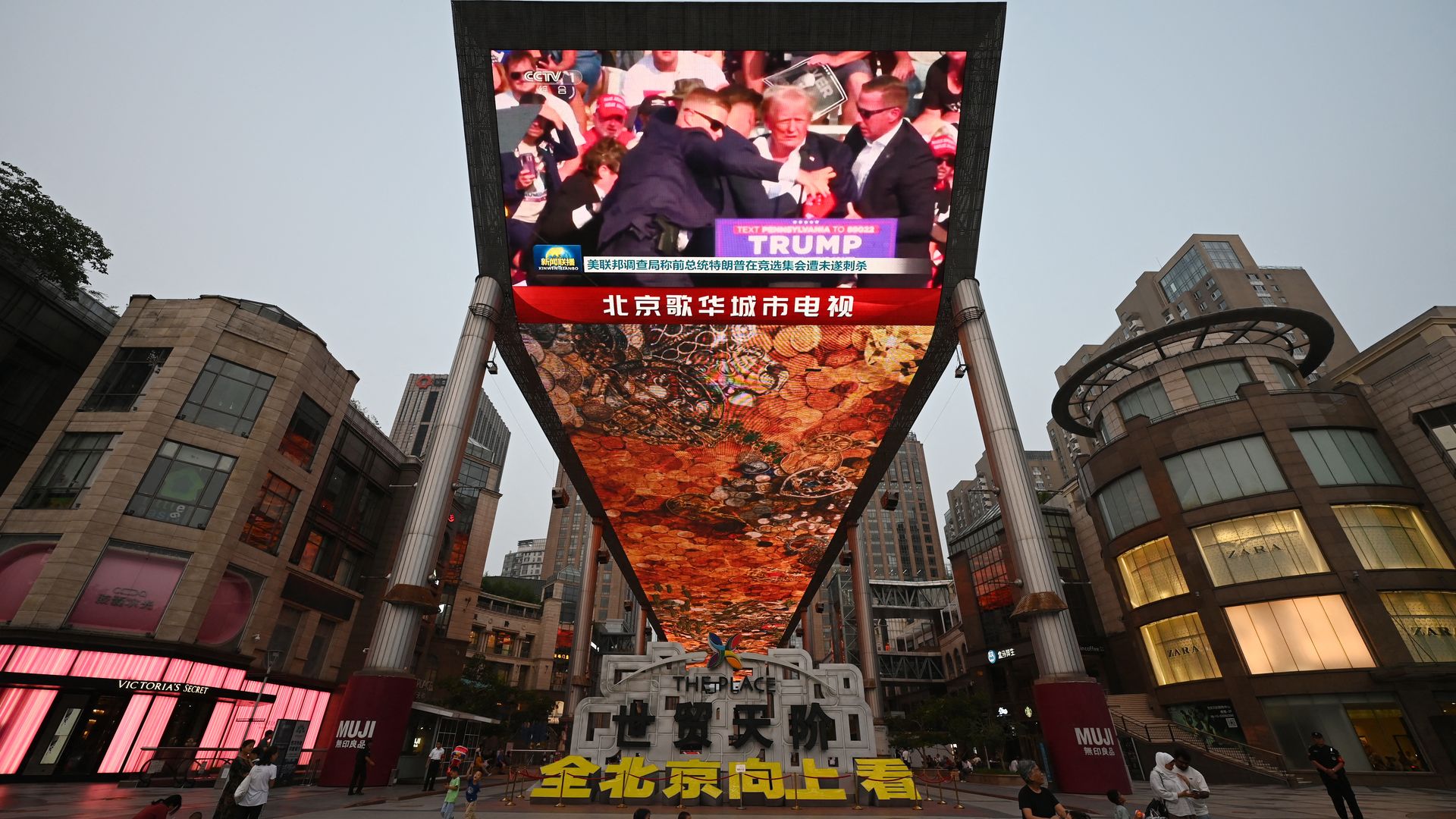
A news program about the assassination attempt on former US president Donald Trump is seen on a giant screen at a shopping mall in Beijing, Sunday. Photo: Greg Baker/AFP/Getty
Leaders from around the world weighed in this weekend on the news of the attempted assassination of former president and presumptive Republican nominee Donald Trump.
Why it matters: While any and all political violence in the United States is likely to generate a global response, many national leaders have direct relationships with the former president, unlike most challengers in the typical American contest to be the next commander-in-chief.
U.S. Allies
Allies of the United States, in particular, members of the so-called Five Eyes (global powers that explicitly cooperate in sharing signals intelligence), promptly condemned the attacks.
What they're saying: The newly elected prime minister of the United Kingdom, Keir Starmer, posted to social media last night, "I am appalled by the shocking scenes at President Trump's rally."
- Canadian Prime Minister Justin Trudeau said "political violence is never acceptable," on X (formerly Twitter) last night. New Zealand's prime minister, Christopher Luxon, posted similar sentiments, noting that he was "shocked."
- Australia's Prime Minister Anthony Albanese told reporters that his nation's ambassador had reached out to the chair of the Republican National Committee to offer condolences. "We must lower the temperature of debate," Albanese told reporters.
- Mexico President Andrés Manuel López Obrador said on social media (in Spanish), "We condemn what happened to former President Donald Trump. Violence is irrational and inhumane."
Zoom out: Another US ally, Ukrainian President Volodymyr Zelensky posted on X, "I am relieved to learn that Donald Trump is now safe and wish him a speedy recovery. My condolences go out to the close ones of this attack's victim."
- While the relationship between the US and India is more complex, its Prime Minister, Narendra Modi, called Donald Trump his "friend" in a post and said, "Violence has no place in politics and democracies. Wish him speedy recovery."
Trump-leaning allies
Catch up quick: After having met with Trump on Thursday, Prime Minister Viktor Orbán of Hungary, posted that his "thoughts and prayers" were with the candidate "in these dark hours."
- Orbán has publicly predicted that Biden will lose the election, effectively endorsing his challenger.
Zoom in: Israeli Prime Minister Benjamin Netanyahu, posted this morning, "This was an attack on America. It was an attack on democracy, it was an attack on all the democracies."
- Many Israeli political leaders inside and outside of government echoed the sentiment.
- Trump has been supportive of the Israeli leader since the war began in the region in October, though he has also called for Israel to quickly finish the war.
Geopolitical rivals
Friction point: China's response was circumspect. According to the state-run news organization, the Xinhua News Agency, the nation's foreign ministry is following the story of the attack, and President Xi Jinping has expressed his condolences to Trump.
- Meanwhile, Russia's Kremlin spokesperson used the incident to make a critique of the current administration. "We do not believe that the attempt to eliminate and assassinate Trump was organised by the current authorities," he told reporters.
- But he added that the tone created in discussing Trump's candidacy "provoked what America is confronting today."
- On the messaging platform Telegram, Maria Zakharova, from Russia's Ministry of Foreign Affairs, took it further, writing (in Russian) that "The United States of America must take inventory of its policies on inciting hatred towards political opponents, countries and people."
What we're watching: Not all leaders have been vocal so far, according to news reports. We are waiting for a direct response from leaders in other rival nations, such as North Korea and Iran.
