Alternative assets love ESG

Add Axios as your preferred source to
see more of our stories on Google.
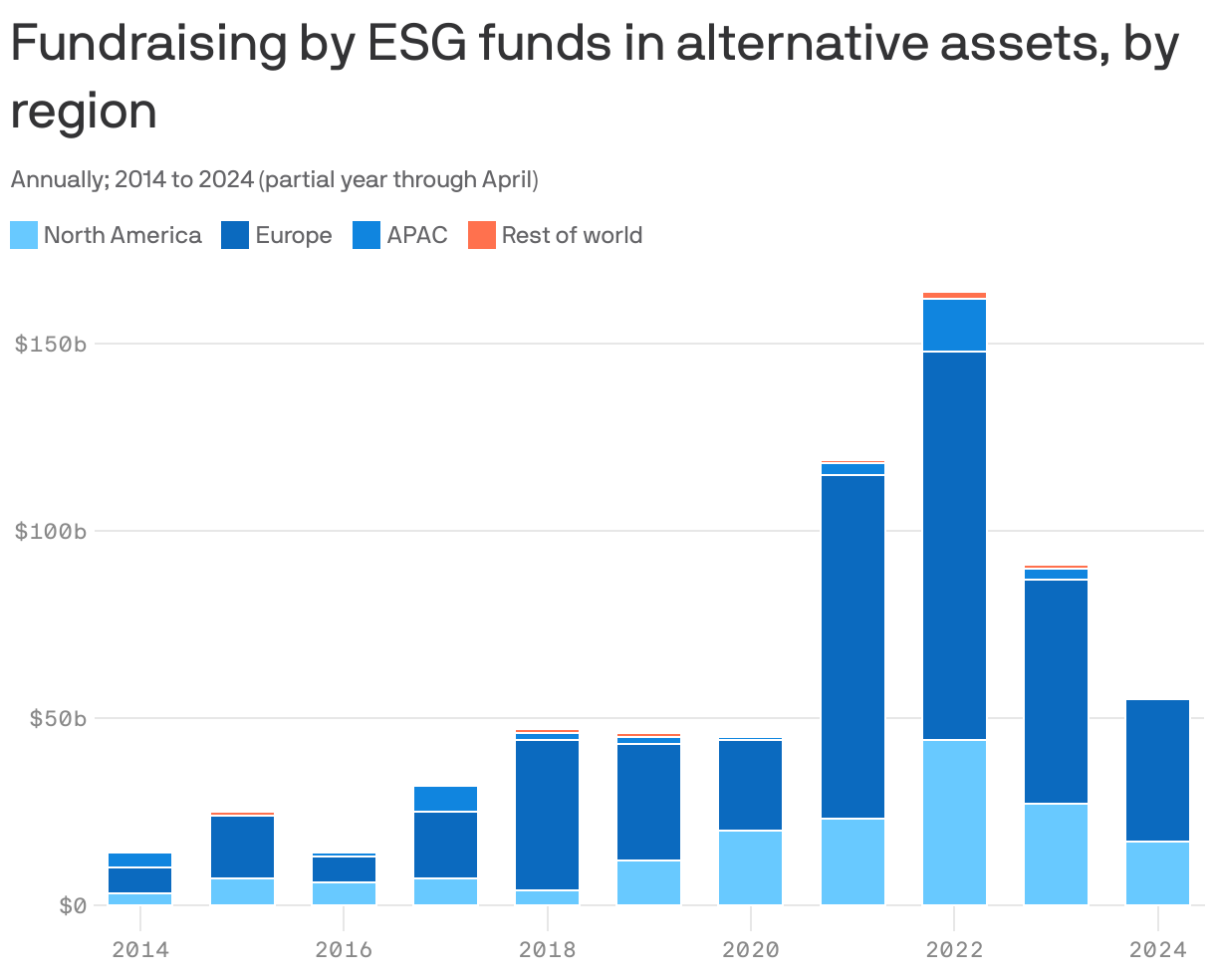
ESG funds in alternative assets have raised $55 billion as of April, on pace with 2022's record of $163 billion, per Preqin.
Why it matters: ESG-focused initiatives across the business world tend to be de-emphasized amid downturns or lessened pressure to support them.
By the numbers: ESG in alternative assets had a notable growth spurt beginning in 2021 — with a total of $282 billion raised in 2021 and 2022 across 528 funds, compared with $226 billion raised by 629 funds in total over the previous seven years.
- And although 2023 totals dropped below $100 billion, fundraising levels were still higher than before 2021.
Zoom in: ESG funds made up 21% of all private capital raised this year as of April.
- As of April, European limited partners make up 44% of all impact investors and 43% of all climate investors, while North American LPs represent 33% and 41%, respectively.
- Infrastructure and private equity dominate ESG fundraising, with the former also dominating assets under management and the funds currently in market.
- This year, climate-focused funds have pulled ahead of impact funds both in terms of number of funds raised and total capital raised.
- Established managers dominate fundraising, although first-time managers have gained some ground since taking only 7% of capital in 2021.
The intrigue: ESG remains a divisive topic in the investment world, with skeptics questioning whether the sector can generate returns on par with their peers (see final numbers).
Between the lines: Despite the controversies, ESG remains a significant factor for investors.
- In a June survey by Preqin, 24% of 67 respondents said they have turned down otherwise attractive opportunities because of ESG standards, 36% said they would, and 40% said they have not.
Yes, but: ESG consideration is not uniform across all alternative assets.
- 50% of infrastructure investors reported having an ESG policy, as did 45% of private equity investors, 19% of hedge funds, and 14% of venture capitalists, to name a few from the survey's results.
The bottom line: ESG investing is subject to investors' whims, but it's nevertheless becoming more entrenched in alternative assets.
