Federal Reserve chair says America's labor market is back in balance

Add Axios as your preferred source to
see more of our stories on Google.
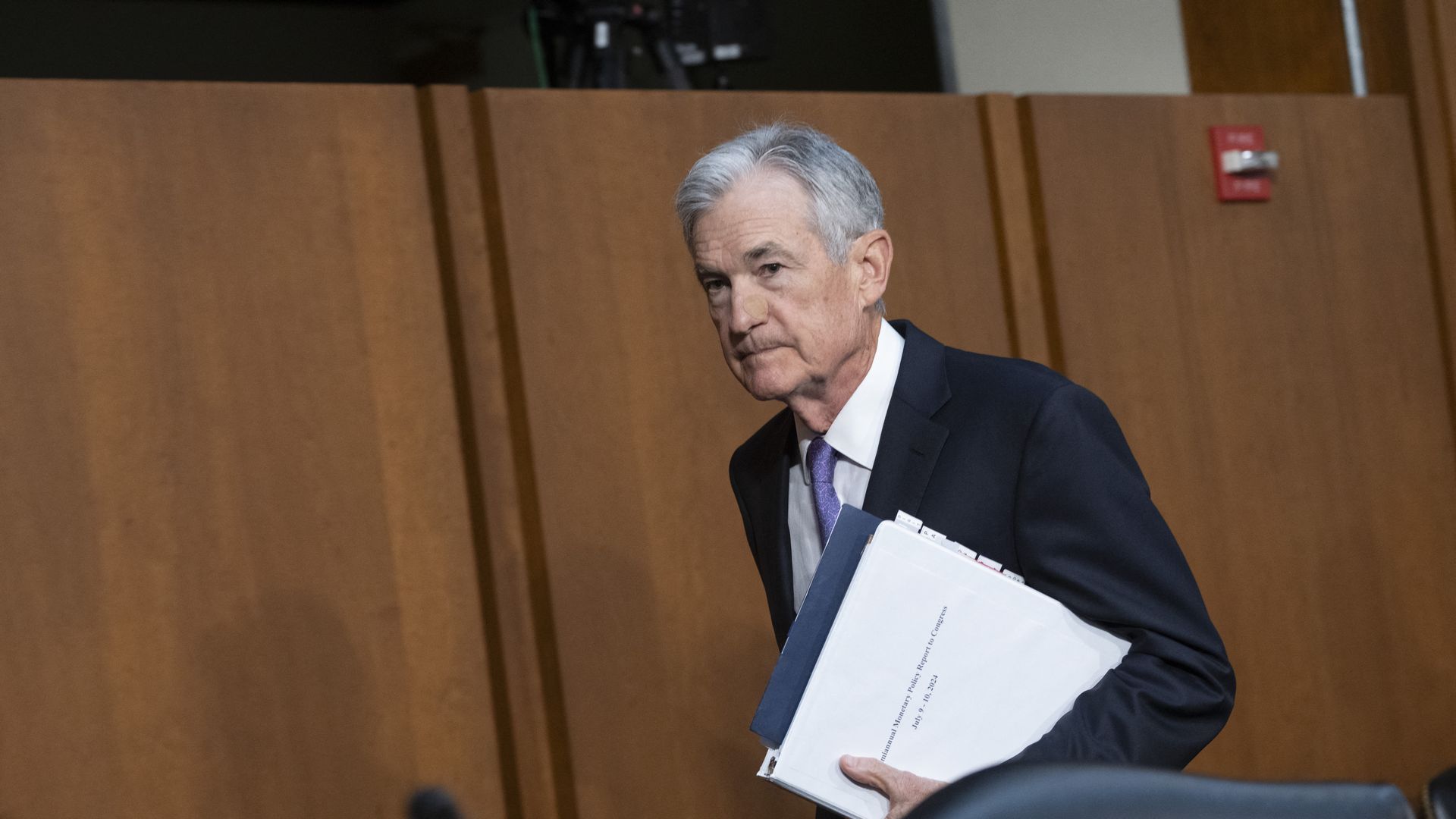
Federal Reserve chair Jerome Powell arriving to testify before the Senate Banking, Housing, and Urban Affairs Committee on Tuesday. Photo: Chris Kleponis/AFP via Getty Images
Hiring has cooled off such that the job market alone is no longer a reason to keep rates high — in fact, doing so might hurt the economy.
Why it matters: It's a flip from the past three years, when the Federal Reserve pointed to a too-hot labor market as a reason for the central bank to keep downward pressure on the economy.
- Early in the pandemic recovery, demand for workers exceeded their availability, setting off a hiring frenzy that pushed up wages.
- That era is well in the past, with further proof that elevated interest rates are weighing more on economic activity.
What they're saying: "The labor market appears to be fully back in balance," Federal Reserve chair Jerome Powell said at a congressional hearing on Tuesday.
- He later told the Senate panel that the job market was no longer "a source of broad inflationary pressures for the economy."
Between the lines: The Fed had previously said the labor market was "coming back into balance." Powell confirmed that it has at last achieved this balanced state and that elevated inflation is no longer the sole risk to the economy.
- That, along with more benign inflation readings, helps make the case for a rate cut in the months ahead — perhaps as soon as September, at least if futures markets' expectations are correct.
The intrigue: "As the labor market softens, the appropriate policy response is to begin lifting restriction, not holding the federal funds rate at this level even while inflation has fallen so much," Preston Mui, a senior economist at Employ America, wrote Tuesday.
- "At this point, the question is no longer 'What's the rush,' but 'Why are we still here?'"
The big picture: During the hearing, Powell acknowledged that recent labor market indicators sent a "pretty clear signal" that employment conditions were cooling.
- The fact that monthly job gains were increasingly concentrated in a few sectors — namely, health care and government — was proof of a less-hot labor market, Powell said.
- "That tells you job creation is becoming less broad in the economy," Powell said.
What to watch: Senators on both sides of the aisle pointed to evidence the economy is slowing as the Fed keeps rates at a two-decade high.
- "I know you're going to do this anyway, but I'd be really careful with this economy," Sen. John Kennedy (R-La.) said. "People just don't feel better off today."
- "I think the data indicates that we are at risk now of not acting soon enough to curb the increase in unemployment — and that if we allow that to go too long, we may see a real uptick there," Sen. Chris Van Hollen (D-Md.) said.
The bottom line: Powell said cutting rates too late, or too little, might unduly hurt the economy — but moving too soon could risk an inflation flare-up, a tension he has repeated in recent weeks.
- "It appears that they are open to the idea of loosening monetary policy, but it has to be backed up by the data," ING chief international economist James Knightley wrote.
