Don't stress about kids' screen time, leading pediatrician says

Add Axios as your preferred source to
see more of our stories on Google.
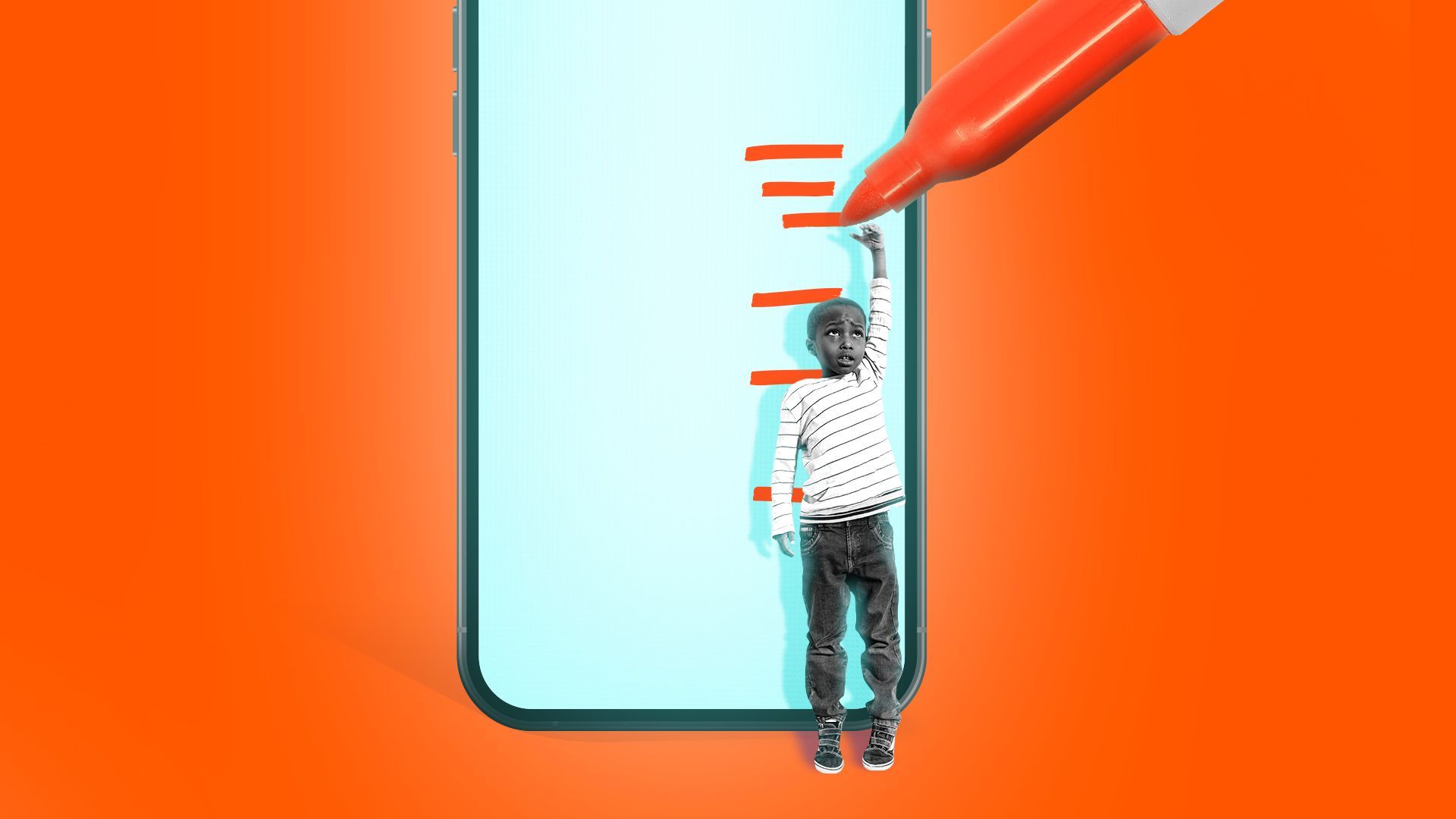
Illustration: Aïda Amer/Axios
Don't get hysterical about your child's screen time or yank away their cellphone protectively, says Dr. Michael Rich, a pediatrician who runs a leading treatment program for kids with so-called "internet addictions" (a term he detests).
- Children will go through life with a smartphone, he points out — and it's important for the adults in their lives to teach them to use one wisely.
Why it matters: Amid calls to ban phones for children before high school and banish them from schools, Rich aims to inject a calming voice in the debate over kids, screens and social media.
- "There are lots of people who use these tools quite effectively, in ways that do enhance their humanity, education and connectedness," says Rich, who practices adolescent medicine at Boston Children's Hospital and calls himself the "Mediatrician."
Driving the news: In a new book, Rich argues for carving out "digital downtime" with (and for) your child, but warns: "Absolutes are not the answer."
- Most kids who fall into trouble with phones and screens suffer from one of four underlying conditions: ADHD, social anxiety, autism or depression, Rich says.
- Children with those conditions can easily fall prey to what Rich calls Problematic Interactive Media Use (PIMU).
- PIMU includes excessive video gaming or social media scrolling, obsessive online pornography use, or "information bingeing" (e.g. surfing Reddit, YouTube or other sites for hours to the exclusion of other activities).
Zoom in: Rich's book — "The Mediatrician's Guide: A Joyful Approach to Raising Healthy, Smart, Kind Kids in a Screen-Saturated World" — is drawn from his experience as the founder and director of the Digital Wellness Lab at Boston Children's Hospital and the Clinic for Interactive Media and Internet Disorders, a treatment program for kids.
- Nearly all the children in Rich's clinic have underlying conditions that the devices are merely a symptom of — not the cause, he says.
- "Addiction is not a good model for it," Rich tells Axios. "In an addiction paradigm, there's the sense that the thing is doing something to me, and I am powerless — it serves as a cop out."
What they're saying: Most parents should relax when it comes to their kids' screen time and phone use, Rich argues.
- "Let go of the illusion that you can enforce screen time limits or even measure screen time in today's media environment," he writes in his book.
- "More importantly, let go of the guilt that you can't restrict your kids' time on screens."
"That energy is better spent on helping your child learn to use screens in healthy and productive ways — and learning to replace daily screen time limits with daily non-screen minimums."
- His book is a primer for parents on how to best deal with "screen time" at each stage of a child's development (and keep the family dinner sacrosanct).
State of play: While legislators debate whether to crack down on social media companies because of the harms to children, Rich has opened a dialogue with them and coaxed several to sign the Inspired Internet Pledge.
- It's a non-binding commitment by media companies to "make the internet healthier for kids."
- Signatories include TikTok and Pinterest.
Zoom out: Rich's advice and conclusions are largely the opposite of those in a current bestseller by New York University social psychologist Jonathan Haidt, "The Anxious Generation," which argues that phone-based childhoods are destructive.
- Rich also has a beef with influential social scientist Jean Twenge, author of the book "Generations," who argues that smartphones are causing an epidemic of depression, anxiety and other mental health problems in young people.
- Twenge and Haidt "don't work with the kids directly" and cherry-pick their data, says Rich, echoing other critics.
- "What we are seeing is not that smartphones and technology are causing depression, but that they accelerate and amplify it," says Rich, who has practiced adolescent medicine for over 30 years and teaches pediatrics at Harvard Medical School.
The other side: Zach Rausch, Haidt's lead researcher and collaborator on "The Anxious Generation," tells Axios that there is "debate about causality," but "the primary thing that we are trying to understand is why adolescent mental health fell off the cliff right around 2010."
- Their scientific research and observations — and Twenge's work — concluded that smartphones and social media were a primary cause.
Friction point: "Working with the kids themselves, I do not see that the problems are worse or more prevalent, but what's happening is we're talking about it more — it's more in our faces," Rich tells Axios.
- Such discussions about the dangers and over-use of screen time are healthy and positive, he says.
- Phones and social media can be very helpful places to make connections for kids who are "historically marginalized," Rich says — disabled kids, bullying victims, LGBTQ youths, etc.
- "I work with the kids all the time, particularly with the kids who are most powerfully affected" by phone use, Rich says. "I actually have confidence in the kids and optimism for them — I think they will lead us to a better place."
The bottom line: Every child is different, and parents tend to be the best judges of what's right for their kids.
- "There is no specific age at which it is appropriate for all children to use a device or consume certain media content," Rich writes in his book.
- "Know your child — some will be ready before, and some after the recommended ages."
