Tron's new stablecoin might draw other blockchains' envy

Add Axios as your preferred source to
see more of our stories on Google.

Justin Sun, founder of Tron, in Hong Kong in 2021. Photo: Fan Kar-Long/Getty Images
Justin Sun, founder of the controversial Tron blockchain, is promising an innovation in crypto's most popular use case.
Why it matters: Tron has become the second-largest generator of on-chain revenue year to date, driven in no small part by being a very popular medium for sending stablecoins around the world.
- Sun is now promising a free-to-use stablecoin soon, which would be a strong user experience upgrade for the chain.
A fee-free stablecoin
Tron has mainly been known for copying innovations and remixing them to appeal to its largely Asian audience.
- The last time it announced a new stablecoin, USDD, it was a copy of the ill-fated algorithmic stablecoin from Terraform Labs, launched just before that blockchain imploded.
- Tron is a leader in stablecoin transfers. Fifty percent of all tether, the world's largest stablecoin, is issued on Tron.
- And if it executes its free-to-use stablecoin well, that would represent something new under the digital sun. Other blockchains would surely follow suit.
- That said, Sun has not explained how his plan would work.
💭 Our thought bubble: It could be that the underlying dollars are invested for some kind of yield, such as on U.S. Treasuries, which could be used to pay transaction costs.
- Plus, we could even imagine a world where Tron gave users of the stablecoin (or perhaps all stablecoins) a discount.
Stablecoin rivalry
Ethereum still leads in total dollar value transferred with stablecoins, but Tron has become its chief rival.
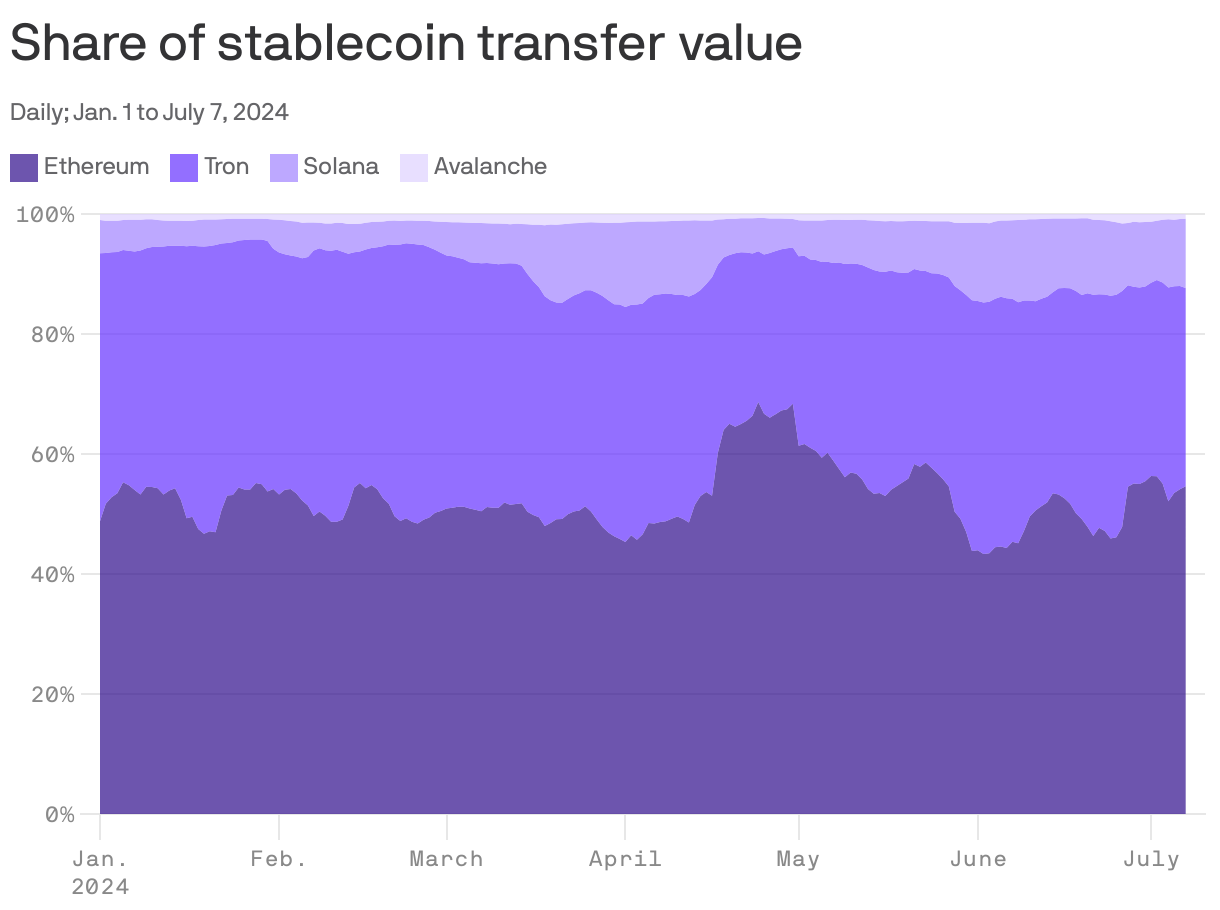
The big picture: Stablecoins are the clear killer app of blockchains so far, with a trillion dollars in volume per month (despite the fact that the total supply of stablecoins is still $25 billion below their 2022 peak).
- Crucially, Tron has its own user profile. A paper by Brevan Howard last year found that far more people were using Tron for transactions, which were largely much smaller than those on Ethereum.
- This squares with a January report from Coin Metrics that found the average value of tether transfers on Tron is vastly lower than on Ethereum (see the fifth chart).
Zoom in: Tron is much less expensive to use than Ethereum, which probably makes it more appealing for lower-value transactions where maximum security is less important than a low price.
- Average fees on Tron are around $0.18 these days, versus Ethereum, which is more like $1.87 (and that's surprisingly low, historically).
Profit motive
By the numbers: Tron recently overtook Ethereum as the blockchain earning the most revenue over the last 30 days, according to TokenTerminal, bringing in $142.1 million, versus Ethereum's $110.4 and Bitcoin's $56.5 million.
- The revenue comes from users paying Tron's distributed network of validators to verify their various transactions.
- Somehow, though, transactions with this new stablecoin will be the exception, traversing users for free.
Yes, but: Despite recent success, Tron's coin, TRX, is up less this year (19%) than either bitcoin (29.3%) or ether (29.7%).
- TRX started the year rising with the others, but fell behind in February, around the time that Circle announced it would quit using Tron for usd coin (USDC).
What's next: Technical details on this new stablecoin.
