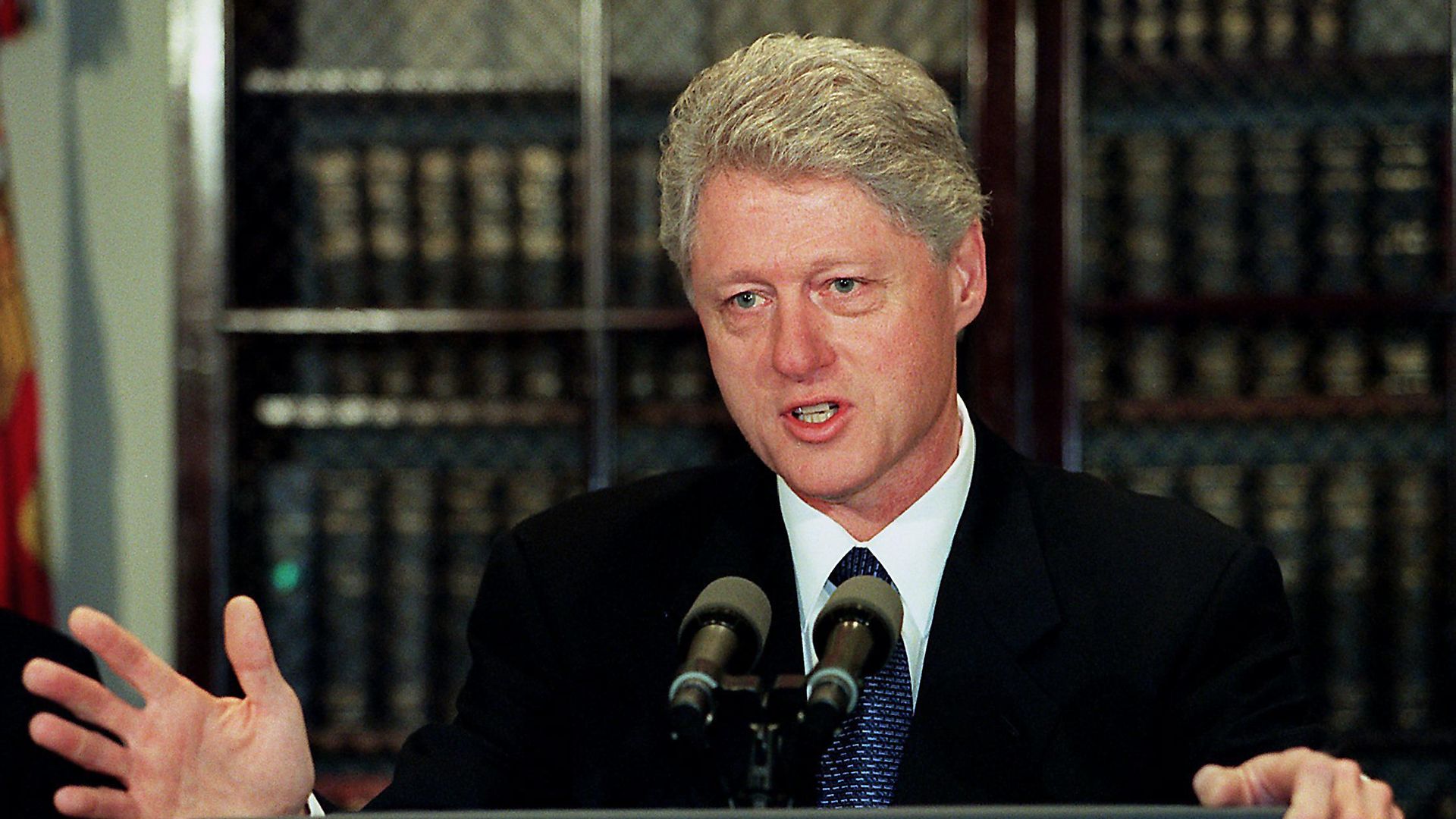
Former President Clinton speaks to reporters in 2000 about China potentially joining the World Trade Organization. Photo: Manny Ceneta/AFP via Getty Images
The flip side of job losses caused by the China shock was that it really did result in cheaper manufactured goods — pulling inflation down and real incomes up.
From December 2001, when China joined the World Trade Organization, to December 2016, just before Trump took office, consumer prices fell for such goods as apparel (down 10.3%), furniture (14.7%), appliances (20.1%) and toys (60%).
That process played out over 15 years, involved hundreds of billions in investment and involved a painful reallocation of workers away from U.S. factories into other industries. It would be hard to unscramble that egg.
What they're saying: "Can they undo the China shock? The answer is obviously no," the Peterson Institute's Mary Lovely tells Axios. "This would be about moving supply chains to different places that aren't America."
"What it means for U.S. consumers is obviously higher prices," she says.
The other side: To those with Trump's ear on trade policy, the risk of higher consumer prices or lower profits is a small price to pay for supporting domestic manufacturing — and an economic cleavage with a rival world superpower is nothing to be feared.
"Washington should, in fact, seek to decouple its economy from China's," wrote Robert O'Brien, Trump's former White House National Security Adviser, in an essay published last month.
He wrote that Trump began a "de facto policy of decoupling" in his first term with tariffs. "Now is the time to press even further," O'Brien writes.