Charted: The 401(k) race gap

Add Axios as your preferred source to
see more of our stories on Google.
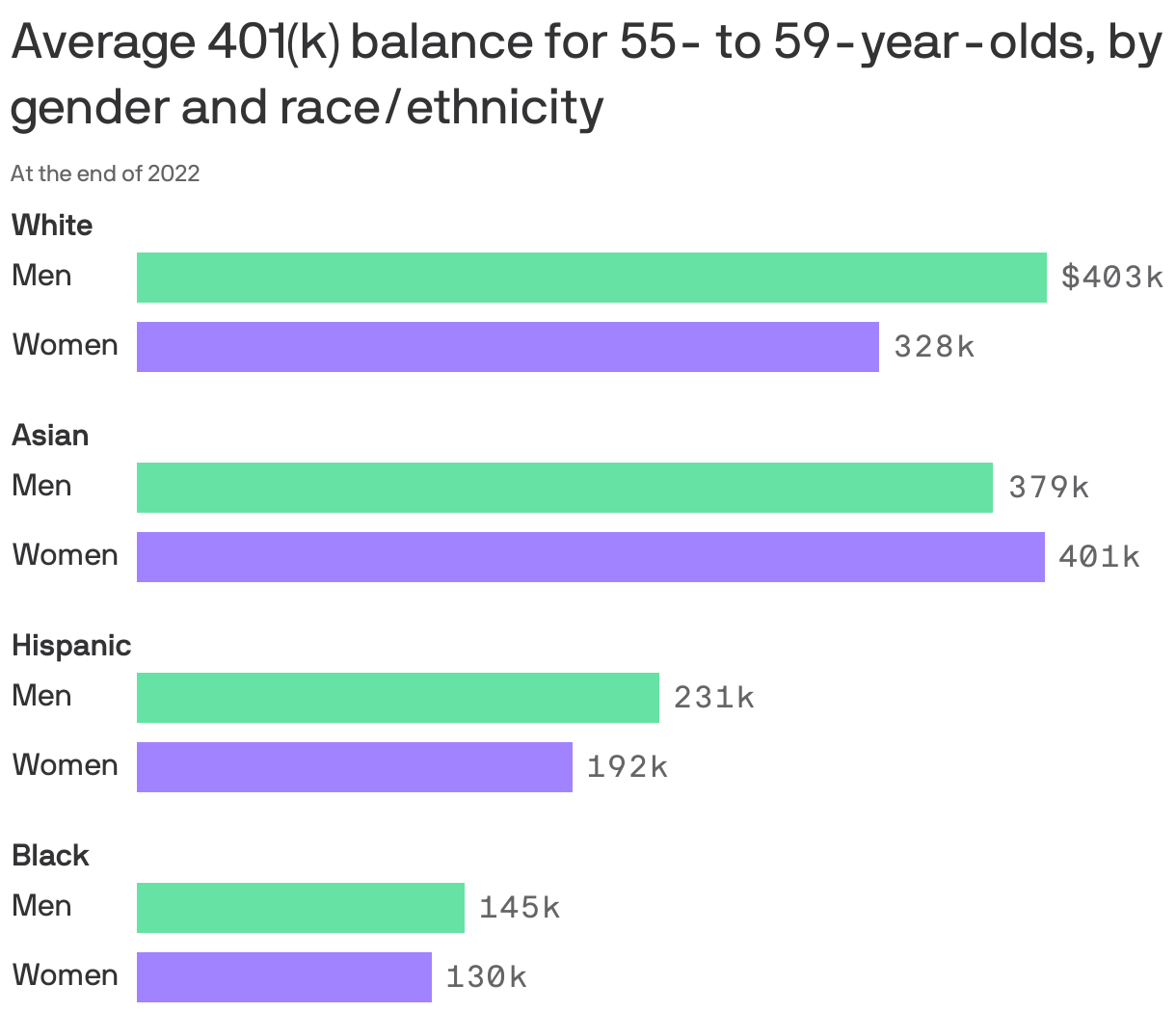
Black Americans, and Black women in particular, tend on average to have lower 401(k) balances than the rest of the population, contribute less to retirement accounts, and be more likely to take out loans against the balance they do have. That's true even after adjusting for any difference in salary.
Why it matters: The Saver's Match, a federal retirement-savings incentive that is due to be introduced in 2027 as part of the Secure 2.0 Act, should help to narrow the gap, although it won't come close to closing it.
The big picture: Lower salaries for Black women, combined with lower levels of intergenerational wealth, mean they tend to have significantly less discretionary income. Spending on necessities eats up whatever is available, and leaves much less for retirement.
By the numbers: The Collaborative for Equitable Retirement Savings (CFERS) examined a huge dataset of 180,684 active plan participants across nine 401(k) plan sponsors, as of the end of 2022. They found:
- For workers between age 55 and 59, white Americans have account balances of about 1.8 times their annual salary, and Asian women have saved up 2.5 times their salary. Black men, by contrast, have a balance of 1.1 times their salary, and Black women have saved only 0.9 times.
- That's partly because contributions are lower. Black women between 55 and 59 save 8% of their salary on average for retirement, compared to 11% for white women and 17% for Asian women.
- Black women in that age group also have a 29% probability of having taken a pre-retirement withdrawal from their retirement account. For white Americans, that number is 8% and for Asian Americans, it's 5%.
Follow the money: Female Black retirement plan participants aged 55 to 59 also earn lower salaries on average, at $85,500 per year, compared to $107,631 for white women.
What's next: The Saver's Match, which will kick in starting in 2027, will offer a 50% match on up to $2,000 of retirement savings contributions for Americans making less than $71,000 per year. It's projected to increase Black women's retirement funds at age 65 by 9% even assuming no increase at all in contributions.
- If contributions rise to maximize the amount of the match, then account balances for Black women would rise by an impressive 21.5%, per CFERS estimates.
- Other groups also benefit, but none by as much. White women, for instance, see their balances rise by 5.7% assuming no contribution increase, and by 12.7% assuming they maximize the match.
The bottom line: More than 50% of Black Americans have no access to a workplace retirement plan at all. Even the ones who do find it much harder to save for a comfortable retirement.
