Scientists create smiling robot face from living human skin cells

Add Axios as your preferred source to
see more of our stories on Google.
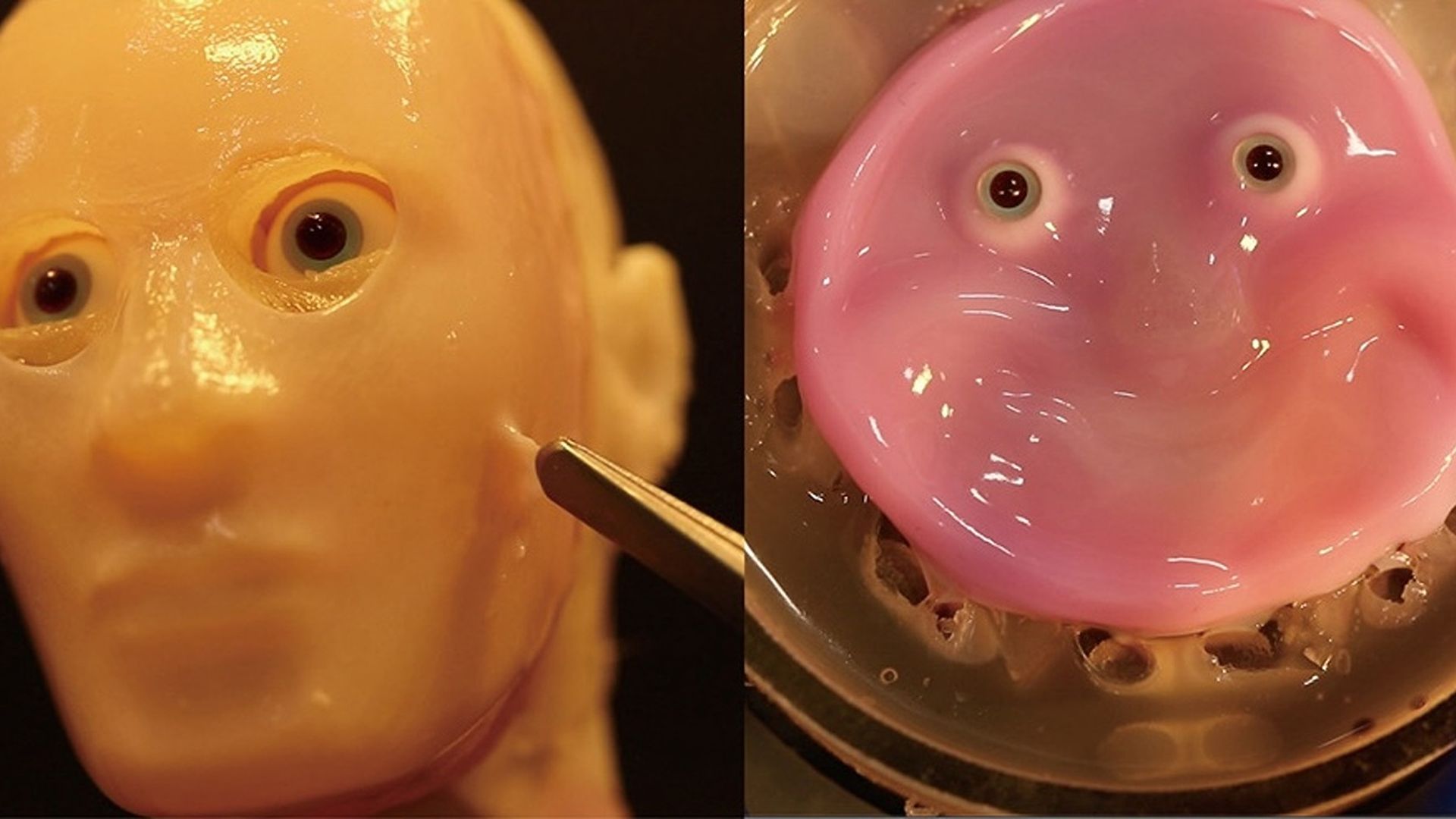
From left: A 3D facial mold covered with living skin; a 2D facial robot with living skin smiling through actuation via anchors. Photos: Takeuchi et al via the University of Tokyo
Scientists unveiled Tuesday a humanoid robot face they created from lab-grown, self-healing human skin.
Why it matters: The researchers from the University of Tokyo, Japan, hope the breakthrough could one day prove "useful in the cosmetics industry and to help train plastic surgeons," per a statement announcing the breakthrough.
"This brings with it potential benefits to robotic platforms such as increased mobility, self-healing abilities, embedded sensing capabilities and an increasingly lifelike appearance."— University of Tokyo statement
What they did: For the study, published in Cell Reports Physical Science on Tuesday, the researchers created the artificial skin using living cells in a lab — resulting in a 3D facial mold and 2D skin robot.
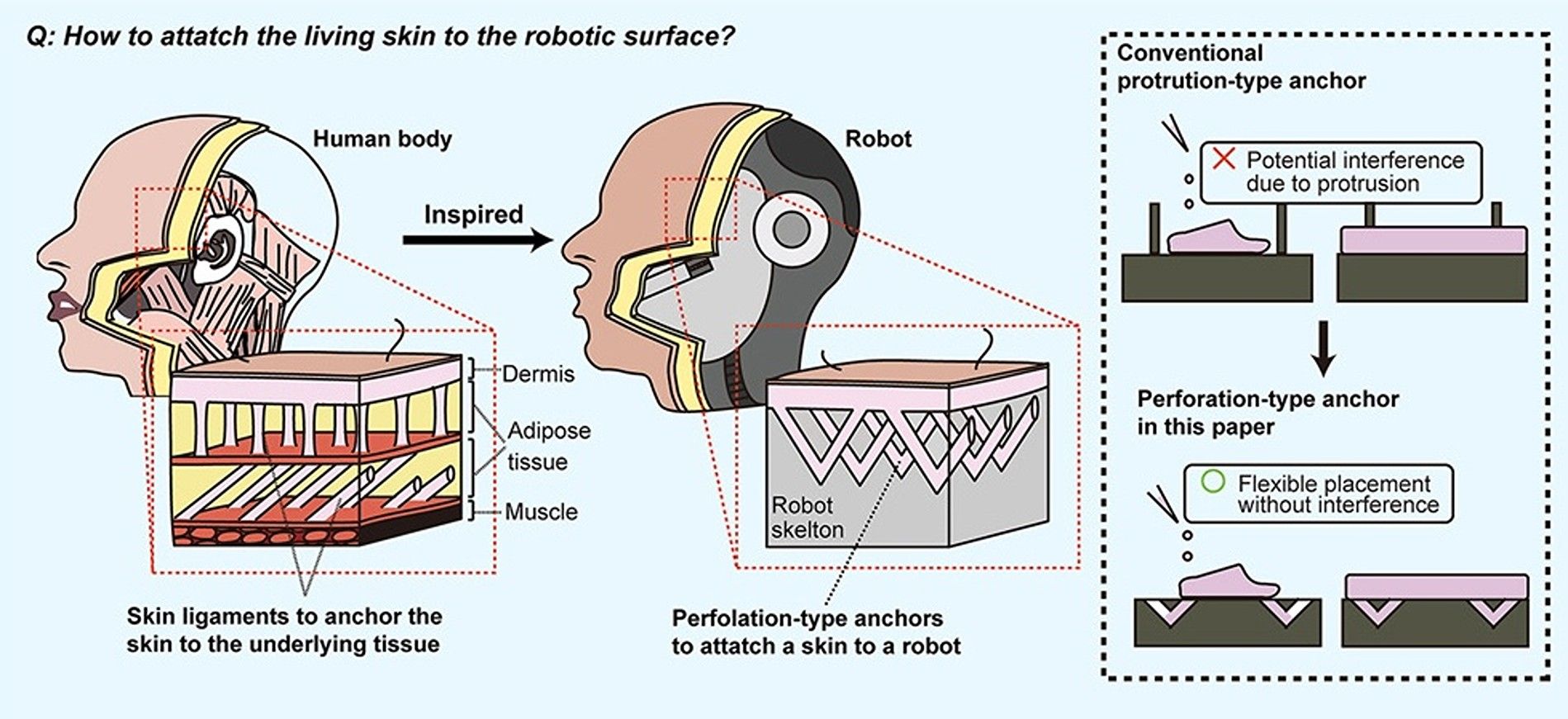
- The scientists mimicked human skin ligaments "predominantly composed of collagen and elastin" with "diminutive connecting tissues that anchor the skin to the underlying tissues," per the study.
- This helped a layer of skin take hold and enabled fluid facial expressions.
- "By mimicking human skin-ligament structures and by using specially made V-shaped perforations in solid materials, we found a way to bind skin to complex structures," said study lead author Shoji Takeuchi, of the University of Tokyo, in a statement on Tuesday.
- "The natural flexibility of the skin and the strong method of adhesion mean the skin can move with the mechanical components of the robot without tearing or peeling away."
Between the lines: Krishna Manaswi Digumarti, from the Queensland University of Technology in Australia, said in an email Thursday that the paper "presents an interesting new way" to attach soft and rigid materials together, taking inspiration from how biological systems solve the problem.
- "The idea of anchoring the skin-like material on a rigid surface by letting it proliferate into carefully designed channels is a useful design feature wherever a soft-rigid interface is desired," said Digumarti, who's a lecturer and lead investigator at QUT's Center of Robotics.
- "I would have loved to see a test for how many cycles the skin-like material is still attached to the face. Is there any wear and tear at the anchors? Does it peel off after 1000 smiles or can it last a million smiles?"
What we're watching: Takeuchi said the research revealed new challenges for the scientists.
- "We believe that creating a thicker and more realistic skin can be achieved by incorporating sweat glands, sebaceous glands, pores, blood vessels, fat and nerves," said Takeuchi, who's regarded as a pioneer in the field of biohybrid robotics, where biology and mechanical engineering meet.
- "Of course, movement is also a crucial factor, not just the material, so another important challenge is creating humanlike expressions by integrating sophisticated actuators, or muscles, inside the robot."
- Digumarti concurred with this and said keeping the skin alive for a long time would be another challenge, but he believes some of these questions will be answered in the next decade.
The intrigue: Other potential uses in this field, via Digumarti:
- Stroke patients, burn victims, those with paralysis or who have undergone major open surgeries could in the future benefit from skins or more natural augmentations.
- Soft robotics — which uses soft materials in the construction of robots.
- Animatronics and movies — achieving life-like movement would be the bigger hurdle there.
Go deeper: Jeff Bezos, Nvidia, OpenAI invest in humanoid robot startup
Editor's note: This article has been updated with comment from Queensland University of Technology's Krishna Manaswi Digumarti.
