How Richmond is reclaiming its Black history to redefine its future

Add Axios as your preferred source to
see more of our stories on Google.
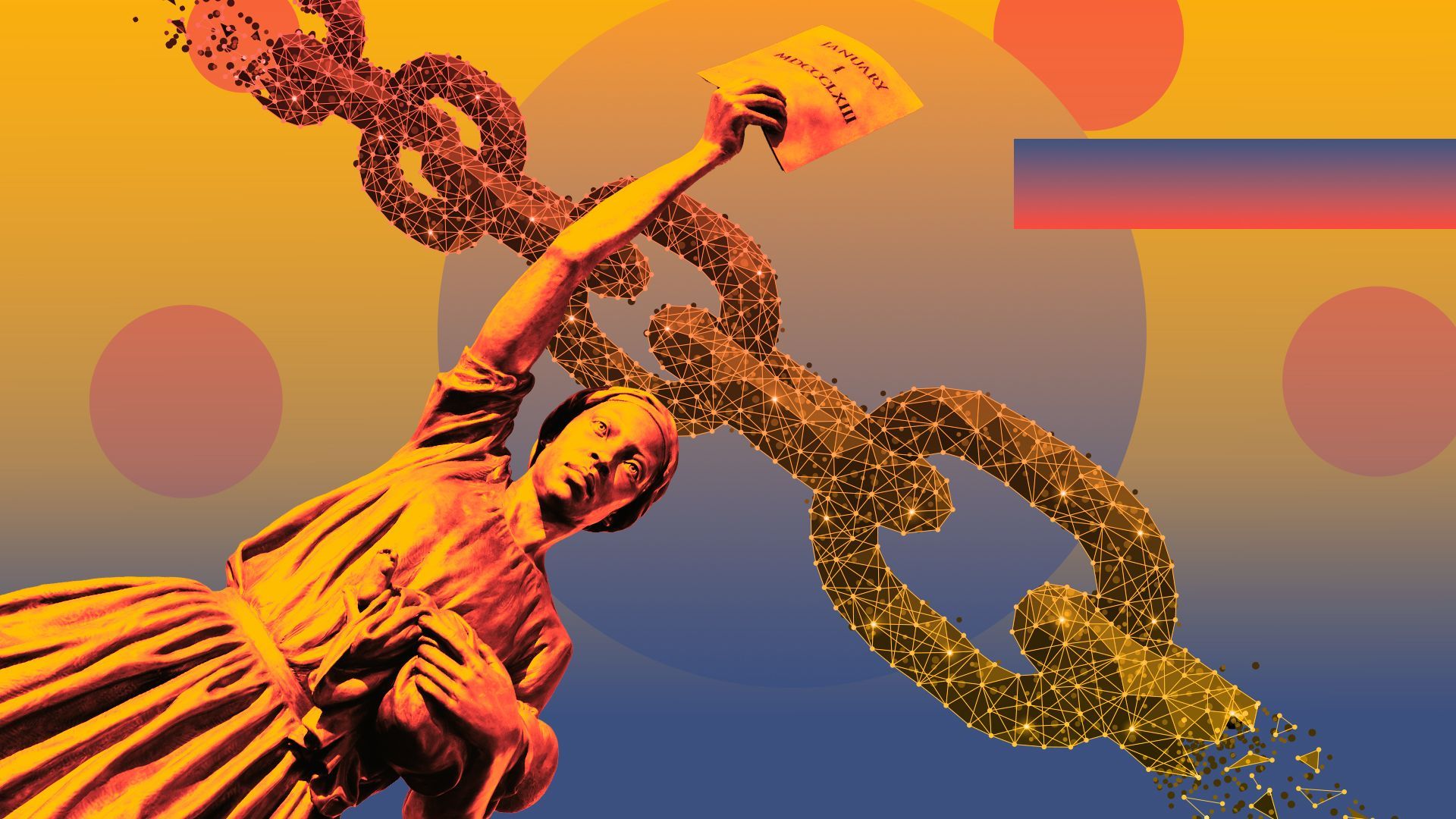
Illustration: Lindsey Bailey/Axios; Photo: Joe Sohm/Getty Images
To outsiders, Richmond's past is often defined by its status as the former capital of the Confederacy.
- But that's nowhere near the full story — and this city wants you to know it.
The big picture: As many states restrict how Black history is taught, Richmond is vowing to make its past as the country's second-largest hub for buying and selling enslaved people a permanently visible part of its future.
- City leaders are aiming to memorialize that mostly untold story through the Shockoe Project, an ambitious, $265 million, 10-acre effort in the Shockoe Bottom neighborhood.
- Officials hope the project, anchored by a 62,000-square-foot National Slavery Museum and expected to be completed by 2037, will become Richmond's version of D.C.'s National Mall.
Zoom in: It's the first time that Richmond has developed a neighborhood with Black history as its central theme, says Ana Edwards, a Virginia Commonwealth University historian focused on preserving Richmond's Black history.
- The project could "fundamentally change Richmond's very narrow self-identification into something that's much broader and more reflective of not only its history, but also, frankly, of the current American scene — the people who live here," Edwards tells Axios.
Between the lines: The effort builds on work that advocates, Black historians and other Richmonders have done for decades.
- The Black History Museum on Leigh Street, for example, opened to the public in 1991, while the City Council established the Richmond Slave Trail Commission in 1998.
- It also coincides with a national rise in Black heritage tourism, with people traveling to sites linked to once-forgotten moments in Black history.
The latest: The 2020 protests over the police killing of George Floyd, which led to Richmond pulling down its Confederate monuments, "created a domino effect," says Enjoli Moon, co-founder of the JXN Project, a nonprofit telling the history of the city's Jackson Ward — the birthplace of Black capitalism.
- "Not just in the physical landscape of Richmond, but I think also in the mental and energetic landscape of the city," adds Moon, who also founded the Afrikana Film Festival.
Richmond — frequently overlooked in Black and Indigenous history — is now establishing itself as a starting point for the Black American story, Moon tells Axios.
- The city was so central to American slavery that an estimated 1 in 4 Black Americans can trace some ancestry back to the area.
- That history is driving people to visit, move and create art here, Moon says.
- CNN also cited it as a reason for proclaiming Richmond the No. 1 American town to visit this year, along with the city's high number of Black-owned restaurants.
The bottom line: "This is what makes this place resonate for people," Edwards tells Axios.
- "We accept the complexity of its history. We want to know the truth."
