Mapping charging deserts

Add Axios as your preferred source to
see more of our stories on Google.
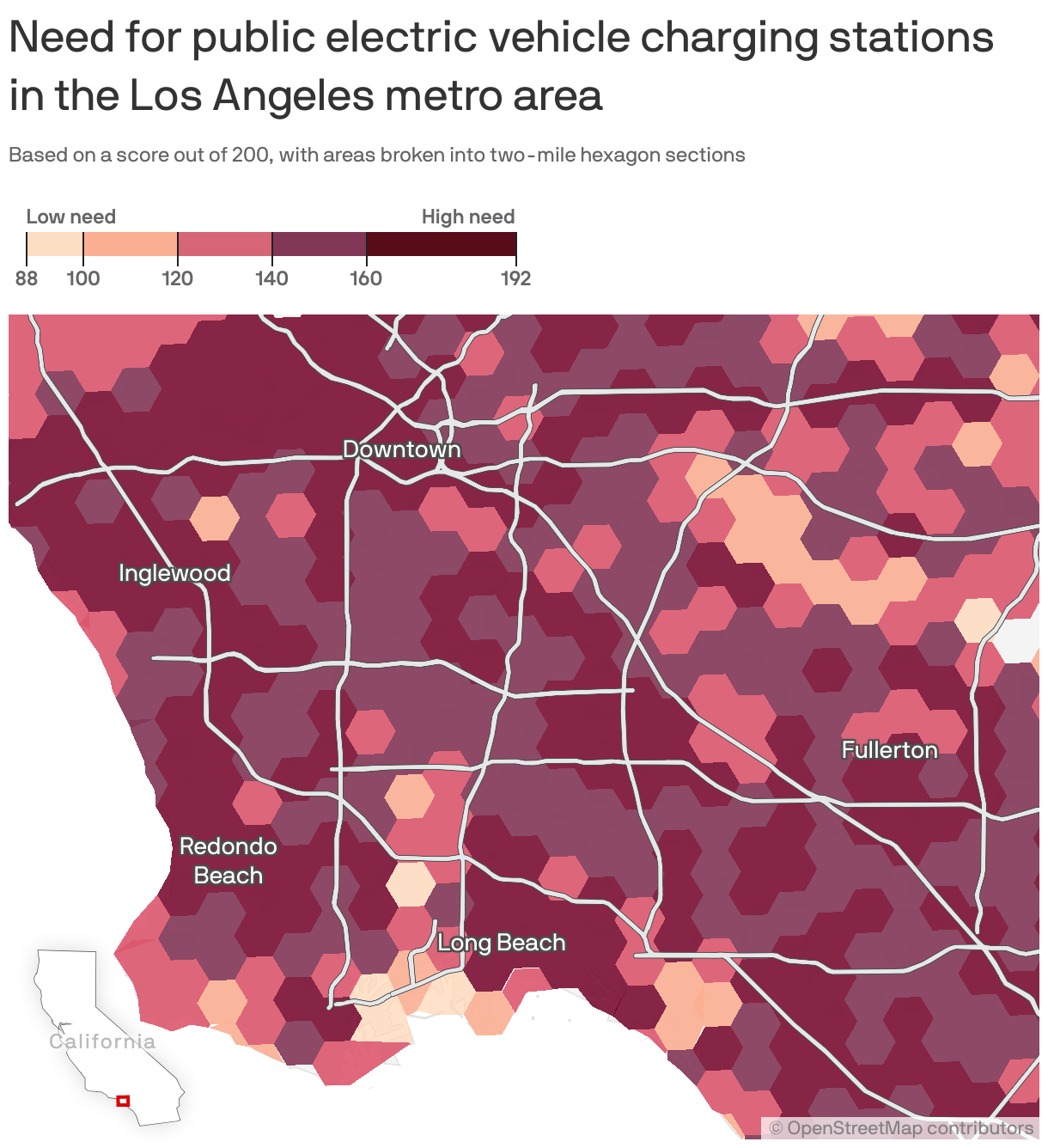
A new digital mapping tool that highlights electric vehicle "charging deserts" found a surprise: Los Angeles is pocked with them.
Why it matters: If a monster EV market like L.A. can't get public charging right, the rest of America is probably not doing much better.
Driving the news: CBRE, the giant real estate services company, created an advanced digital mapping tool to help clients assess EV charging needs in communities nationwide.
- The tool — shared first with Axios — is meant to help charging networks and property owners pick the best sites to install new chargers.
- By identifying underserved neighborhoods, CBRE essentially acts as a matchmaker.
What it found: If you live in the Los Angeles suburbs of Inglewood or Redondo Beach, you might want to think twice about buying an electric car.
- Other L.A. "charging deserts" include Long Beach, Sherman Oaks/Studio City, Lomita, southwest Torrance, UCLA and Cal State, Fullerton.
How it works: The tool pulls in a massive amount of data from up to 80 sources, including mobile phones, traffic, EV ownership, housing types, crime, etc.
- It can compare, say, existing charging infrastructure with anonymized cell phone data to determine whether EV owners are charging at home or at work.
Between the lines: There are lots of reasons for local charging deserts, Jim Hurless, CBRE's global real estate leader for EV infrastructure, tells Axios.
- A city might primarily have rental housing, so few people can charge at home.
- Or there could be insufficient power infrastructure or parking in the neighborhood.
Zoom in: A Los Angeles case study shared with Axios broke the city into 2-by-2-mile hexagons to identify neighborhoods that lack the charging stations to meet current demand.
- Los Angeles is a good case study because it is the third-largest EV market in the U.S., behind San Francisco and San Diego, according to vehicle registration data from S&P Global Mobility.
- Nearly 588,000 EVs are registered in L.A. — about 4.2% of the cars on the road there. In April, the most recent month available, EVs made up 21.5% of L.A.'s new car registrations.
- The city of L.A. is installing chargers on light poles as one way to help meet demand.
Yes, but: In Inglewood, for example, there are no public chargers — despite more than 1,000 registered EVs and 6,000 more passing through daily on I-405.
- Nearly 70% of Inglewood residents are renters.
- Also, the city lacks parking and doesn't have enough electrical substations for distributing additional power.
The big picture: CBRE's tool offers tremendous insights into the state of America's charging infrastructure.
- More than 1 million EVs were sold in the U.S. last year — a record — but the percentage of light-vehicle sales that were electric dipped to 7% in Q1 2024 from 8.1% in Q4 2023, according to Cox Automotive.
- Cox's research suggests a "second, significant wave" of shoppers is ready to consider an EV in the second half of the decade.
Where it stands: The U.S. currently has about 186,000 public charging ports at nearly 70,000 charging locations, per the federal government's Joint Office of Energy and Transportation.
- The vast majority are slower "Level 2" chargers.
The bottom line: CBRE's map underscores how far the U.S. has to go to support the shift away from gasoline.
Note: Cox Automotive, like Axios, is owned by Cox Enterprises.
