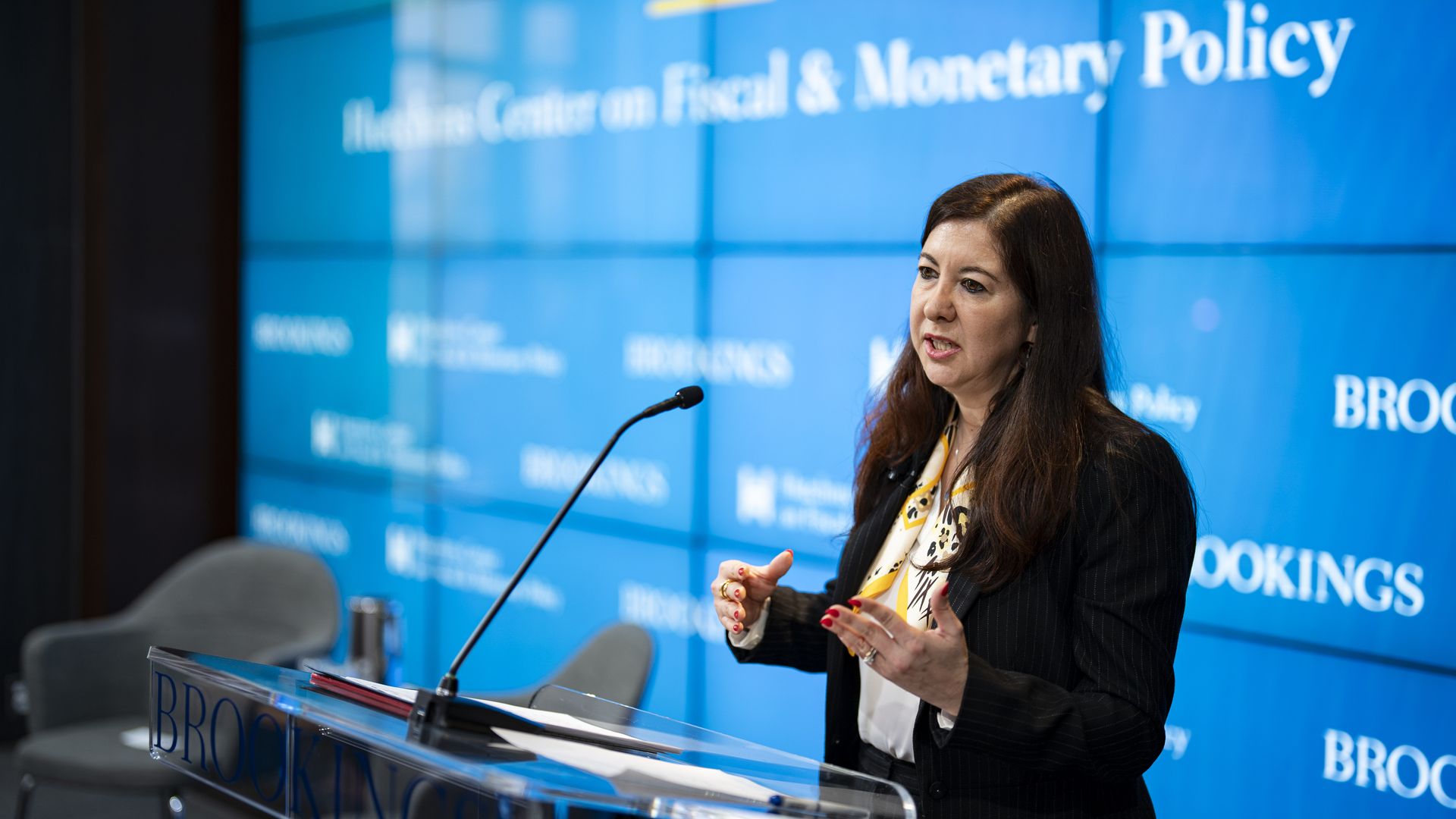
Federal Reserve governor Adriana Kugler in Washington, D.C., earlier this year. Photo: Al Drago/Bloomberg via Getty Images
If economists are right, there will be more good news on inflation come Friday morning.
What to watch: The Personal Consumption Expenditures Index, the Fed's preferred inflation gauge, is expected to be flat for the month of May.
The core reading that excludes energy and food costs should be just as benign, rising 0.1%, economists estimate.
That would bringboth the PCE index and the core index to 2.6% in the 12 months through May — both slightly below that in April.
Why it matters: If the data comes in as economists expect, it would be the latest to confirm inflation's cooling trend after fears that progress was stalling.
The big picture: A top Fed official recently laid out reasons to be optimistic that the cooling trajectory might continue.
In a speech last week, Fed governor Adriana Kugler said higher instances of consumers pushing back against prices might spur slower price increases and even declining prices for goods and services.
"What I have heard in my own conversations with business contacts is that consumers are 'trading down' to lower-cost products and that firms are responding with more discounting," Kugler said
The intrigue: Kugler added that another key reason for optimism is productivity, which would allow the economy to keep humming without sparking inflation.
Widespread adoption of AI might help that be the case: "AI technology has the potential to make workers and firms more productive — effectively boosting aggregate supply," Kugler said.
Kugler said new technologies can take a long time to make a dent in aggregate productivity. But she suspects AI will "diffuse more quickly, in part because many of the complementary assets needed for the initial spread of AI — such as computers, networks, and the like — are already in place."