"So, it has been the degens all along"

Add Axios as your preferred source to
see more of our stories on Google.
Billions of dollars have rushed into spot bitcoin ETFs since January, and a few smart folks in traditional finance (TradFi) have been somewhat skeptical of the narrative that all of that money represented pent-up demand from institutions.
- Recent comments from a BlackRock executive and a JPMorgan Flows & Liquidity report validated that doubt.
Why it matters: Those ringing the alarm on what set of investors — retail or institutions — own bitcoin ETFs worry that the former will spark a selloff when breakeven is reached.
Behind the scenes: "Retail Degens are paper-hands and will sell when they start losing money, more so than TradFi, which historically is a much stronger-handed ETF buyer," Jim Bianco of the eponymous financial services firm said on social media.
- The average purchase price for spot bitcoin ETFs is around $61,000, he added.
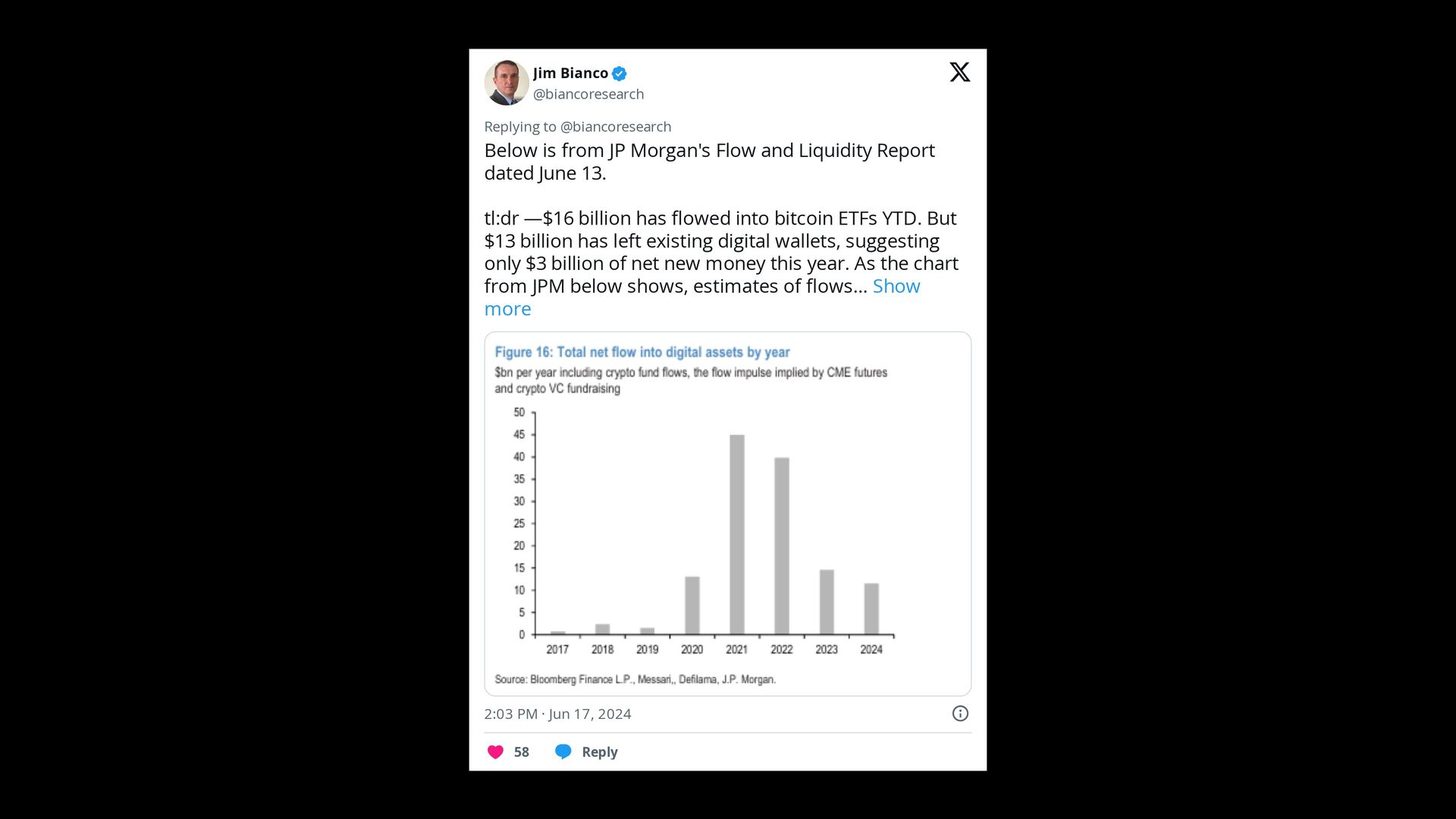
Zoom in: Meanwhile, a JPMorgan report by global markets strategist Nikolaos Panigirtzoglou suggested that of the $25 billion seen going into spot bitcoin ETFs and implied flows by CME futures, only about half, or $12 billion, was new money.
- This was assumed based on CryptoQuant's estimated $13 billion decline in digital wallets since the launch of spot bitcoin ETFs.
- "This implies that the majority of the $16bn inflow into spot bitcoin ETFs since launch likely reflects a rotation from existing digital wallets on exchanges," Panigirtzoglou said.
Flashback: BlackRock executive Samara Cohen, at the Coinbase summit in New York last week, said about 80% of bitcoin ETF purchases have likely been coming from self-directed investors who made their own allocations.
Yes, but: Spot bitcoin ETFs account for a small slice of outstanding bitcoin supply, or under 5%, according to a Dune dashboard by Dragonfly's Hildebert Moulié.
- Crypto natives on social media also pointed out that there is not an absolute 1:1 relationship between exchange and ETF flows.
The bottom line: Bianco isn't a hater, he just doesn't think an ETF is the answer: "The movement from on-chain to regulated brokerage accounts is a big problem in the long run," he said. "What BTC needs is on-chain adoption."
