Boeing "far from perfect" but improving, embattled CEO tells Congress

Add Axios as your preferred source to
see more of our stories on Google.
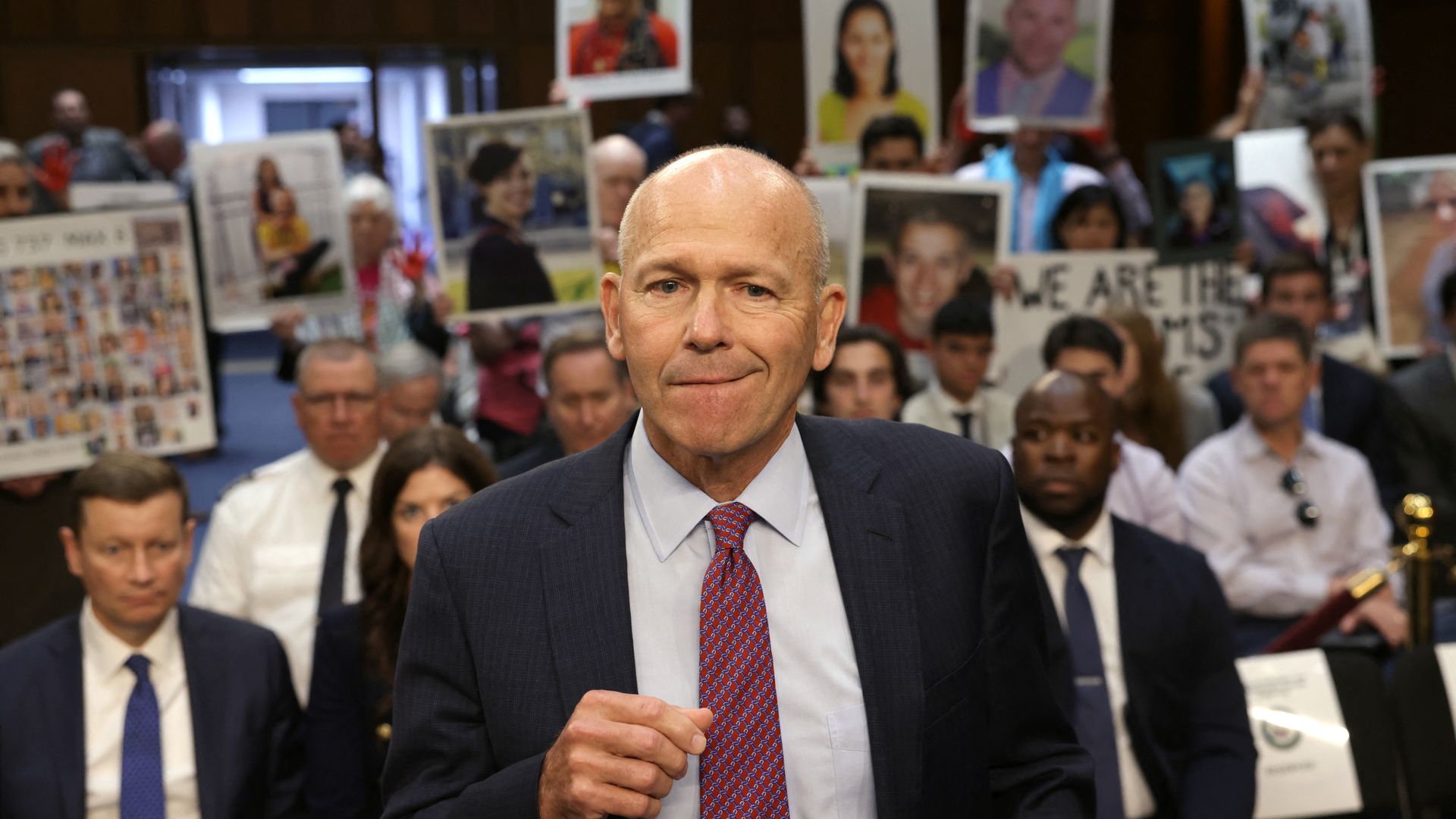
Boeing President and CEO Dave Calhoun in front of relatives of Boeing airplane crash victims in Washington, D.C., on June 18. Photo: Samuel Corum/AFP via Getty Images
Boeing CEO Dave Calhoun in his first appearance before a Senate panel Tuesday since a mid-flight accident with a 737 MAX 9 earlier this year said the company's culture is "far from perfect" but is improving.
Why it matters: The Alaska Airlines accident and multiple recent misconduct allegations from former and current employees have renewed intense scrutiny on the aerospace giant.
- Calhoun's appearance before the Senate Permanent Subcommittee on Investigations came hours after it published new allegations from a current employee.
The intrigue: The appearance may mark Calhoun's last before lawmakers as Boeing CEO, as he announced in March that he will step down at the end of the year.
- At the top of his opening statement, he addressed the families of some of the 346 people who died in two previous 737 MAX 8 crashes between 2018 and 2019 and apologized on behalf of the company.
- Senators on the committee didn't hold back throughout the hearing, accusing the outgoing CEO of prioritizing profits and putting shareholders before an honest attempt to change the company's culture.
What's inside: In the Senate subcommittee's memo, it alleged that Sam Mohawk, a current Boeing quality inspector, witnessed a "systemic disregard" for faulty parts at Boeing's Renton, Washington facility, where the 737 MAX is manufactured.
- Mohawk allegedly feared they were being installed on new aircraft, per the subcommittee.
Mohawk alleged that "hundreds" of nonconforming parts were being lost.
- No apparent action was taken in response to his internal alerts about the loss of the parts, so he also filed a complaint with the Occupational Safety and Health Administration, according to the subcommittee.
- The subcommittee said he further alleged that parts were lost in such "overwhelming" numbers that the company began intentionally hiding improperly stored parts from the FAA.
- His superiors also directed him and other employees to eliminate records that designated a part as faulty, which violated Boeing's policies and federal regulations, according to the memo.
What they're saying: On the plane crashes, Calhoun said Boeing responded by changing its engineering department to prevent "a design problem from every happening again."
- "Alaska — very different. That was a manufacturing miss," he said, adding that he believes it stemmed from documentary issues on the removal of the door plug during repairs.
- "While that happened, and it was a discrete incident on one airplane, we've tried to look at literally everything we do to make certain that can never happen again," he said.
- Asked how many employees had been fired for retaliating against other employees who raised safety concerns, Calhoun said he did not know the number offhand but said "I know it happens."
Zoom out: Mohawk's allegations, which had not been previously released publicly, come after several other former and current Boeing employees have alleged misconduct and a hostile work environment for those who raise safety concerns internally.
- Sam Salehpour, a quality engineer at Boeing, alleged earlier this year that structural problems within Boeing's 787 Dreamliner and 777 jets could cause the aircraft to suddenly fail.
- A former quality manager for the company alleged he witnessed extensive mismanagement of nonconforming parts at Boeing's factory in Everett, Washington, and feared such parts were being installed on new planes, according to the New York Times.
Between the lines: The company has approached the FAA on multiple occasions warning of potential lapses in quality control.
- In May, the FAA opened a new investigation into Boeing after the company disclosed to employees that it may not have completed required inspections on certain 787 Dreamliner airplanes.
- It also opened an investigation into how titanium sold with falsified documents regarding its authenticity was used in recent Boeing and Airbus jets, the Times reported last week.
The big picture: Late last month, the company gave federal regulators a plan for how it will resolve safety problems that plague its production processes.
- It will not be able to increase its production of 737 MAX jets until it follows through with the plan, according to the Federal Aviation Administration (FAA).
Go deeper ... DOJ: Boeing breached 2021 safety agreement that prevented charges for crashes
Editor's note: This story has been updated with additional details and developments.
