The economy hits a midyear holding pattern

Add Axios as your preferred source to
see more of our stories on Google.
From the C-suites of big companies to the halls of the Federal Reserve, economic decision-makers are waiting to see whether the next shift is toward recession, reacceleration or something in between.
Why it matters: The economy has hit a midyear holding pattern in which policy is static, growth and inflation have leveled out and CEOs aren't making major adjustments to hiring plans as they await the results of the U.S. presidential election and a Fed policy pivot.
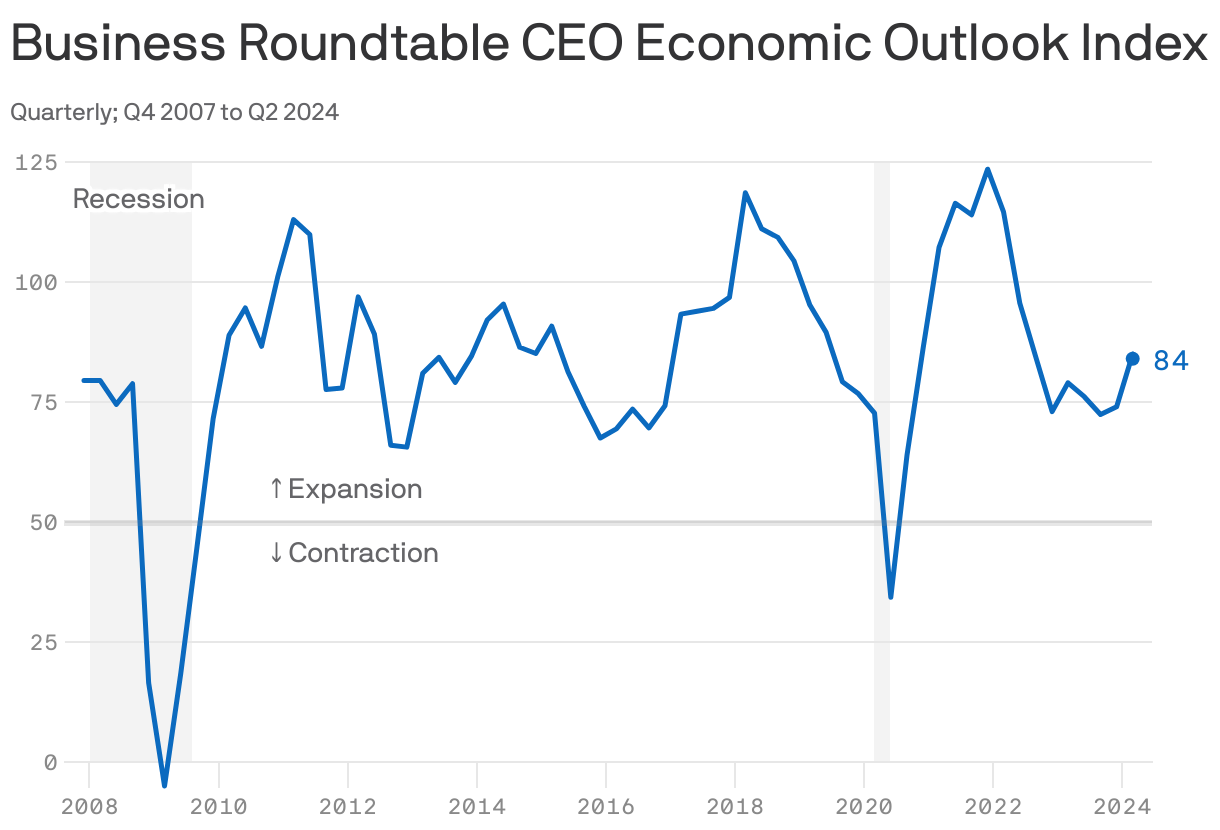
Driving the news: The Business Roundtable's quarterly survey of major company CEOs, to be released Wednesday, shows steady confidence in the economy, Axios can report exclusively.
- The BRT's economic outlook index, at 84, was a tick below the 85 reported in March and near the long-term average of 83.
- Wednesday morning, the Labor Department will release the Consumer Price Index for May, which is expected to show inflation continuing to bump along at 3.4% over the past 12 months — down dramatically from 2022 highs but no longer falling like it did in 2023.
- Wednesday afternoon, the Fed is expected to leave interest rates unchanged following a policy meeting, and it looks unlikely Chair Jerome Powell will give an explicit indication of when the central bank will cut rates.
What they're saying: "The overarching message from our member CEOs is that the economy is steady and stable, but they remain cautious," said Cisco CEO Chuck Robbins, who chairs the Business Roundtable, in a statement.
By the numbers: CEOs reported growing sales — with BRT's index of sales activity rising to 123 from 118. They reported lower plans for capital spending, however, with that index falling to 70 from 78.
- Plans for hiring were unchanged compared to March, with that sub-index steady at 60.
- CEOs expect GDP to grow 2.3% over the coming year, up from 2.1% in March.
- "The survey results imply stable CEO plans and expectations, broadly in line with the historical average — certainly not signaling either overheating or recession." Business Roundtable chief executive Josh Bolten tells Axios.
The intrigue: In a special question, 86% of CEOs said they agree or strongly agree that securing new trade agreements is critical to maintaining U.S. competitiveness. Both leading candidates for president have shown a fondness for new tariffs.
- To strengthen America's global competitiveness, "it will be more important than ever for Washington to protect and expand the economic gains from tax reform, modernize America's workforce development system, lead on responsible deregulation to lower costs, and solidify high-standard trade agreements," Robbins said.
The bottom line: After a tumultuous four years of pandemic, supply chain breakdowns, labor shortages, inflation, war, and then a cooldown, this summer is looking like a period of stability and re-assessment.
