The 988 rollout remains uneven two years later

Add Axios as your preferred source to
see more of our stories on Google.
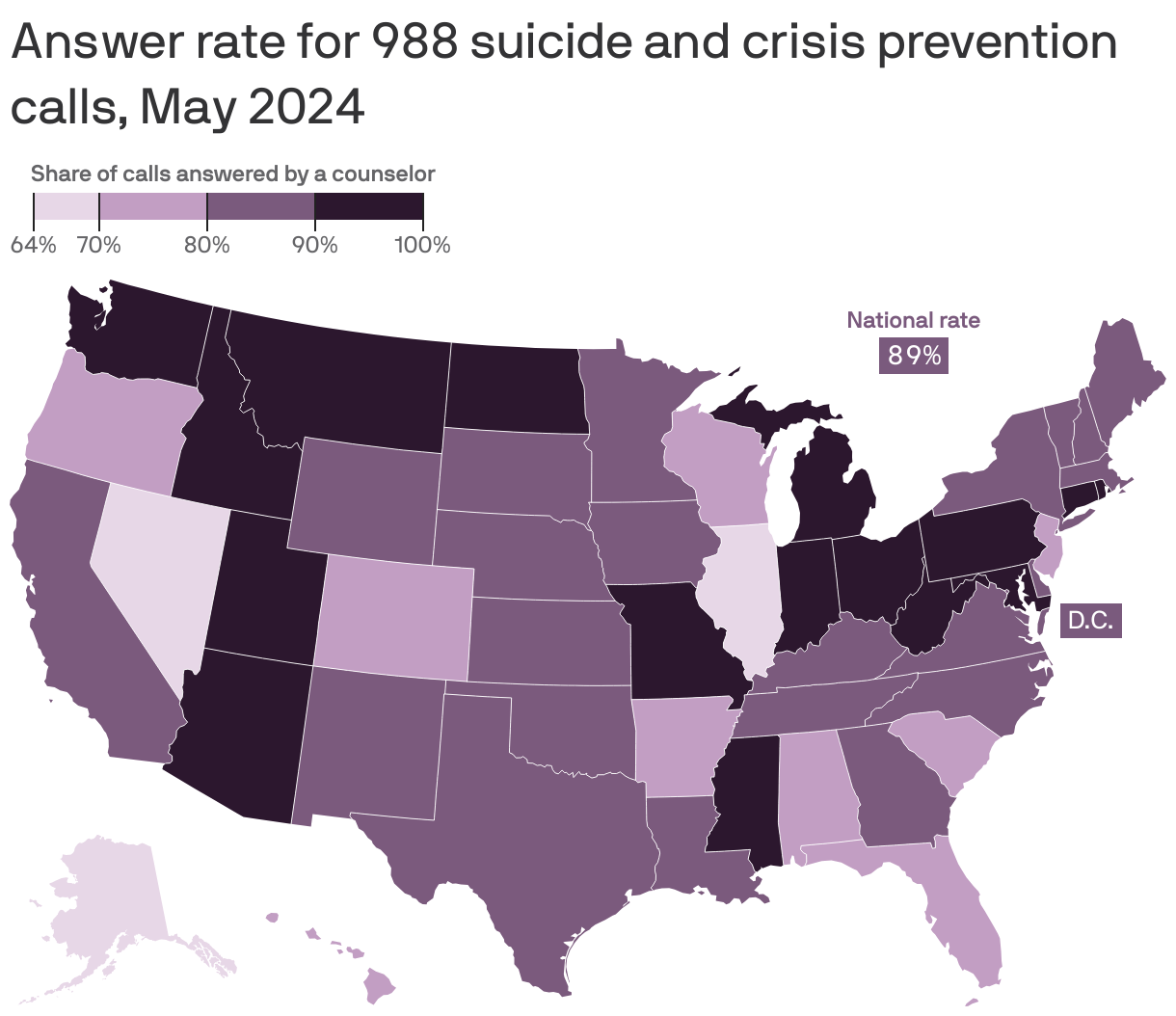
Almost two years after the debut of a revamped national suicide hotline, its promise of a quicker, more seamless crisis response across the country is still a work in progress.
Why it matters: Congress gave states $1 billion to build out the 988 hotline, amid nationwide concern over worsening mental health, with the expectation that states would establish their own long-term funding to operate call centers and crisis services.
- But those efforts have been uneven, contributing to significantly lower response times in certain states. As with much of the health care system, the level of crisis services available to people depends greatly on where they live.
What they're saying: "We want a system where everybody has a comparable experience. It seems to me we're still a few years from that," said Chuck Ingoglia, CEO of the National Council for Mental Wellbeing.
- He and other advocates and experts Axios spoke with said 988 implementation has been improving.
State of play: Though all states use surcharges on cellphone bills to fund 911 services, just 10 states so far have done the same for 988, according to a new report from mental health advocacy group Inseparable shared first with Axios.
- Several states have used general funds to make short-term investments in 988. But just 15 states have applied for and received temporarily boosted federal Medicaid funding for mobile crisis services, and eight at least partially require private insurers to cover these services, according to the report.
- "There are states where one piece of the puzzle is happening well, and another piece is not happening as well," said Angela Kimball, Inseparable's chief advocacy officer.
It's not just a money problem. States have to set rules around 988 services and coordinate among agencies and local officials.
- Some states, like Arizona, have been honing their mental health crisis response systems for years, while the effort is newer for some states.
- "Transformation of this scale takes time and long-term success depends heavily on an ongoing coordinated effort by the federal government, states, territories, tribes, and the network of more than 200 crisis contact centers," a Health and Human Services spokesperson said.
Where it stands: Calls, texts and chats to the hotline are up since it was relaunched as an easy-to-remember three-digit service in July 2022.
- But in Nevada, 64% of 988 calls were answered locally last month, well below the national average of 89%, according to federal data. Response rates in Illinois and Alaska were also below 70%, while they were in the low 70s in Arkansas, Colorado and New Jersey.
- Mississippi, Montana and Rhode Island answered 97% of calls last month.
- Just looking at response rates doesn't give the full picture of how well a state has implemented 988, but it's an indicator of whether a state's call center has adequate resources, Kimball said.
- A federally funded national backup system exists so anyone in the country can access a trained counselor when they call 988, HHS told Axios.
What's next: States and cities are also moving toward integrated 988 and 911 services, said KFF researcher Heather Saunders, who tracks policies around the hotline.
- Federal regulators are also looking to require that 988 calls are routed to a person's actual location, rather than their area code, to better connect them with nearby resources.
Editor's note: This story has been corrected to show that Chuck Ingoglia is CEO of the National Council for Mental Wellbeing (not the National Alliance for Mental Wellbeing).
