"Underground Railroad to public education" helps parents flee segregation

Add Axios as your preferred source to
see more of our stories on Google.
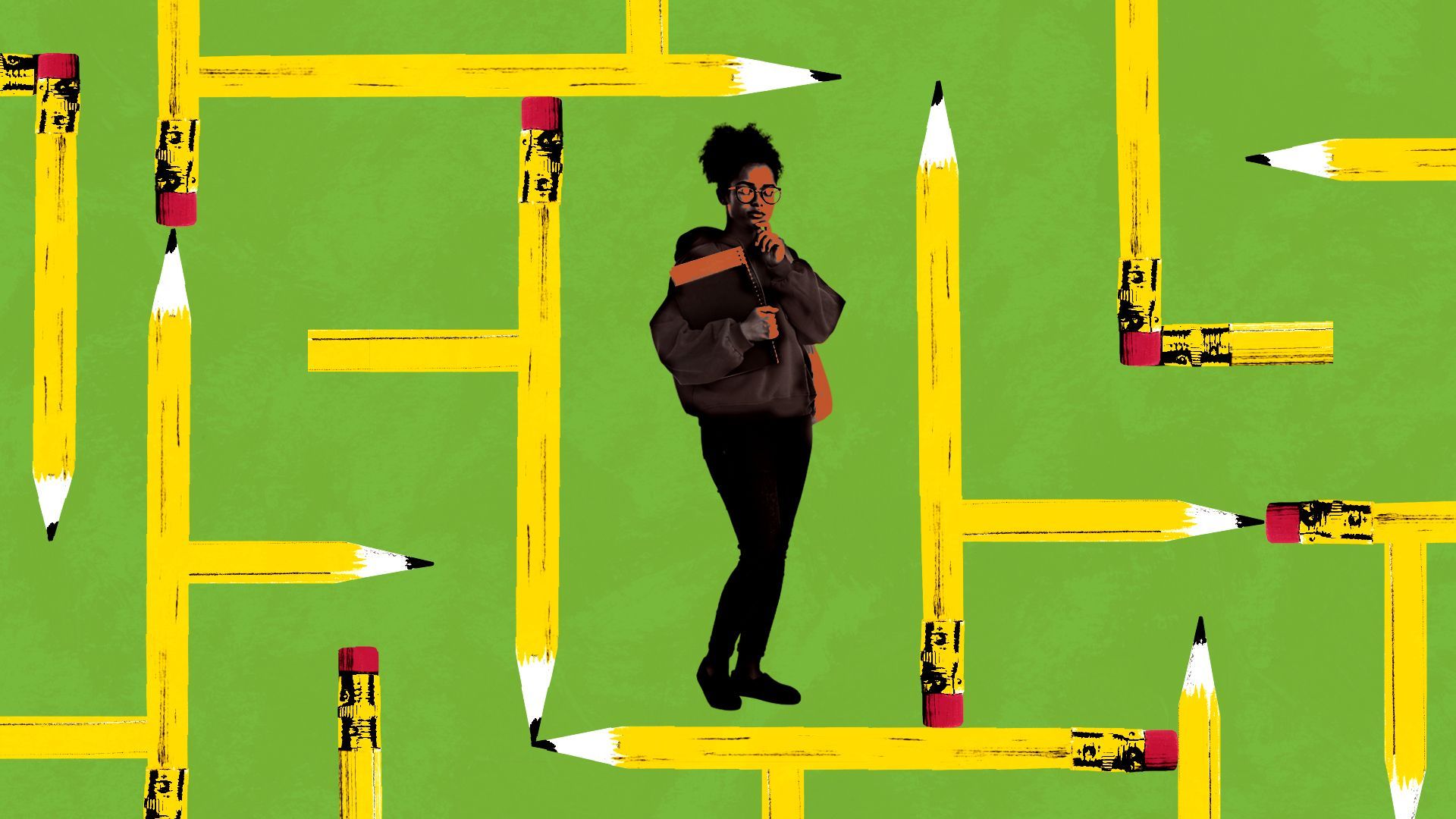
Illustration: Shoshana Gordon/Axios
Parents locked into strict school boundaries and forced to send their children to subpar schools have developed clandestine networks to circumvent what they view as "unfair" local laws to get them into better ones.
Why it matters: Rigid school boundaries often reinforce racial and economic segregation, experts say, and these parents believe they are simply going around unjust laws that foster inequality.
The big picture: As the U.S. marked the 70th anniversary this month of the landmark Brown v. Board of Education ruling that banned separating schoolchildren by race, two new reports fault strict school boundaries for reinforcing segregation
- The reports — from the nonpartisan advocacy groups Available to All and yes. every kid. — call for abolishing most neighborhood school boundaries and enacting laws protecting families seeking enrollment.
Zoom in: Parents in states with harshly enforced school boundaries are sharing information, developing carpools, sharing bus schedules and researching laws, parent activist Kelley Williams-Bolar tells Axios.
- The parents, almost all Black, Native American or Latino, work together to avoid getting fined or criminally charged for trying to get their children into a good school that's down the street but out of their assigned zone, she said.
- "It's an Underground Railroad to Public Education. I think parents just want the best for the kids, and nobody should be criminalized for it."
Background: Williams-Bolar spent nine days in jail in 2011 after being convicted of a felony for enrolling her teenage daughters in an Ohio school using her father's address.
- The conviction came even though Williams-Bolar and her daughters divided their time between the two homes.
- Williams-Bolar's status as a "felon" barred her from ever being able to obtain a teaching license. But then-Ohio Gov. John Kasich later commuted her charges from felonies to misdemeanors after a parole board left her sentence intact.
The intrigue: Advocates say no one knows how many parents participate in the Underground Railroad to Public Education, and laws vary by state.
- In New Mexico, for example, Navajo parents share information about the best schools and work to get buses to take students to schools more than an hour away, Cuba, New Mexico, Superintendent Karen Sanchez-Griego tells Axios.
- "All they want is what's best for their kids," Sanchez-Griego said.
How it works: School districts set boundaries and assign schools generally connected to families' neighborhoods.
- All 50 states and the District of Columbia allow or require school assignments to be based on students' residential addresses.
- Tim DeRoche, founder and president of Available to All, says some districts hire private detectives and spy on parents to determine whether they are sending their children to the correct schools.
- Sometimes, the schools will even penalize homeless parents if they are living in their cars and the car is parked outside of a boundary, he said.
The other side: Districts say they need boundaries to prevent chaos or families from obtaining services meant for taxpayers.
Yes, but: Halli Faulkner, a senior legislative drafter with yes. every kid, tells Axios those school district boundaries often reflect racist redlining lines created between neighborhoods in the 1930s and 1940s.
What we're watching: South Carolina is considering legislation that would introduce open enrollment to any school while North Carolina lawmakers are considering strengthening its open enrollment laws.
- The NAACP and the Latino Action Network have sued the state of New Jersey to end residential assignment of public schools.
