The Pentagon's growing costly headache: Cheap drones

Add Axios as your preferred source to
see more of our stories on Google.
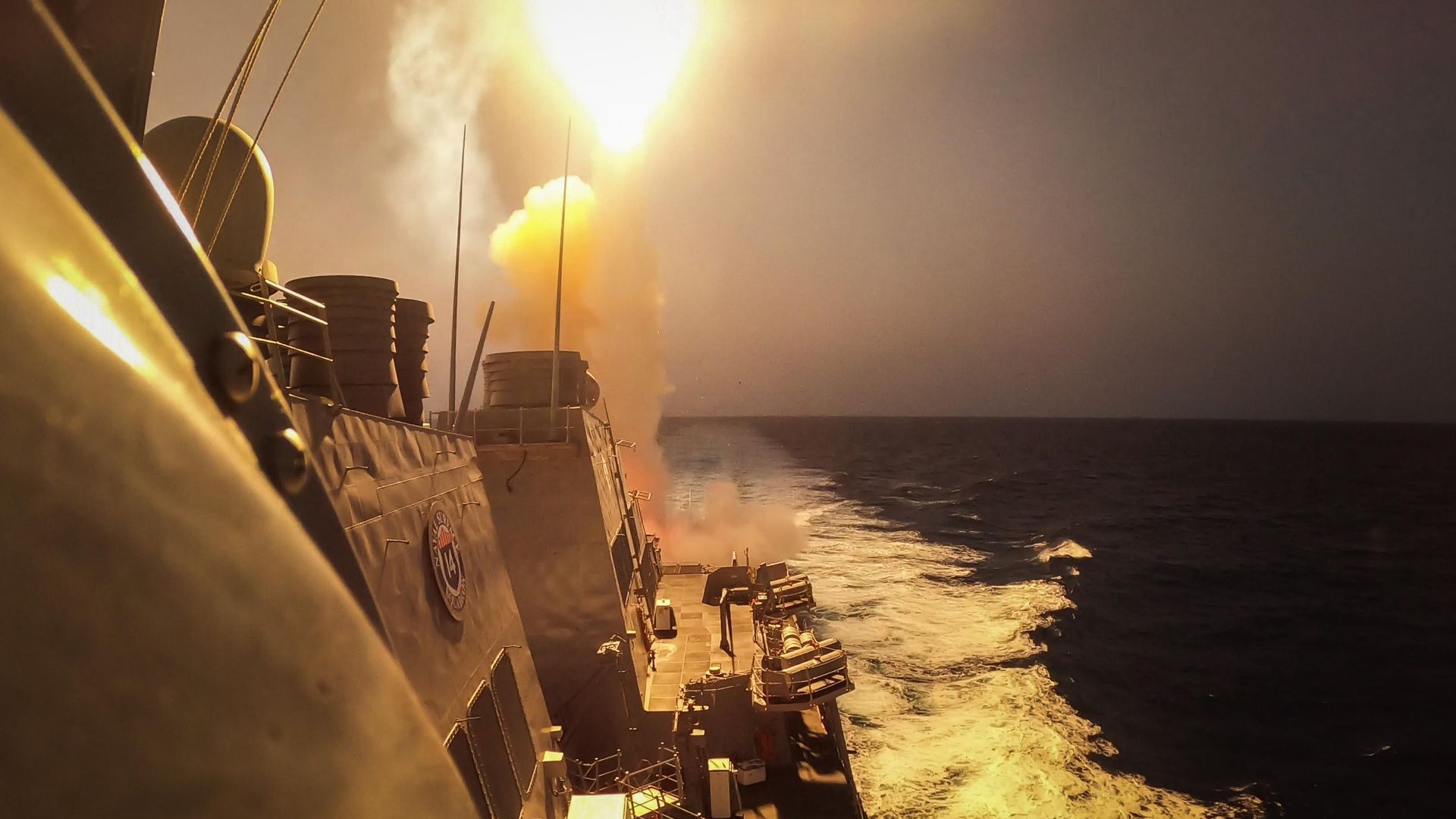
The USS Carney engages Houthi missiles and drones in the Red Sea in October 2023. Photo: Aaron Lau/DVIDS
The Pentagon faces a dilemma exemplified by its battles in the Red Sea and Gulf of Aden: How to cost-effectively intercept cheap but deadly drones wielded by a growing number of forces.
Why it matters: The U.S. and other militaries are at times using munitions worth millions of dollars to blow up unmanned aerial systems that can be made with off-the-shelf parts for far less money. That trade may prove unsustainable.
What they're saying: "If we're shooting down a $50,000 one-way drone with a $3 million missile, that's not a good cost equation," Bill LaPlante, the Pentagon's chief weapons buyer, told a Senate appropriations subcommittee on Wednesday.
- "The technology is changing every couple of weeks, and the tactics are changing, and it's going to be a constant fight."
- LaPlante also said he is leading a new group tasked with getting counter-UAS equipment to where it is most needed.
Driving the news: Iran unsuccessfully targeted Israel with hundreds of attack drones earlier this year, and Houthi rebels have for months peppered vessels in the waters near Yemen, taxing U.S. warships and fighter jets.
- The U.S. Navy has expended roughly $1 billion in munitions in the half-year it's patrolled the region.
- A drone strike in January killed three troops in Jordan at Tower 22, near al-Tanf garrison.
Zoom in: Rear Adm. Fred Pyle, the director of surface warfare on the chief of naval operations' staff, on May 14 said the service is challenged by the "wrong side of the cost curve." Missile-based air defense has proven successful but pricey.
- "Do we need to find — or should we find — a more-cost effective way of downing, say, an inexpensive drone? Absolutely," Pyle said at an event hosted by the Center for Strategic and International Studies think tank.
- Ships across the Greater Middle East have relied on variants of the Standard Missile to swat incoming barrages. An SM-2 costs roughly $2 million. An Iranian Shahed drone or Houthi clone can cost thousands.
- The Army in February bought 600 Coyote interceptors from RTX, formerly Raytheon Technologies, in a deal worth $75 million. Coyote devices are used in what's known as the Low, slow, small, unmanned aircraft Integrated Defeat System, or LIDS.
What's next: Both LaPlante and Pyle said the Pentagon is consulting defense industry, but declined to name potential contractors.
