Crises at AT&T, CBS and Lyft show the power of rapid response

Add Axios as your preferred source to
see more of our stories on Google.
Communicators are increasingly conducting crisis drills in anticipation of the next big operational failure, cyberattack, misinformation campaign or labor issue.
Why it matters: Communication teams are expected to take control of the crisis by quickly contacting the right stakeholder, at the right time, through the right channel.
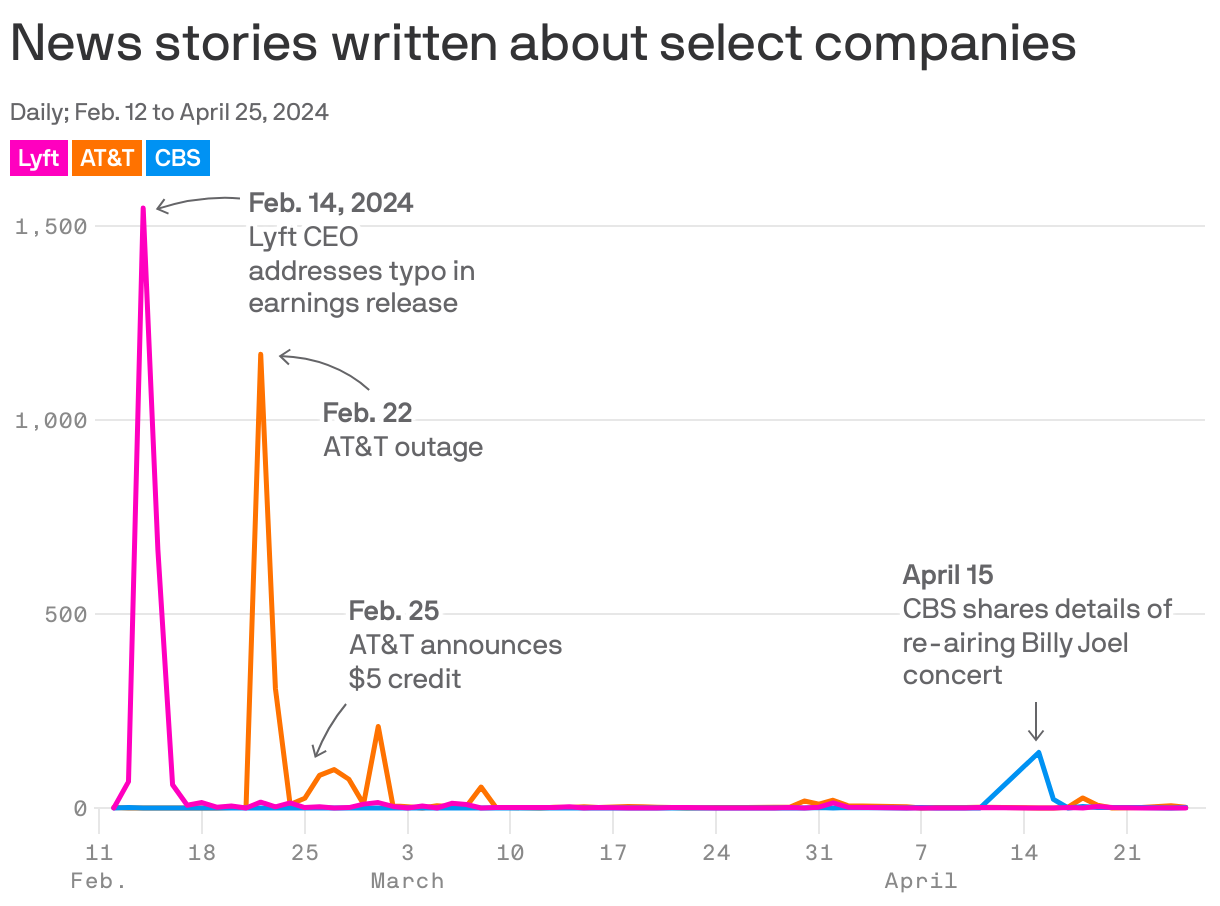
State of play: Axios examined three recent crises of various degrees across different industries — Lyft's earning release typo, AT&T's network outage and CBS' programming error.
In each case, the companies quickly acknowledged the problem and communicated with key audiences.
- Lyft CEO David Risher was immediately very vocal after an earnings release typo affected the stock price in mid-February. By quickly engaging in media interviews and posting on social media, he was able to reshape the narrative, slow down the news cycle and ease investor concerns.
- Following a nationwide outage across AT&T's network in February, the telecom provider communicated directly with regulators, engaged with the media and posted across its digital and social platforms to provide updates to its customers, beat back misinformation and offer credits.
- After a CBS programming error cut Billy Joel's concert special short — "Piano Man" was interrupted by the local news in some areas — the network quickly apologized and worked with Joel, rights owner Sony Music and local stations to schedule a re-airing. The swift response kept the news cycle to under 24 hours, per Muck Rack data.
Zoom in: AT&T's outage attracted over 25 million readers on Feb. 22 — 114 times higher than its average daily readership, according to a new crisis index report by reader insights platform, Memo.
- However, the story died down almost as quickly as it began, with readership falling 89% by Feb. 23.
- "In the first few hours of the crisis, articles about what might have caused the outage generated the highest average readership," the report said. "By addressing the cause of the outage right away, AT&T was able to keep conspiracies at bay. Ultimately the brand's explanation attracted more readers than initial internet theories."
What they're saying: Speed should not supersede accuracy, says Brooke Buchanan, chair of U.S. crisis and risk mitigation at Edelman.
- "The worst thing you can do in the middle of a crisis is create an inadvertent additional crisis by sharing information that isn't factual, because ultimately, you'll have to walk it back," she said. "That erodes trust not only with your key stakeholders but [with] your customers, your employees and regulators."
Reality check: Often times it's the internal processes, not missing facts, that slow teams down, said Nathan Miller, founder of crisis communications firm Miller Ink.
- "They need legal review, they need the 12 members of the board to sign off, they need to have another internal conversation — and those are bad reasons to wait," he said. "If you do the crisis prep ahead of time, it makes a big difference because you've already determined what the decision-making process should look like, and everybody has signed off on it."
The big picture: The rampant spread of mis- and disinformation online only increases the need for communication teams to act quickly.
- An MIT study found false news online reaches people about six times faster than the truth, yet 28% of businesses don't have a formal mis-disinformation response plan in place and 23% have no plan.
What to watch: The U.S. election and those abroad — compounded by geopolitical issues, fragmented media landscape and the rise of generative AI — have the potential to gin up more mis- and disinformation campaigns.
Go deeper: The modern crisis communications playbook
