Fake engine noises coming to EVs

Add Axios as your preferred source to
see more of our stories on Google.
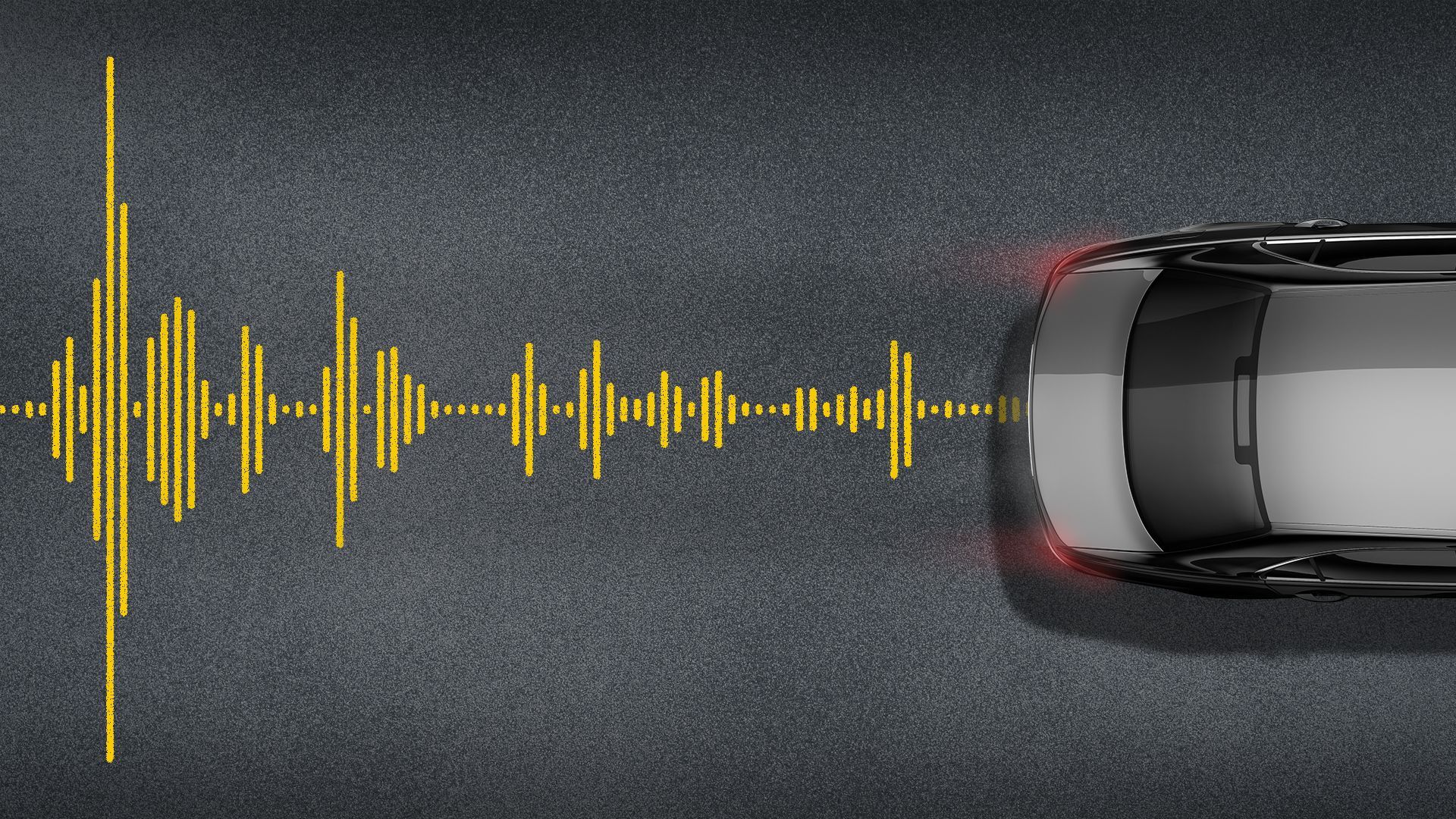
Illustration: Sarah Grillo/Axios
The guttural roar from a gas engine disappears in an EV — but some people want it back.
Why it matters: Lacking engines, EVs are quiet, emitting only the sound of tires on pavement and the purring whir of an electric motor as it powers the vehicle.
State of play: Dodge has had enough.
- The Stellantis brand is debuting what it's dubbed a "Fratzonic Chambered Exhaust" system in the new 670-horsepower 2024 Dodge Charger Daytona — the first EV version of the Charger muscle car.
- The system replicates the deafening burble of Dodge's Hellcat V8 engine, Axios' Joann Muller reported.
How it works: It "employs a series of chambers strategically placed" under the vehicle that work "in conjunction with woofers and mid-range speakers" to generate exhaust noises, according to enthusiast site MoparInsiders, citing a patent filing.
- Those noises are then "channeled through dual pipes akin to those found in internal combustion engine (ICE) vehicles."
- "The system utilizes a combination of digital sounds and basic filtering, with the emphasis on fine-tuning the sound in the acoustic domain rather than relying solely on digital manipulation."
The intrigue: Dodge isn't the first to realize that drivers might want fabricated engine noise.
- A company called Borla Performance Industries sells an aftermarket system called Active Performance Sound that allows drivers to dial up fake engine noise for the Ford Mustang Mach-E electric vehicle.
- "It's funny in one sense," Ivan Drury, analyst at car research site Edmunds, tells Axios. "Are they also going to have an aromatizer diffuse a gasoline scent? Is it going to give you a little shimmy in the morning when you start it up?"
The big picture: What EVs don't have to fake is the instant torque they deliver when you hit the accelerator, providing 0-to-60 times that are the envy of their gas-powered ancestors.
- Yet the fake-noise features demonstrate how the human connection between drivers and their gas-powered vehicles is nonetheless blurred in the transition to EVs.
"When I've driven the Dodge Hellcat, there has been a sense of vibration that goes right up your chest and comes out through your heart, if you will," Rebecca Lindland, an analyst at Cars.com, tells Axios.
- "I will be curious to see if these noises will incorporate some element of vibration as well."
Friction point: Many people who live and work near roads generally liked the idea that the EV revolution would make streets quieter.
- How will they react to entirely artificial noise?
- "The driver" of a sports car like the Charger "wants what they want — loud, noisy," Drury says. "Everyone else doesn't want to hear that."
Yes, but: Pedestrian safety advocates have been concerned for years about EVs because they're harder to hear coming, which is especially dangerous for anyone who is visually impaired.
- That's why the National Highway Traffic Safety Administration implemented a new rule in 2022 requiring EVs and hybrids to emit safety noises when they go below 18.6 mph.
- "Pedestrians are at a higher likelihood of being struck by a hybrid vehicle than an ICE vehicle," Ian Reagan, a research scientist at the Insurance Institute for Highway Safety, tells Axios. "It's an ethical no-brainer that the sound needs to be added to the vehicle for the visually impaired."
The bottom line: EVs are still a lot quieter than gas-powered vehicles — unless they're emitting fake noise meant to trick people into believing they're something that they aren't.
