Supreme Court weighs how cities address homelessness

Add Axios as your preferred source to
see more of our stories on Google.
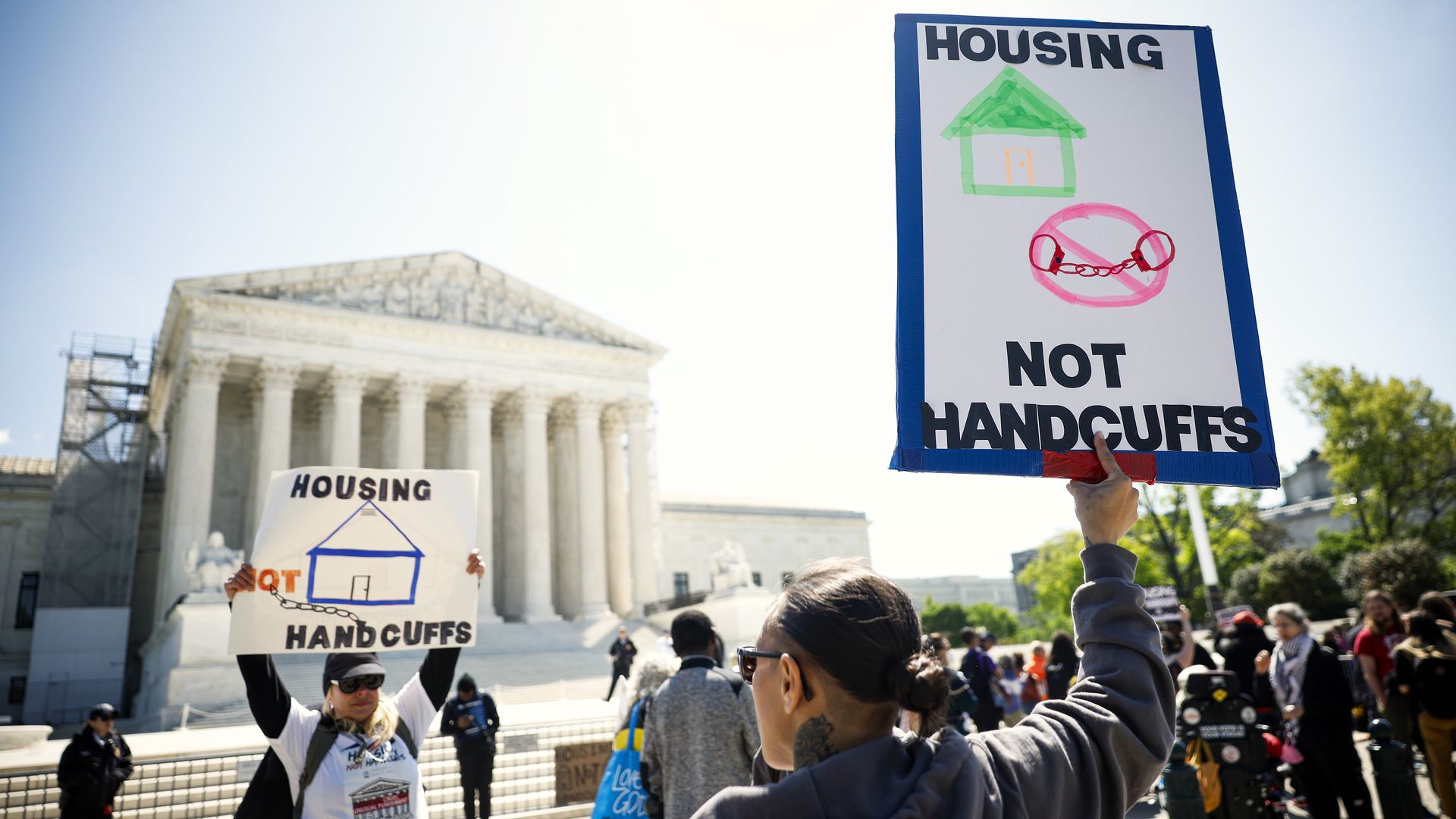
Housing advocates rally in front of the U.S. Supreme Court building. Photo: Kevin Dietsch/Getty Images
The Supreme Court heard arguments Monday over whether a small town in Oregon could enforce ordinances that criminalize behaviors associated with being unhoused — like sleeping or camping on public property or city parks if there's no available shelter.
Why it matters: The court's decision in Grants Pass v. Johnson is likely to have national implications, and could reshape the kinds of policies cities are allowed to use to address rising homelessness.
- At the center of the case is whether a person's "status" is punishable.
Flashback: In 2018, Oregon Law Center sued Grants Pass on behalf of its unhoused population on the basis that its policies of ticketing and jailing those who broke municipal code violated the Eighth Amendment.
- According to Grants Pass' city code, it is illegal to sleep in public parks, including sidewalks and parking lots, or to use sleeping materials to set up temporary living space.
- Those found guilty more than twice in one year face up to 30 days in jail and a $1,250 fine.
What they're saying: "Our view is that punishment, when people have nowhere to go, and driving people out of their hometown, is cruel and unusual," Ed Johnson, Oregon Law Center's director of litigation, told Axios before Monday's hearing.
- The only shelter in Grants Pass — a town of nearly 40,000 near the California border — is a religious missionary shelter that requires participants to be sober and "dress and behave according to their birth gender."
- There are also few available affordable housing options, "so making it a crime for them to live outside isn't going to change the fact that they're still homeless," Johnson said.
The other side: Attorneys representing Grants Pass argued Monday that previous injunctions issued by lower courts in the case limit how its government can respond to "legitimate public health and safety concerns" surrounding homeless encampments.
- In a brief submitted to the court, the city said its "modest" fines and "short" jail times do not constitute cruel or unusual punishment.
The intrigue: After two-plus hours of arguments, a few justices seemed to question whether it was appropriate for the court to weigh in on local government policy on such a complicated issue.
Friction point: In a brief exchange with Grants Pass lawyer Theane Evangelis, Justice Elena Kagan asked if the status of homelessness could be criminalized.
- Evangelis responded, "I don't think that homelessness is a status like drug addiction," to which Kagen replied, "It's the status of not having a home."
What's next: The court is expected to release its opinion by the end of June.
