3 reasons why everyone aboard Japan Airlines Flight 516 survived

Add Axios as your preferred source to
see more of our stories on Google.
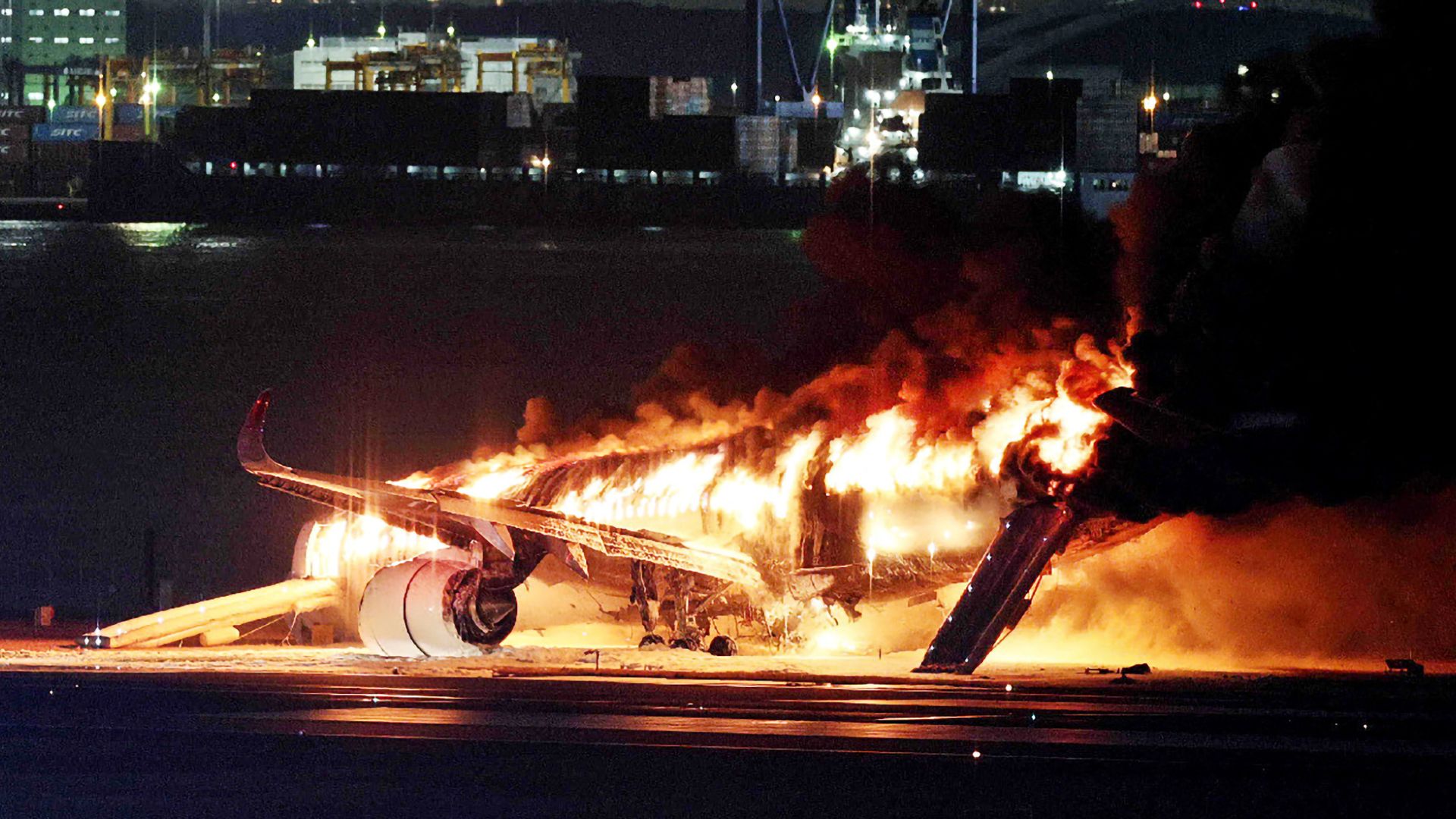
Japan Airlines Flight 516 ablaze at Tokyo's Haneda Airport on Jan. 2, 2024. Photo: STR/JIJI PRESS/AFP via Getty Images
That all 379 passengers and crew aboard Japan Airlines Flight 516 survived after the airliner collided with a Japan Coast Guard aircraft in Tokyo on Tuesday is a miracle — but an explicable one, with valuable lessons.
The big picture: As with all major aviation incidents, it will take time for investigators to piece together exactly what caused the crash, which killed five of six aboard the smaller Coast Guard craft.
- Investigators are focused on communications between the two aircraft involved and air traffic controllers.
- But even in these early hours, it's becoming clear that several things went right, at least after the collision, including...
A quick evacuation: It reportedly took under 20 minutes from touchdown to complete evacuation of the Japan Airlines Airbus A350.
- Faster is always better — U.S. rules require that airliners take no longer than 90 seconds to evacuate — but at least in this case, there was enough time to clear the plane.
- And that's despite several hiccups, including unusable rescue slides and a malfunctioning intercom system, as the Wall Street Journal reports.
Detailed safety briefing: Several aviation experts have lauded Japan Airlines' to-the-point preflight safety video, which shows passengers exactly what to do — and what not to do — in an emergency.
- That's in stark contrast to many such videos in the U.S., which include the required safety info but also increasingly go for laughs or promote an airline's destinations — and are routinely ignored by travelers regardless.
- Among the video's suggestions: Leave your baggage behind so it doesn't clog escape routes. (Flight 516 passengers complied, according to the Journal.)
High-tech components: The A350 is one of the first modern passenger airliners to be made extensively of cutting-edge, lightweight composite materials — which may better resist heat, buying time to clear a burning plane.
- If there's a silver lining here, it's that Flight 516 — the first A350 completely lost to fire — "could provide valuable insight into the flammability of large composite aircraft structures based on in-service experience that have so far been unavailable," Aviation Week reports.
- Translation: Aircraft makers and regulators will get valuable data to boost safety in future flights.
The bottom line: The biggest takeaways here for travelers: Pay attention to the safety briefing, and in an emergency, do your best to stay calm, listen to your flight attendants and don't try to save your stuff.
