The kindergarten vaccine exemption rate keeps ticking up


Add Axios as your preferred source to
see more of our stories on Google.
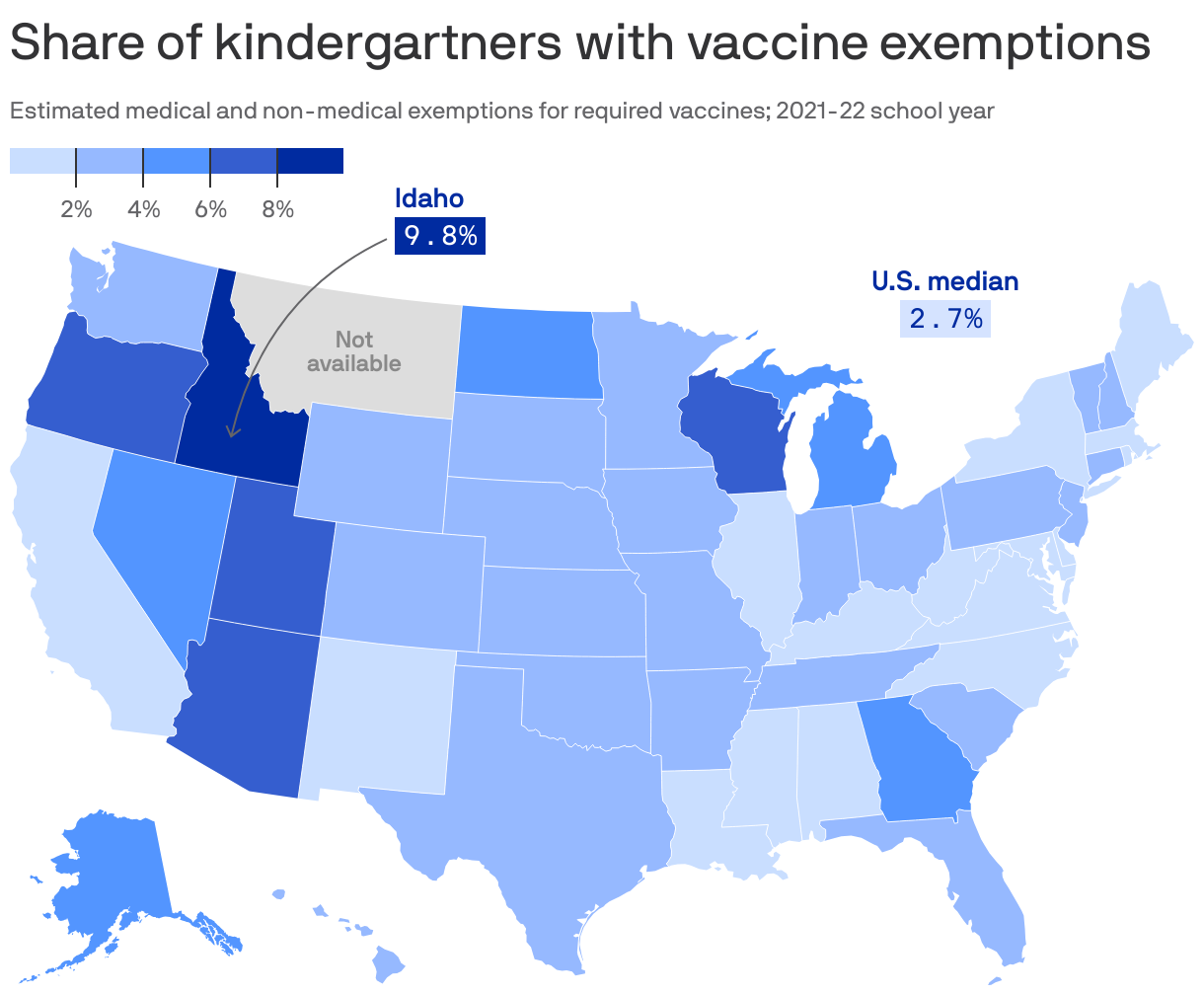
The nationwide median rate of kindergartners with vaccine exemptions nearly doubled between the school years ending in 2012 and 2022, per CDC estimates.
The big picture: While COVID-19 vaccination is not required for young children attending public school anywhere in the U.S., it appears that concerns over that shot may be fueling broader vaccine skepticism among a relatively small but growing number of parents — though that trend certainly existed before the pandemic.
Why it matters: Vaccinations reduce the spread of childhood illnesses — some potentially fatal — that once plagued the country, such as polio.
- While children are generally required to get a number of vaccinations before attending public school, exemptions can be given for both medical and non-medical reasons (such as religious or moral objections), depending on local rules.
- Studies have found an increased risk of infection from vaccine-preventable diseases among exempt children.
By the numbers: The nationwide median kindergarten vaccine exemption rate was rising even before the COVID-19 pandemic, increasing from 1.4% in 2012 to 2.6% in 2019.
- It has stayed at 2.5% or higher since 2020, coming in at 2.7% in 2022, the latest year for which data is available.
Zoom in: As of 2022, Idaho (9.8%), Utah (7.4%) and Oregon (7%) had the highest median kindergarten vaccination exemption rates.
- Mississippi, New York and West Virginia were tied for the lowest, at 0.1%.
Between the lines: Even as the kindergarten vaccine exemption rate ticks up, Americans as a whole are overwhelmingly supportive of childhood vaccinations, per a recent (and deeply enlightening) Pew Research Center survey.
- When it comes to the measles, mumps and rubella (MMR) shot, 88% of Americans said the benefits outweigh the risks, compared to 10% who feel the opposite.
- "The share expressing confidence in the value of MMR vaccines is identical to the share who said this in 2019, before the coronavirus outbreak," per Pew.
Yes, but: Just 70% of Americans now say healthy kids should be vaccinated as a requirement to attend public school, Pew found — down from 82% in the pre-pandemic era.
- There's a significant partisan split here, with 85% of Democrats agreeing with such a requirement compared to 57% of Republicans.
- While Democratic support for vaccine requirements held steady between pre- and post-pandemic years, Republican support took a remarkable nosedive, falling from 79% in 2019.
- Put another way, the overall decline in support for vaccination requirements is being driven almost entirely by Republicans.
The bottom line: We'd like to see further research before definitively saying that skepticism around the COVID shots is leading to higher childhood vaccination exemption rates — but it sure seems that way.
- As Pew put it: "Those who are not vaccinated for COVID-19 are among those most likely to express concern about childhood vaccines generally."
