SF Fed President Mary Daly on rate hikes, the economy and Silicon Valley Bank

Add Axios as your preferred source to
see more of our stories on Google.
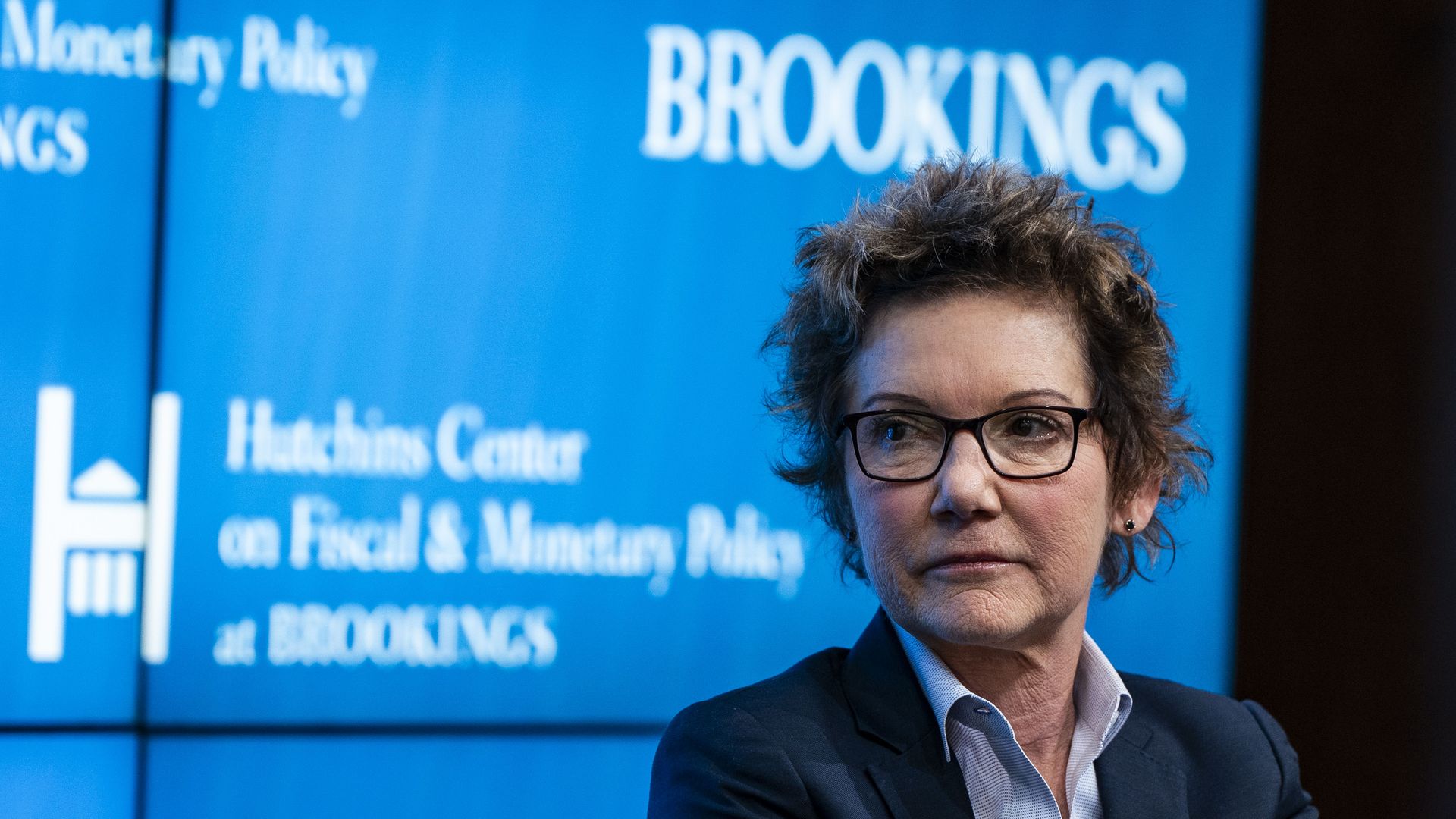
San Francisco Fed president Mary Daly. Photo: Haiyun Jiang/Bloomberg via Getty Images
Mary Daly, president of the Federal Reserve Bank of San Francisco, stopped by Axios' headquarters in Arlington, Virginia, on Monday to meet with several reporters and editors. Here are some key takeaways.
The last time Axios interviewed Daly was a year ago, when the Fed was entering an aggressive phase of interest rate hikes. We asked where things stand now.
- "We have definitely come a long, long way," she said. "We've raised over 500 basis points in a very short amount of time. And we're seeing the economy respond to that tightening."
- "The housing market started to cool immediately. We now see goods price inflation coming down. We see a softening in activity and in the labor market, we see a softening of job growth, etc. Now this has been a long time coming, but it is coming."
- "And as we've seen those signs, then we have slowed the pace of tightening going from 75 basis points to 50 to 25. … But the question is how much more is left."
At this point, "I think that there's two things going on simultaneously that determine what we'll do next. And it's why I was very much in favor [and] a strong advocate of standing pat at the last meeting and not saying specifically what we'll definitely do in coming meetings. I don't know if we'll stop and say that's done, or we'll keep going."
- "I personally think that the two rate hikes that were penciled in in June are a reasonable projection, but we have to be open to say that we don't need to do that much or that the economy evolves differently [and] we might need to do more."
On the signs of economic resilience: "We have all the incoming data, which while they have slowed, there's no doubt they're still at levels that if you took a basic Econ 101 class and we showed you these statistics, and you said, 'Can you do the chair of the Fed game?' you would absolutely say, 'We should raise interest rates.'"
- "So I think my own view is we're close to the end, but we definitely aren't necessarily finished and we have to be open-minded and data-dependent."
- "I don't think we need to act aggressively, like I talked with you last year about, and yet we do have to be prepared to act if the data continue to become stronger than that we've expected them to come in"
- "I've teased my teams that I'm gonna get new T-shirts printed that say 'thoughtful and resolute.' So we want to be thoughtful about how we do it as gently as possible but resolute that we want to bring inflation back down to 2%."
On the slowness at which inflation is coming down: "It's really part of why I am comfortable with the projection of two rate hikes or more going forward, because again, the direction [is] in the right way, but the progress is slow."
- "If you think of core services ex-housing, just take goods price inflation to its historical average, take shelter price inflation to its historical average, and ask how much was left, and we're way above 2%."
- "I'm really paying a ton of attention to core services, ex-housing, as well as watching for goods price inflation and shelter price inflation behaving as we anticipated. "
On housing and rent inflation: "Our own models in San Francisco still think that we'll have continual declines in shelter price inflation over the course of this year, but a vulnerability to that forecast is … home prices dropped and are coming back up again."
- "And people seem to have adjusted to interest rates. I think their parents taught them that, said '6% is nothing; it used to be 18%.'"
- "They're adjusting to the new normal. However you cut it, you have limited housing supply for the amount of people who want a home, and that imbalance is going to cause prices to remain high even if home price appreciation cools off."
On the manufacturing investment supercycle: "We have all these opportunities for new activity. That could be infrastructure investment dollars that the government is pouring in. It could be reshoring, it could be the efforts people or firms are making to be greener. All of these call for more investment in things like infrastructure and buildings and manufacturing."
- "That's a big boost to demand at a time we already have an imbalance between demand and supply. When I think of that, I think of more worker shortages in these areas."
- "Now that is going to be partially offset by the slowing that we know comes because as the Fed raises interest rates, it slows the economy. As it slows the economy, then people stopped demanding so much stuff."
- "The question in my mind is: Is there going to be an offset? We're going to substitute some of these investment projects for falling off of the demand that we see coming from the slower economy? But ultimately, I think there's going to be just a lot of signals of underlying strength."
On calls for different immigration policy to ease worker shortages: "Since 1996, when I started at the Fed, it's an issue that comes up regularly. I'm hearing much less about it right now. What I'm hearing right now is, 'We need child care so that we can get people who feel like they can't come because of child care into the workforce.'"
- "Even in the intermountain states — which tend to be more independent, 'everyone takes care of themselves' mentality — they're saying the lack of child care is a barrier to people coming back to work. That's kind of superseded that call for different immigration policy."
On lessons from pandemic-era inflation: "I think we fight the last war a lot. What I've learned as a monetary policy maker is it's not a bad thing to learn from history, but we really have to keep a very strong eye on the future."
- "We had our eyes mostly on the past and the present and we didn't really think as carefully as we should have about what's going to happen in the future."
On the San Francisco Fed's role in supervising firms like the failed Silicon Valley Bank: "The San Francisco Fed has a supervisory team. They reside in the San Francisco Fed and they report to the [Fed] Board of Governors for their supervisory activities."
- That team is "responsible for going into the firm and assessing it ... but they're not independently making decisions. They assess the firm and they go and work with their Board of Governors colleagues to determine how the firm will be judged."
On the Fed's Silicon Valley Bank report, led by vice chair for supervision Michael Barr: "I'm completely aligned with the report. It was thorough and unflinching."
On policy direction disagreements among Fed members: "As we near the destination of where we will stop raising rates and simply hold them, it just gets to be a more difficult decision."
- "We would have more disagreements about what is best to do next, because the decisions have gotten much, much harder."
Axios' Kate Marino, Javier David and Matt Phillips contributed reporting.
