Poor planning under Trump, Biden led to chaotic Afghanistan withdrawal, report says

Add Axios as your preferred source to
see more of our stories on Google.
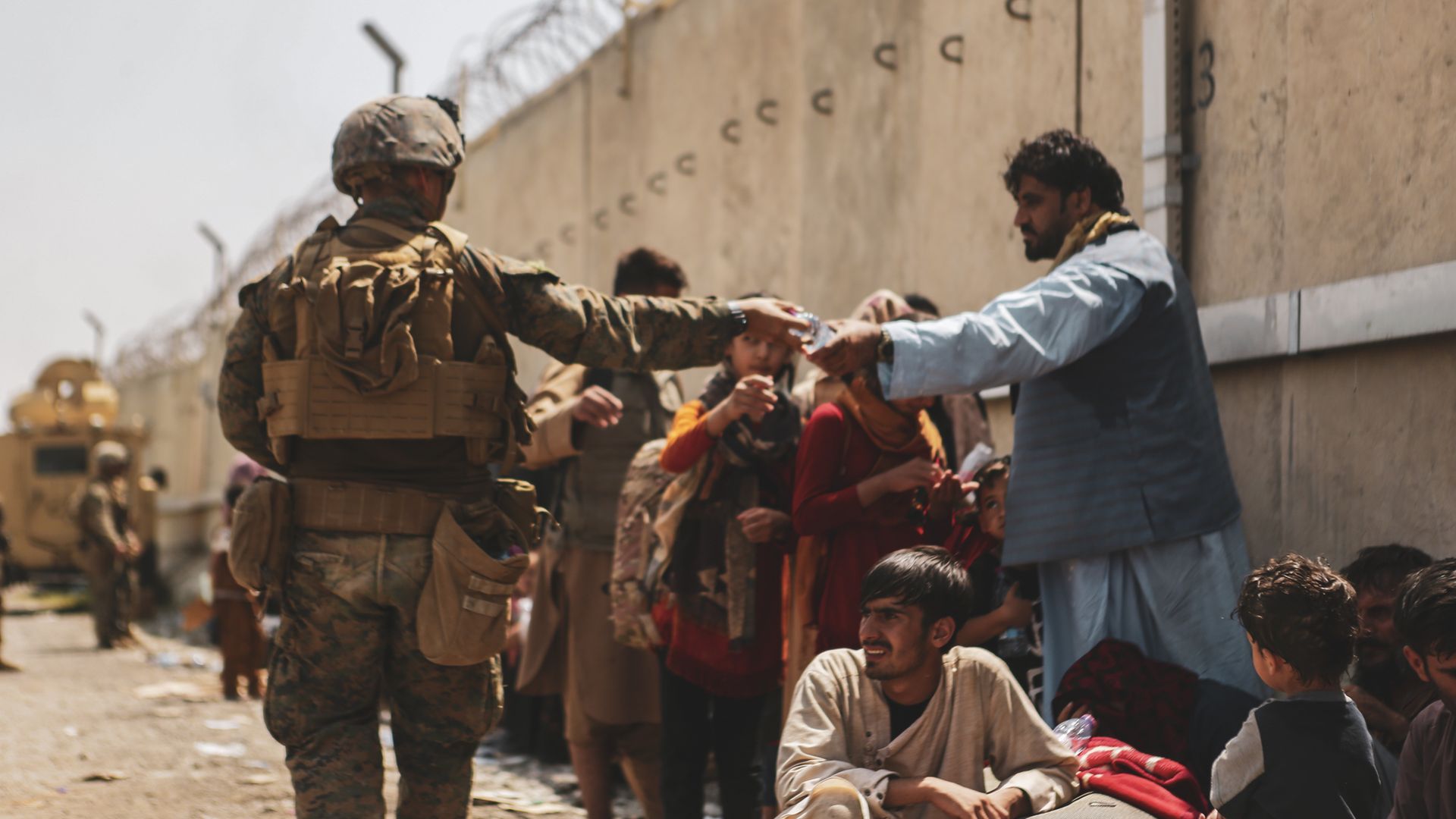
A U.S. Marine giving out water to evacuees at Hamid Karzai International Airport in Kabul, Afghanistan, in August 2021. Photo: Isaiah Campbell/U.S. Marine Corps via Getty Images
Poor planning among senior officials during both the Trump and Biden administrations contributed to the chaotic and deadly U.S. withdrawal from Afghanistan in the summer of 2021, according to a report released Friday.
Driving the news: The State Department's long awaited after action report found that under both presidents, "there was insufficient senior-level consideration of worst-case scenarios and how quickly those might follow."
- The State Department, which released the critical report on Friday afternoon before a holiday weekend, told CNN it would not answer "process" questions.
The big picture: The report said that once the Taliban took control of Kabul in mid-August — much earlier than anticipated — the State Department "confronted a task of unprecedented scale and complexity."
- "The scope and scale of this evacuation was highly unusual, with no comparable situation since the U.S. departure from Vietnam in 1975 following many years of intense military and political involvement," the report said.
- Though the U.S. evacuated roughly 125,000 people — including nearly 6,000 U.S. citizens — 13 U.S. troops and more than 150 Afghans died in a suicide bombing during the operation.
Zoom in: When Trump left office in early 2021, "key questions remained unanswered" about maintaining the embassy in Kabul and the fate of Afghan allies after the withdrawal, the report says.
- It was also unclear how the U.S. would meet the initial May 2021 deadline, the report says — despite the fact that the Trump administration had struck the withdrawal deal with the Taliban more than a year before.
- There was also "a significant backlog" in the process for Afghan special immigrant visas (SIV) for those who worked alongside U.S. forces during the war.
- "That administration made no senior-level or interagency effort to address the backlog or consider options for other at-risk Afghans despite its commitment to a military withdrawal," the report says.
When President Biden took office, he decided to proceed with the withdrawal with a new deadline: Sept. 11, 2021.
- Top administration officials "took steps to accelerate the SIV process," the report says.
- But the U.S. military's swift "retrograde" from the country compounded the difficulties the State Department had in "mitigating the loss of the military’s key enablers," the report found.
- It also criticized the Biden administration's decision to transfer Bagram Air Base to the Afghan government, as it left Hamid Karzai International Airport in Kabul as the only viable evacuation avenue.
Between the lines: The report lauded the State Department employees and members of the military — particularly those on the ground — tasked with getting thousands of people to safety in an increasingly dangerous place.
- "The stress, demands, and risks of the situation are hard to exaggerate and placed tremendous burdens on the Department’s personnel and its crisis response structures," the report said.
- "Overall, the Department’s personnel responded with great agility, determination, and dedication, while taking on roles and responsibilities both domestically and overseas that few had ever anticipated."
Yes, but: The report made a range of recommendations for the State Department as a whole, including better planning for "worst-case scenarios" and ensuring "that senior officials hear the broadest possible range of views including those that challenge operating assumptions or question the wisdom of key policy decisions."
Go deeper: U.S. admits Afghanistan evacuation should have begun sooner
Editor's note: This story has been updated with additional details from the report about the SIV process.
