Tech's stake in the U.S.-India relationship

Add Axios as your preferred source to
see more of our stories on Google.
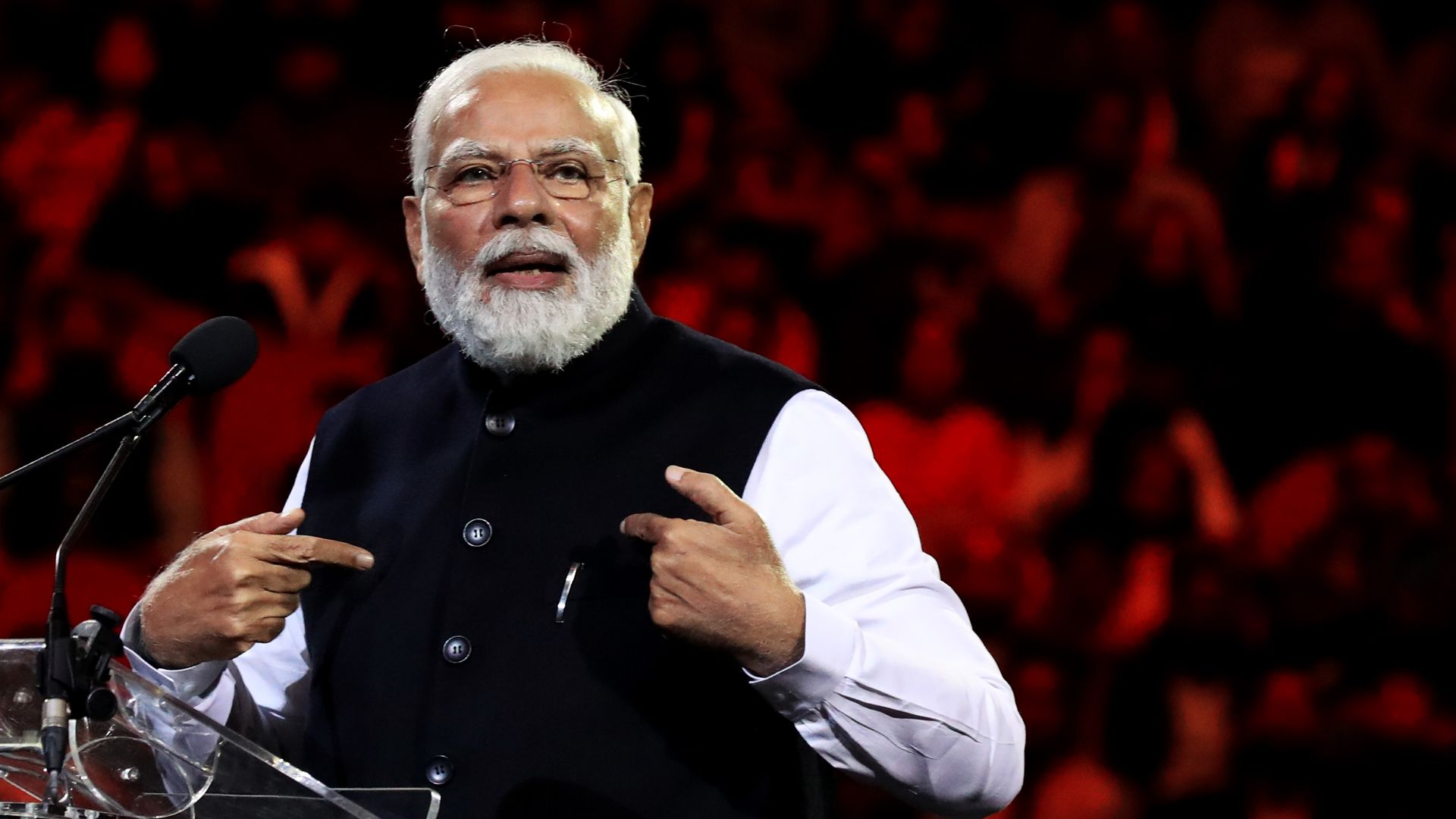
India's Prime Minister Narendra Modi speaks during an Indian cultural event. Photo: Lisa Maree Williams/Getty Images
China's shadow hangs over the first state visit of Indian Prime Minister Narendra Modi to the U.S., which begins Wednesday.
Why it matters: Modi's India is a global leader in both tech innovation and democratic backsliding, and American tensions with China have placed urgent new demands on the U.S.-India relationship.
- India is a huge supplier of tech talent, both to American companies operating in India and directly to the U.S. itself — a role that's grown as friction with China has made it harder for the U.S. to tap Chinese tech talent and industrial capacity.
Yes, but: Modi uses India’s democratic status and America’s need for Asian partners to contain China as a cover for what the State Department labels "significant" human rights abuses.
The big picture: Key elements of American AI are often made in India — usually at much lower wages that prevailing U.S. rates, as workers manually label data to improve AI foundation models.
- Established names such as IBM have in recent years employed around half their global workforce in India.
- Lesser-known companies such as Sama contract for clients ranging from Walmart to Microsoft to Google.
By the numbers: India is a hub for more than 1,500 multinational companies and around 60 CEOs at Fortune 500 companies have an Indian background, including the CEOs of Microsoft, Google, IBM and Adobe.
- The Indian public's trust in AI is the highest in the world, with 75% expressing strong trust. That support comes with experience of the world's largest biometric ID system and the government's mobile-based instant payment system, which processes 6 billion transactions a month.
Driving the news: Ahead of Modi's visit, Secretary of State Antony Blinken told Indian media, “We’re elevating and expanding the strategic technology partnership."
- The U.S. may sign off on joint production of GE military jets.
- Twitter co-founder Jack Dorsey said last week Modi’s government ordered him to restrict accounts critical of the government, or face shutdown. Modi's government labeled that a “lie.”
Between the lines: President Biden needs Modi as a hedge against China.
- Both the American and Indian governments would like deeper military tech ties. India wants technology transfers and joint production, while the U.S. doesn't fully trust India — which has refused to condemn Russia's Ukraine invasion.
- But Freedom House rates India as only "partially free," and Human Rights Watch says the government engages in arbitrary internet shutdowns, which deprive Indians of work and basic services.
- The Modi government has increasingly targeted members of minority Muslim communities, activists, and journalists with violence and legal action.
The intrigue: Modi all but endorsed then President Donald Trump in the 2020 election — even with Vice President Kamala Harris, the first Indian-American elected to serve in the White House, on the Democratic ticket.
What's next? India is looking to carve out its own path on AI under the banner of AI for All.
- India is a leading supplier of tech talent and solutions but punches below its weight in regulatory discussions, which pivot around competing U.S., European and Chinese approaches.
- India is using its G-20 presidency to push for broader access to AI tools, especially for small businesses in the global South.
Go deeper: Listen to the Axios Today podcast, where host Niala Boodhoo and Ryan Heath catch us up on the U.S.-India relationship.
