Clashes in Kosovo spark fears of renewed conflict with Serbia


Add Axios as your preferred source to
see more of our stories on Google.
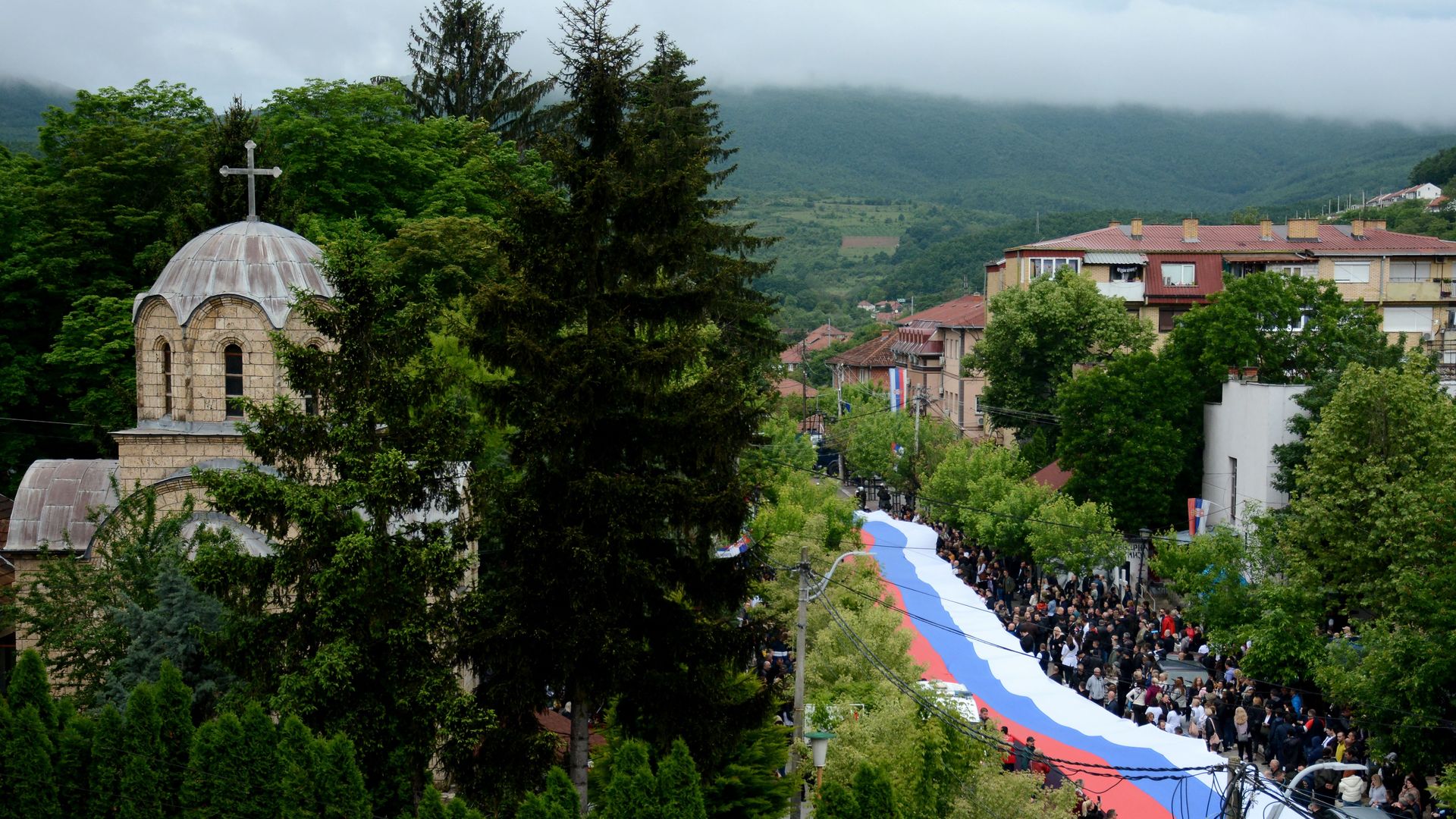
Ethnic Serbs carry a giant Serbian flag last week through the town of Zvecan, in northern Kosovo, where the worst clashes with NATO-led peacekeepers took place. Photo: AFP via Getty
Officials in Washington, Brussels, Paris and Berlin are urging the leaders of Serbia and Kosovo to dial down tensions after violent clashes last week in northern Kosovo.
Why it matters: The flurry of diplomacy was sparked by fears of a return to violence 25 years after the devastating war in Kosovo.
Driving the news: Ethnic Serbs attempted to forcefully block ethnic Albanian politicians, escorted by police, from entering municipal offices in heavily Serb-populated towns in northern Kosovo. At least 30 NATO peacekeepers were injured while attempting to quell the violence, along with dozens of protesters. NATO last week sent an additional 700 troops to the region.
- The Albanian mayors were elected in April, but voter turnout was just 3.5% because most Kosovo Serbs boycotted the vote.
- Serbian President Aleksandar Vučić, who supported that boycott, announced after the clashes that Serbia's army had been placed on the highest level of combat readiness.
- Kosovo Prime Minister Albin Kurti, meanwhile, blamed the violence on "orchestrated violent mobs" and accused Belgrade of working to "destabilize Kosovo."
The latest: U.S. deputy national security adviser Jon Finer spoke to both leaders over the weekend, urging Vučić to pull his troops back from the border and Kurti to withdraw police from the government buildings in the north.
What they're saying: Secretary of State Tony Blinken said Kurti's decision to install the mayors "unnecessarily escalated tensions."
- Washington also excluded Kosovo from planned military exercises and threatened to stop lobbying for Kosovo's international recognition.
- French President Emmanuel Macron and German Chancellor Olaf Scholz have called for fresh elections in the northern region.
- Kurti told NBC's "Meet the Press" that he was open to new elections but only after the "violent extremists" who participated in the clashes "face justice."
- Vučić continues to demand that Kosovo withdraw the mayors. Moscow, which has close relations with Serbia, accused Kosovo of bringing the conflict close to a "hot phase."
Breaking it down: Kosovo declared independence from Serbia in 2008 but Belgrade has never recognized Pristina's sovereignty and actively worked against it on the international stage.
- Kosovo is more than 90% ethnically Albanian. Still, many Serbs continue to view Kosovo as an integral part of Serbia's history and culture, and Vučić portrays himself as a defender of the Serbian minority in Kosovo.
- Serbian tennis star Novak Djokovic, whose father was born in Kosovo, made a high-profile intervention last week, writing, "Kosovo is the heart of Serbia" on a camera lens after a victory at the French Open, adding "stop the violence."
The big picture: Serbs in Kosovo are increasingly frustrated at being used as a "bargaining chip" for negotiations by both Belgrade and Pristina, says Ilva Tare, a nonresident senior fellow at the Atlantic Council.
- An EU-backed plan for normalization between Kosovo and Serbia earlier this year outlined the need for a degree of "self-management" for the Serb community in Kosovo.
- The plan included key conditions the community had outlined to ensure their rights are protected, Tare tells Axios. But it hasn't been implemented.
What to watch: Integrating the Serbian minority is key to Kosovo's normalization process with Serbia and its relations with the EU.
- Still, many ethnic Albanians see plans to give ethnic Serbs greater autonomy as "a capitulation to Serbia that will impede the functioning of Kosovo," according to a report from the Center for Strategic and International Studies.
- Russia also has "no interest in seeing the issue of Kosovo resolved," the report notes.
