You might be flying like a pelican in a few years

Add Axios as your preferred source to
see more of our stories on Google.
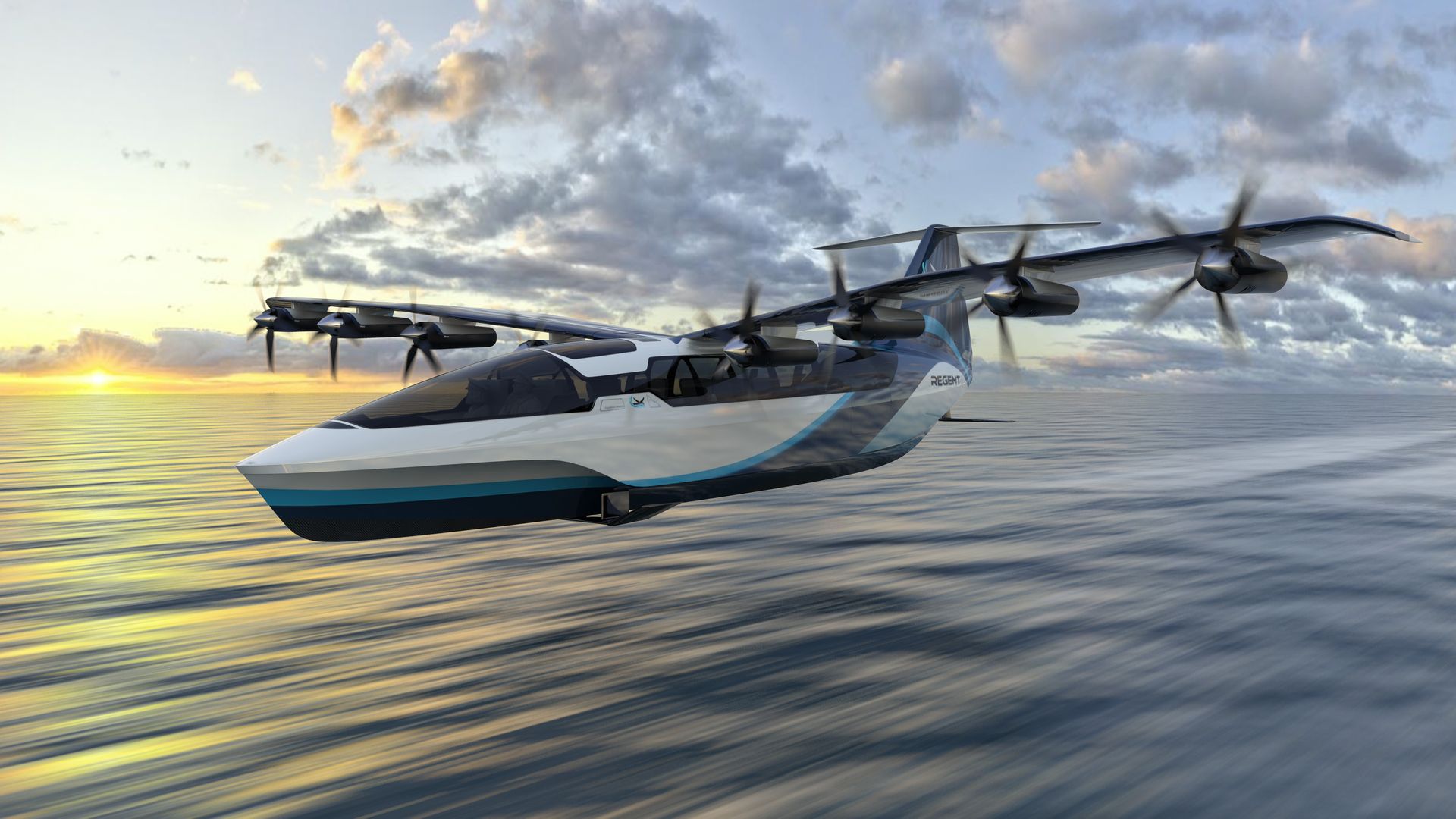
Regent's Viceroy concept would glide above the water, linking coastal communities. Image courtesy of Regent Craft
All-electric "seagliders" could someday offer fast, low-altitude flights in coastal communities like the Hawaiian Islands.
Why it matters: Electric aviation is the next frontier in the movement of people and goods.
- Better batteries, lighter-weight materials and other innovations — plus huge capital investments — are opening the door to novel and lower-emissions transportation solutions like flying taxis, drones and seagliders.
- "It's a space race all over again," Billy Thalheimer, CEO of seaglider startup Regent Craft, tells Axios.
Driving the news: Boston-based Regent is partnering with Hawaiian carrier Mokulele Airlines and investment firm Pacific Current to create a seaglider network in Hawaii.
- Service is expected to begin by 2025 with a fleet of 12-passenger Viceroy seagliders that will fly like pelicans, about 10 to 30 feet over the water, at speeds of up to 180 miles per hour.
- Hawaiian Airlines recently invested in Regent, with an eye toward building a 100-person version of the craft by 2028.
- The idea is to offer a cheaper, faster, cleaner alternative to existing ferries and regional air service.
How it works: The seagliders are designed to operate in what's called "ground effect."
- Put simply, an aircraft flying close to land (or water) experiences less drag and more lift. (Here's a good visual explainer.)
- Aircraft designers have experimented with "wing-in-ground" (WIG) effect vehicles for decades — the former Soviet Union's Ekranoplan and Boeing's Pelican concept were two examples — but the technology has been difficult to master in choppy seas.
- New technical innovations will allow vehicles to glide more smoothly across the waves and make the technology more feasible, Thalheimer tells Axios.
Details: Retractable hydrofoils, for example, lift Regent's aircraft out of the water to navigate the harbor on takeoff.
- Then a series of small propellers on the wings provides the lift for slow-speed takeoffs over a short distance.
- This so-called "blown wing technology" is also incorporated into the design of efficient new aircraft being developed by companies like Electra.aero.
- Even DARPA, the Pentagon’s premiere research agency, is working on a WIG seaplane design to potentially replace the giant C-17 Globemaster cargo plane.
Seagliders are neither fish nor fowl — while they fly at low altitudes, they're expected to be regulated by maritime authorities, which could mean an easier path to commercialization, says Thalheimer.
- Operating a seaglider will be more like driving a boat than piloting an aircraft, he says.
- And digital controls will manage stability, altitude and the transitions between modes in and above the water.
- Regent's 12-passenger Viceroy would have a range of about 180 miles, based on existing technology, he says. But as batteries improve, it's expected that future aircraft could go as far as 500 miles.
Yes, but: With $28 million in funding, Regent still has a long way to go. It won't enter full-scale prototyping until the end of 2023.
