Eastern European countries fall way behind on vaccinations

Add Axios as your preferred source to
see more of our stories on Google.
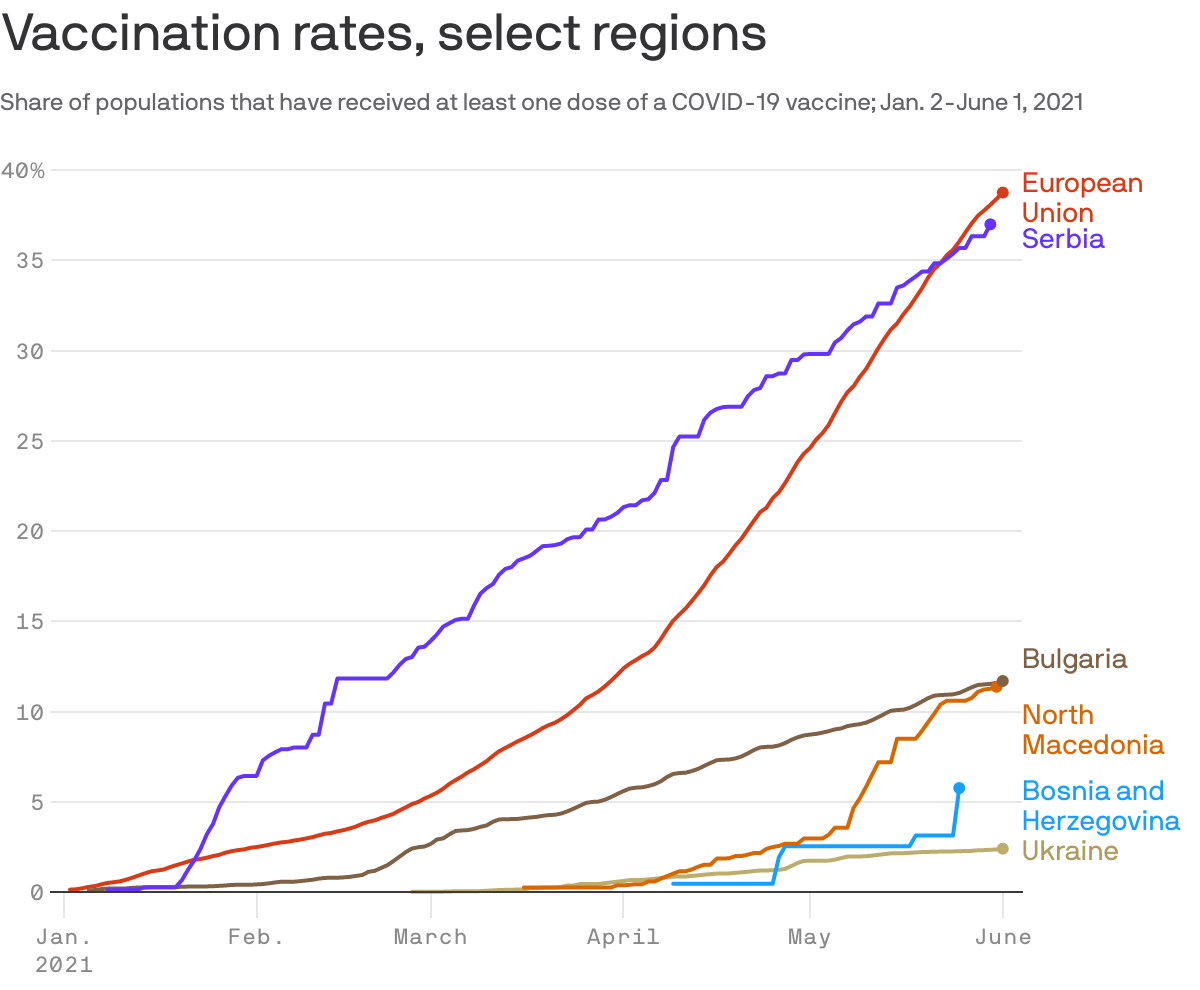
While most countries in the European Union have raced ahead after a slow initial vaccine rollout, countries in Eastern Europe are far behind, with little prospect of catching up quickly.
The state of play: While 39% of people across the EU have had at least one dose, just 12% have in Bulgaria, the lowest rate among the 27 member states. The situation is even more difficult for non-EU members that don’t have access to the bloc’s bulk vaccine purchases.
Bulgaria, the EU's poorest member, declined to order its full share of Pfizer/BioNTech jabs under the EU's procurement scheme, relying mainly on AstraZeneca shots that are cheaper and easier to store.
- But Bulgaria suspended the AstraZeneca rollout in March after the death of a women who received the vaccine, before resuming it with added restrictions.
- Vaccine hesitancy is also a major problem. Just 18% of Bulgarians wanted to be vaccinated right away as of February, according to a Eurobarometer poll, while 64% thought the vaccines had been approved too quickly to ensure their safety. Conspiracy theories about the vaccine have spread widely in the country.
The big picture: Bulgaria is actually far ahead of non-EU neighbors like North Macedonia, where just 4.5% of the population — primarily health workers and the elderly — have received a first shot, mostly from supplies shared by Serbia and Russia.
- The situation is similar in Bosnia and Herzegovina, which is relying on the WHO-backed COVAX initiative for its doses. They've been slow to arrive, and Bosnia and Herzegovina was one of the last countries to start its vaccination program.
Between the lines: Geopolitical factors have made a big difference for some countries in central and eastern Europe.
- Serbia was far ahead of even most EU countries on vaccinations for months, with supplies mainly coming from China and Russia, with which Serbia has friendly relations.
- Serbia even has sufficient supply to begin to share — President Aleksandar Vucic announced Thursday that residents of Bosnia and Herzegovina will be able to receive free vaccinations in Serbia as well.
- Ukraine, on the other hand, ruled out approval of the Sputnik V vaccine, seeing Russia's "vaccine diplomacy" as an unwelcome power play.
- Ukraine has been one of the hardest-hit European countries during the pandemic, but just 2.4% of the population has been vaccinated. President Biden announced on Thursday that Ukraine would be one of the countries to receive vaccine donations from the US.
What's next: The European Union has promised to ship over half a million COVID-19 shots to the Western Balkans by August, using for the first time a vaccine-sharing mechanism meant to help its poorer neighbors and counter Chinese and Russian influence.
