Retirement communities may be perfect for launching self-driving cars

Add Axios as your preferred source to
see more of our stories on Google.
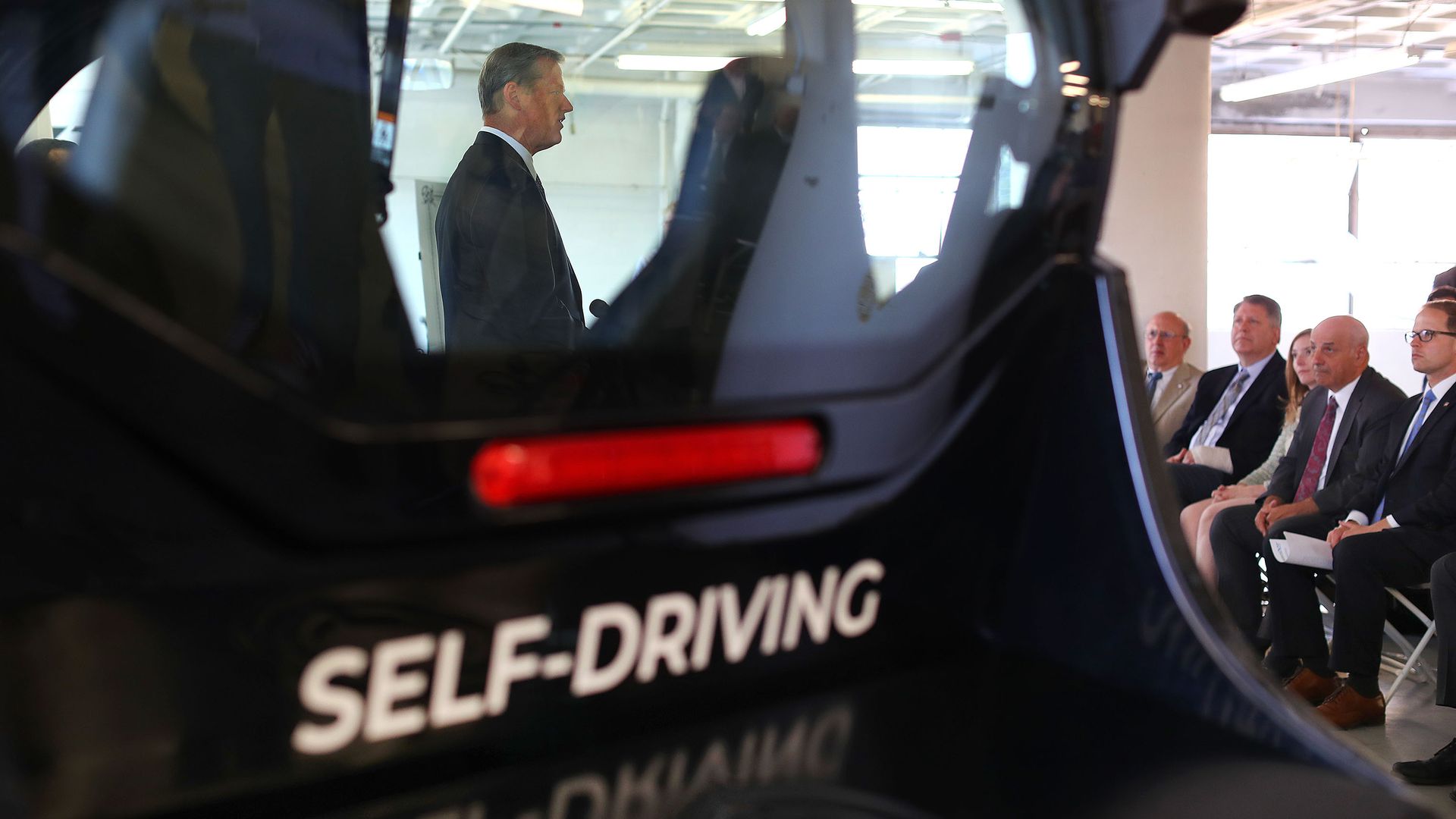
Self-driving car. Photo: John Tlumacki/The Boston Globe via Getty Images
Voyage, one of America's first automated taxi services, is now up-and-running in a Florida retirement community. This means trendsetting grandparents — not car-averse urban millennials — might be the early adopters of self-driving cars.
The big picture: Retirement communities may be the perfect place to launch driverless cars — slower, simpler roads are easier to master and there's an unmet need from people who can no longer drive but want to remain active in their communities.
Yes, but: Studies show that seniors are the most reticent to ride in self-driving cars, which means it will be important to earn their trust.
What's new: After a year of testing, Voyage on Feb. 1 launched its free on-demand AV taxi service in The Villages, a sprawling retirement community with 125,000 residents north of Orlando.
- For now, the robot-driven minivans, with a backup safety driver and a top speed of 25 mph, are limited to a few neighborhoods in the 33,000-acre community.
- An unspecified number of "pioneers" were selected as the first customers, but the company plans to add more users and more roadways in the future.
What's different: While other AV companies are aiming for the moon — General Motors, for example, is trying to launch a robotaxi service in downtown San Francisco — Voyage CEO Oliver Cameron favors deployment on calmer streets.
- As AV technology advances, the company can tackle tougher environments, he says. In the meantime, it's serving real people who need transportation.
Context:
- 8 million people age 65 and over don't drive, AARP says.
- Most people outlive their ability to drive safely by an average of 10 years.
- At least 3.6 million Americans miss medical appointments every year due to a lack of transportation, according to a 2017 study.
- Yes, but: 67% of people over the age of 50 aren't willing to ride in a self-driving car, AARP found.
But, but, but: Adults with a disability are more willing to ride in an AV than those without a disability (44% vs. 31%), AARP states.
- "There's a stereotype that older people are not interested in technology but when the tech enables them to accomplish something, they will use it," AARP's Nancy LeaMond tells Axios.
- Many seniors have embraced smartphones and Facebook because they can keep in touch with grandkids, for example.
What's needed: Education and training to keep seniors up to date on rapidly changing automotive technology.
- AARP offers programs in many places that teach seniors about the advanced safety tech in their cars and how to use ride-sharing services like Uber and Lyft. The free 90-minute workshop is also available online.
- SAE International, an engineering group, has a series of AV demonstration events, which started for seniors in Florida in December.
- One key takeaway: 61% said they would prefer to own a self-driving car versus 12% who said they'd prefer shared AV access, SAE tells Axios.
The bottom line: Seniors value their independence, especially when it comes to transportation, and may be the first to adopt AVs if companies can prove their worth and earn their trust.
