PBC is making Arizona's bioscience ecosystem easier to navigate

A message from: Phoenix Bioscience Core
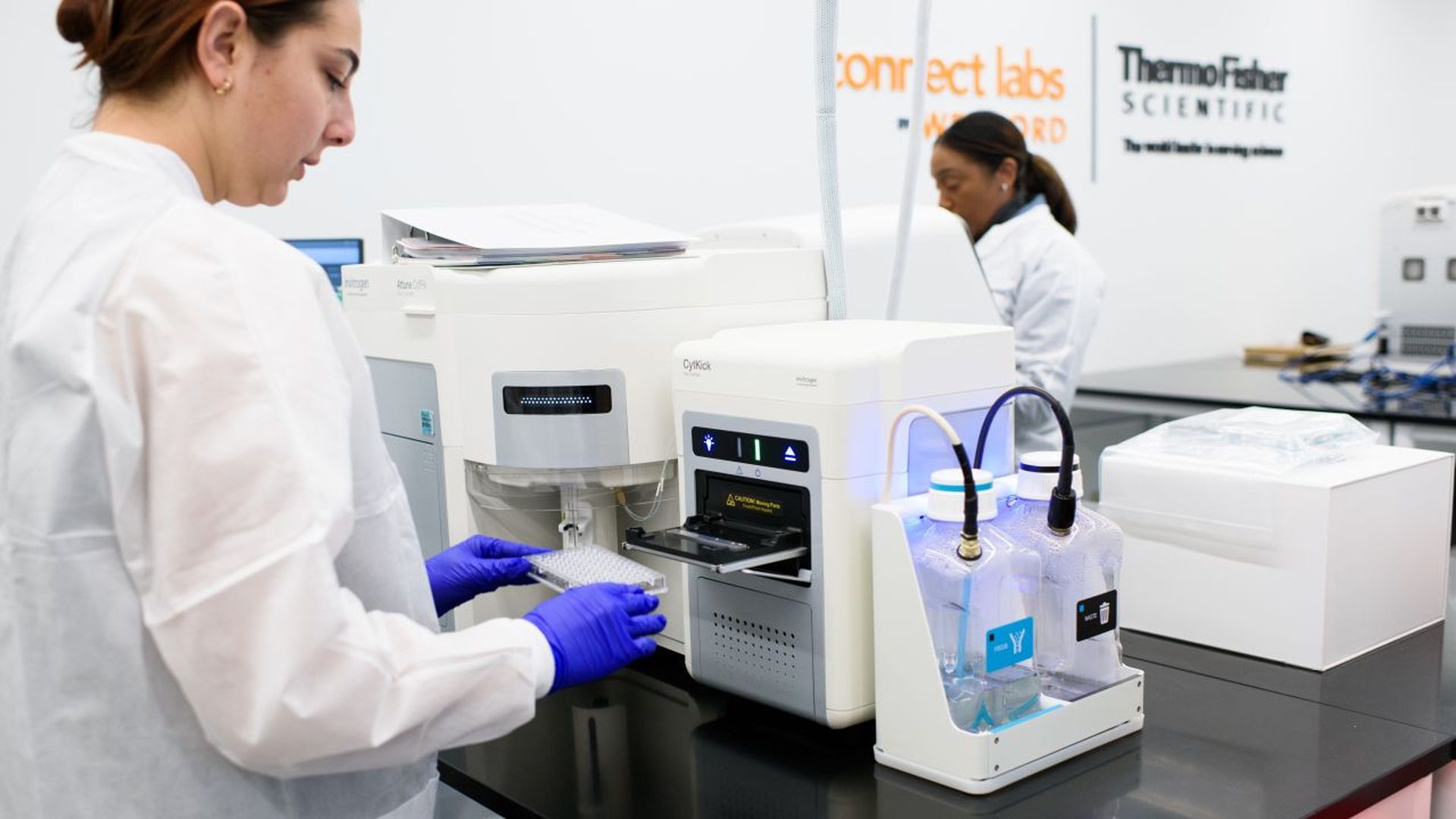
Health innovation increasingly depends on how quickly researchers, clinicians, engineers and industry partners can drive discoveries into the real world.
In downtown Phoenix, a bioscience district is making that process easier.
What you need to know: The Phoenix Bioscience Core, or PBC, is a 30-acre bio innovation district in downtown Phoenix designed to concentrate the people and infrastructure that life sciences companies need to grow.
- Its anchor institutions include Arizona State University, Northern Arizona University, the University of Arizona, Abbott Cancer Diagnostics, and the Translational Genomics Research Institute (TGen), a part of City of Hope, as well as startups, industry and major health system collaborators.
The challenge: Promising discoveries often stall when academic research, clinical insights, technical talent, lab space, startup support and capital are disconnected.
PBC's goal is to reduce that distance — physically and intellectually — by concentrating Arizona's bioscience in one connected district.
Why now: Arizona's broader innovation economy is expanding across healthcare, AI, semiconductors, advanced manufacturing and biotechnology.
- That mix can support advances in drug development, diagnostics, medical devices, precision medicine and imaging — while giving bioscience companies access to a broader network of technical talent and partners.
The idea: PBC gives the city's bioscience momentum a physical center.
Innovation districts work best when they make collaboration easier — bringing founders, researchers, clinicians, investors and industry partners into closer proximity.
- In practice, that means a founder can be near university researchers, labs and commercialization programs.
- Or a researcher can work closer to entrepreneurs who understand product development and investors who understand market demand.
Some examples: ASU Health's new headquarters is underway at PBC and will house the John Shufeldt School of Medicine and Medical Engineering, along with the School of Technology for Public Health.
- The medical education model is designed around the intersection of medicine, engineering, technology and public health.
Wexford Science & Technology's 800 PBC adds a different kind of proof point: space for companies that need purpose-built labs and innovation infrastructure.
- For life sciences startups, access to specialized lab space can determine whether a company can stay in a market, scale a team or move from early research into more advanced development and commercialization.
What this means: Phoenix is building the bioscience scaffolding needed to move more promising ideas from early discovery toward real-world impact.
- For startups, the district offers proximity to research institutions, mentors, accelerators and flexible lab infrastructure.
- For academic and clinical researchers, it creates more opportunities to work with entrepreneurs and industry partners who can accelerate discoveries beyond the lab.
- For investors and corporate partners, it offers a clearer view into Arizona's bioscience pipeline and the surrounding technology sectors that will shape the next generation of health innovation.
Looking ahead: At BIO International, PBC is inviting founders, investors, researchers and industry leaders to see how the ecosystem is taking shape in downtown Phoenix.
- Join to see how PBC's mix of research, industry and technology partners can help turn promising discoveries into scalable health solutions.