A game-changing approach to tackle farming's toughest challenges

A message from: Bayer
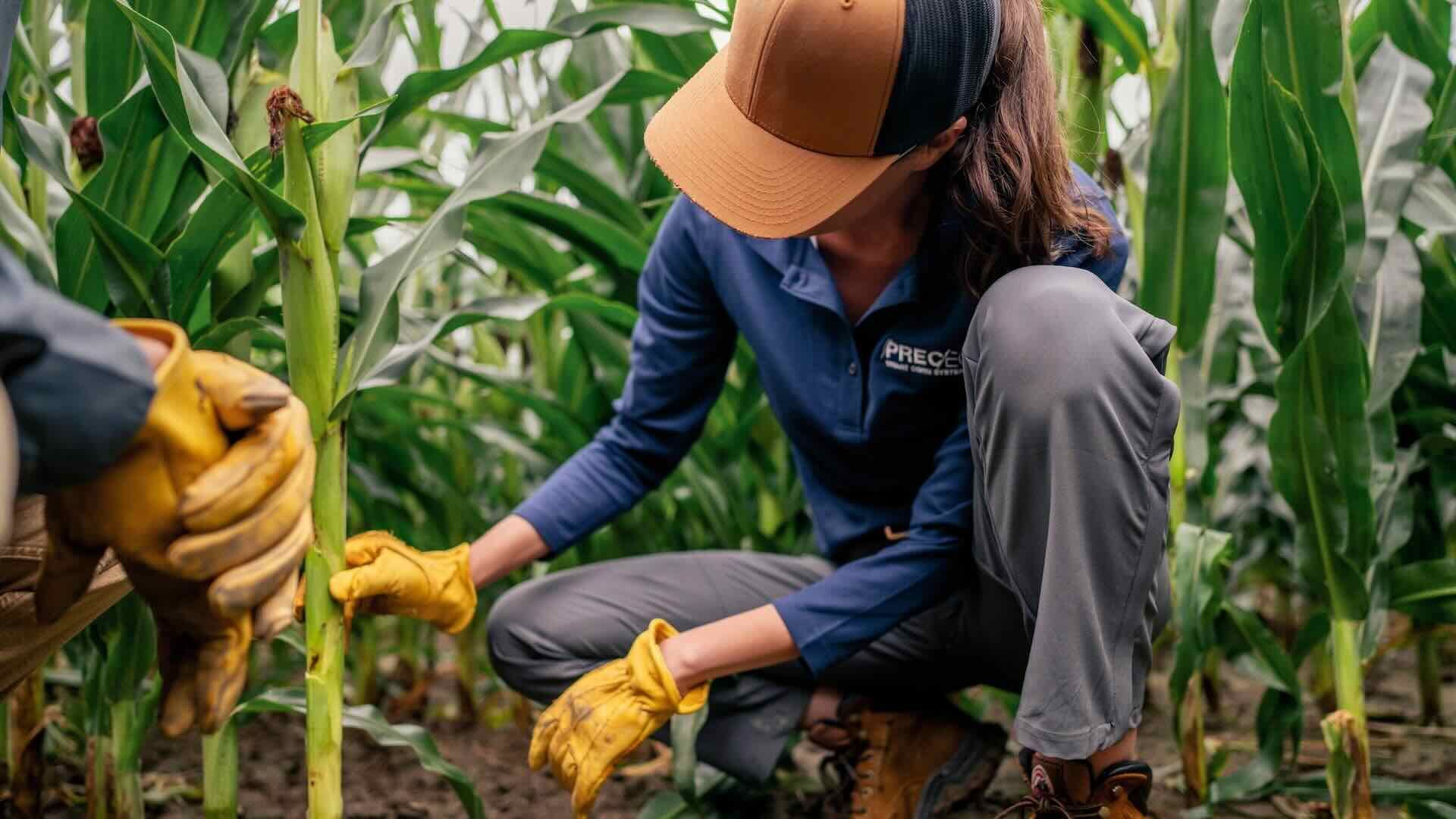
Corn farmers face many challenges, including pressure from weeds, insects, diseases and increasingly unpredictable and severe weather conditions.
Brianna White, head of Trait Design and Sciences for Bayer's Crop Science division, shares how the company is helping these growers through a broad portfolio of agricultural innovations.
1. First things first: How does Bayer's mission guide innovation in agriculture?
White: At Bayer, we live by the mission Health for all, Hunger for none, centering on consumers, patients, and farmers in everything we do.
In agriculture, our innovation is rooted in understanding farmers' needs and the countless ways that pests, weeds and weather can impact their operations and bottom lines.
● Agriculture is an industry that has continually innovated through the years, from hand tending fields and pulling horse drawn plows to the introduction of tractors and combines and innovative technologies like biotech crops.
● In each instance, these innovations helped farmers produce more food on their land while requiring fewer human resources to do it.
● While each introduced revolutionary change, they were also once-in-a-decade (or more) innovations.
Bayer's industry-leading R&D pipeline is powering new technologies to help farmers manage some of their greatest challenges today and ones they will face in the future.
2. The biggest update: What solution is Bayer working on to support corn farmers?
White: Corn plays a major role in our lives. It's the second most widely-grown crop in the world, and the most commonly planted crop in the United States.
We recently introduced our Preceon™ Smart Corn System as another step change for corn growers with a system that harnesses the benefits of short stature corn products that grow to five to seven feet tall instead of the nine to 12 feet of traditional corn products.
Since the plant – and more importantly the corn ear – grows closer to the ground, it fares much better in high winds and the potential to be uprooted or break (what agronomists refer to as lodging and greensnap) is greatly diminished.
This is important because these wind events are becoming increasingly frequent and more severe for U.S. farmers as they battle these weather events and extreme winds brought about by climate change.
Additionally, when corn is uprooted or snapped, the crop becomes extremely difficult and sometimes impossible to harvest. This means that all the time, energy and resources (seed, water, fertilizer, crop protection tools, etc.) go to waste.
Another benefit of the Preceon Smart Corn System is that farmers can explore higher seeding rates with less risk of lodging providing the potential to produce more on every acre.
Shorter plants make the corn fields more accessible with standard ground equipment, which many farmers have access to into the season giving farmers a chance to better scout and protect their crops more precisely and cost effectively — deploying only the crop protection tools that are needed.
Beyond the short corn products, we also provide data-driven insights through our Climate FieldView™ platform and recommendations to optimize performance along with personalized service from Bayer representatives to help growers maximize their yield and ROI potential of their crop.
In short (pun intended), the system offers holistic support and integrated solutions to help every farmer enable the best outcomes for his/her field.
3. The background: How does Bayer approach the development of new seeds and traits like this?
White: It really started with American agronomist Dr. Norman Borlaug, often called "the father of the Green Revolution" and credited with saving over a billion people worldwide from starvation through better breeding techniques.
Now, we're advancing that work with greater precision than ever.
Corn has 12,000 more genes than humans do, and those genes are crammed into 10 chromosomes, while humans, of course, have 23.
● So, the complexity of what we're doing is super challenging.
With the traits-first approach, instead of blindly shooting in the dark, changing some genes and growing the corn to see the outcome, we built on Borlaug's work and found a similar pathway in corn and used that to produce the short-stature corn in the Preceon system.
● This can be done through breeding as Borlaug did, but there can be variability in that approach.
● On the other hand, with biotech traits, results are consistent. Our biotech version of Preceon is expected on the U.S. market as early as late this decade.
4. The impact: What other innovations are on the horizon for farmers?
White: Our Preceon Smart Corn System innovation is just the tip of the iceberg.
● We have countless innovative products already on the market and in use on farms globally, and we aim to deliver 10 blockbusters in the next ten years.
Bayer is a global leader in scaling regenerative agriculture, innovating on seeds, traits, crop protection and digital solutions to help farmers grow more on less land and with fewer resources.
On a personal level, I always think about Dr. Borlaug's famous words, "everything else can wait. Agriculture can't."
I'm passionately invested in developing impactful innovations that deliver on our promise to ensure growers have the best tools in their toolbox.