Axios Future of Energy

June 15, 2026

🗞️ A lot has happened since our last edition! We're opening with a wide-angle look at the future of power, then diving into...
- Oil markets' response to the U.S.-Iran agreement
- The analyst hive-minds' takes on the apparent deal
- Corporate views on energy security, the latest energy deals, and more, all in 1,185 words, 4.5 minutes.
🙏 Thanks to David Nather and Chris Speckhard for editing and to our brilliant Axios visuals team.
🎸 Happy birthday to guitar great Elliott Randall, whose playing animates today's intro tune...
1 big thing: The power decisions that could shape the next century
The AI-driven power boom is forcing a once-in-a-generation decision about how America's electricity system should grow.
The big picture: For decades, utilities planned around predictable increases in demand. AI is changing that.
State of play: Data centers now seek amounts of electricity that used to be associated with entire cities — raising questions about who pays for new infrastructure, who gets access to scarce power and how quickly projects can connect to the grid.
Driving the news: Debates are unfolding at the nation's largest grid operator, PJM, and at the Federal Energy Regulatory Commission.
- Some proposals would allow data centers to connect directly to power plants or generate their own power on site, at least initially operating outside the broader electricity grid.
Zoom out: Those debates reflect a broader question facing regulators across the country: how to handle massive new electricity users.
What we're watching: Multiple decisions will unfold over months and years, with a key decision by the federal agency expected as soon as this month.
- The outcomes will influence electricity prices, reliability and the pace of AI development.
The bottom line: Decisions now being made by regulators, utilities and technology companies could determine whether the AI boom accelerates a historic expansion of the electric grid — or creates a parallel power system alongside it.
This story is part of an Axios Deep Dive on the policy debates shaping America's future. Read more in the series:
America's killer app: The dollar as the world's currency
AI oversight gap could leave a lasting legacy
The fight over America's vaccine future
2. 🛢️ Oil slides on U.S.-Iran agreement...


Crude oil prices are at their lowest levels in over three months following yesterday's announcement of an extended U.S.-Iran ceasefire — one that includes pledges to re-open the Strait of Hormuz.
- The memorandum of understanding would mark the biggest diplomatic breakthrough of the war and buy time to settle the hardest questions over Iran's nuclear program.
The latest: The global benchmark Brent crude is down over 4% to $83.08 per barrel after last night's developments.
- WTI, the U.S. reference, is down over 5% to $80.44 per barrel.

3. 😬 ...but "sentiment is not the same as supply"
Despite the deal slated to be signed Friday, there's a long and uncertain journey ahead toward resumption of anything resembling pre-war oil movements.
The big picture: "[S]entiment is not the same as supply," even as prices slide, Claudio Galimberti of the firm Rystad Energy said in a note today.
- "It will take time for production to ramp back up, for logistics to normalize, and for the risk premium embedded in crude prices to dissipate," said Galimberti, the research and consulting firm's chief economist.
Threat level: One immediate question is whether plans for the Friday agreement that opens the Strait of Hormuz get derailed along the way.
- Vandana Hari, founder of energy market analysis firm Vanda Insights, points out via X that "four days is a long time in Middle East diplomacy."
- "The gap between announcement and signing leaves room for competing narratives, last-minute disagreements and renewed volatility," she writes.
What we're watching: A big basket of variables will sway what's next for oil flows and prices.
- Bloomberg queried shipowners and traders, with "many saying they would need more details in order to assess whether safe transits are possible after months of false starts."
- "Key questions remain over mine clearance, transit protocols, insurance risk and Iran's role in managing the waterway," Hari notes.
And once oil is flowing, analysts will watch how it's used after the unprecedented shock that exposed many countries' vulnerabilities.
- "Inventories and strategic stockpiles will need to be rebuilt after recent disruptions, which should keep prices supported even as flows gradually resume," ING analysts said in a note.
The bottom line: "[I]t could take months (or years) to fully restore shut-in oil production and replenish global petroleum stocks," the research firm ClearView Energy Partners said in a client note.
4. 💼 Top execs say instability makes case for electrifying


A huge share of senior corporate execs say geopolitical instability helps make the case for electrification as a way to boost energy security, according to a survey by the U.K.-based polling and strategy firm Public First.
Why it matters: The sentiment is a fresh sign the Iran crisis could boost efforts in some countries to ease reliance on oil and gas imports by expanding domestic power sources.
- The survey, commissioned by climate and clean energy groups, was conducted well into the conflict.
Driving the news: Seventy-nine percent of corporate leaders say geopolitical instability has made electrification more urgent.
- Sixty-one percent expect this instability to increase energy costs, while 88% expect electrification will make their business more competitive.
Threat level: The survey finds a gap between "business ambition and the speed of infrastructure and policy delivery," with 72% of respondents saying government policy is moving too slowly on electrification.
Zoom out: Using more electric cars, replacing natural gas-fired power, and replacing oil- and gas-fired industrial boilers with electric tech are all ways to help electrify economies.
Catch up quick: The survey was commissioned by the climate think tank E3G; the We Mean Business Coalition that looks to marshal business climate advocacy; and the Global Renewables Alliance, a coalition of clean energy trade groups.
What we're watching: Keep an eye on whether the sentiment puts pressure on governments, especially in countries heavily reliant on oil and gas imports, to ease reliance.
5. 🤝 Energy and climate finance news you might have missed

🏷️ Via Bloomberg, "Shell Plc is preparing to launch a sale of its offshore wind farms in the oil major's latest move away from renewable energy to focus on its higher-returning fossil fuel business."
📈 The average early-stage round in low-carbon energy has swelled to its largest size since the end of 2022, per Sightline Climate data shared with Axios Pro.
- Why it matters: Soaring electricity demand is inflating even the earliest stages of investment. Go deeper
☀️ The Standard Electron Co., a stealth startup aiming to supply industrial plants with on-site solar and batteries, is raising $25 million to $35 million in seed funding, Axios Pro has learned. Go deeper
✈️ Sustainable fuels maker Airco is trying to raise $40 million via convertible notes at a valuation of up to $800 million, Axios Pro has learned. That would more than double the valuation it secured in 2024. Go deeper
Want a steady diet of scoops and smart analysis? Talk to our sales team about Axios Pro Deals.
6. 🧮 Number of the day: 3.65 gigawatts
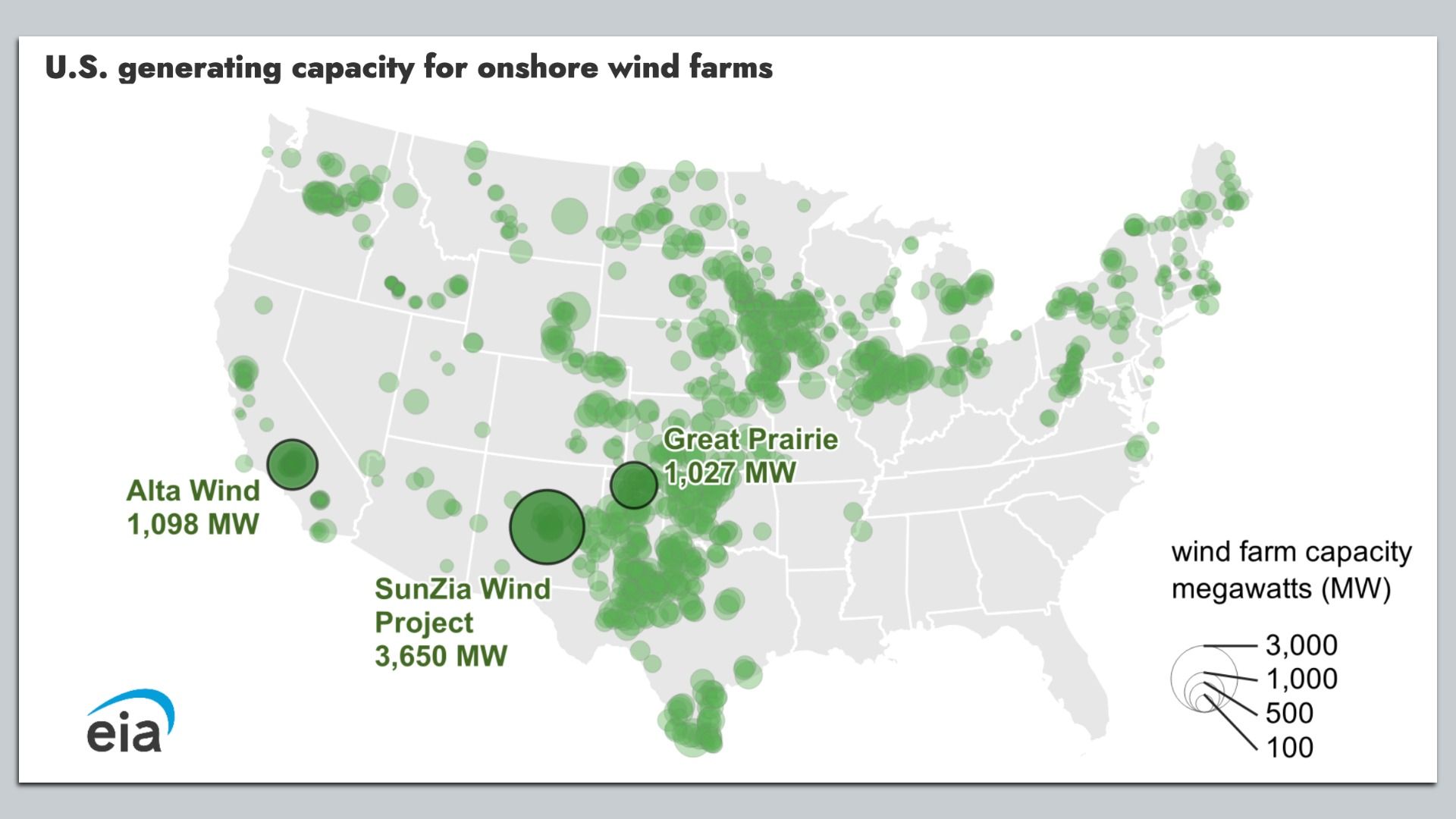
That's the capacity of Pattern Energy's SunZia Wind Project that's now operating in New Mexico.
- The 916-turbine project is by far the country's biggest wind facility, with much of the power sent to Arizona and California. Go deeper
📫 Did a friend send you this newsletter? Welcome, please sign up.
Sign up for Axios Future of Energy