Steve Bannon privately unloaded on Breitbart reporter - Axios
Featured

Steve Bannon privately unloaded on Breitbart reporter

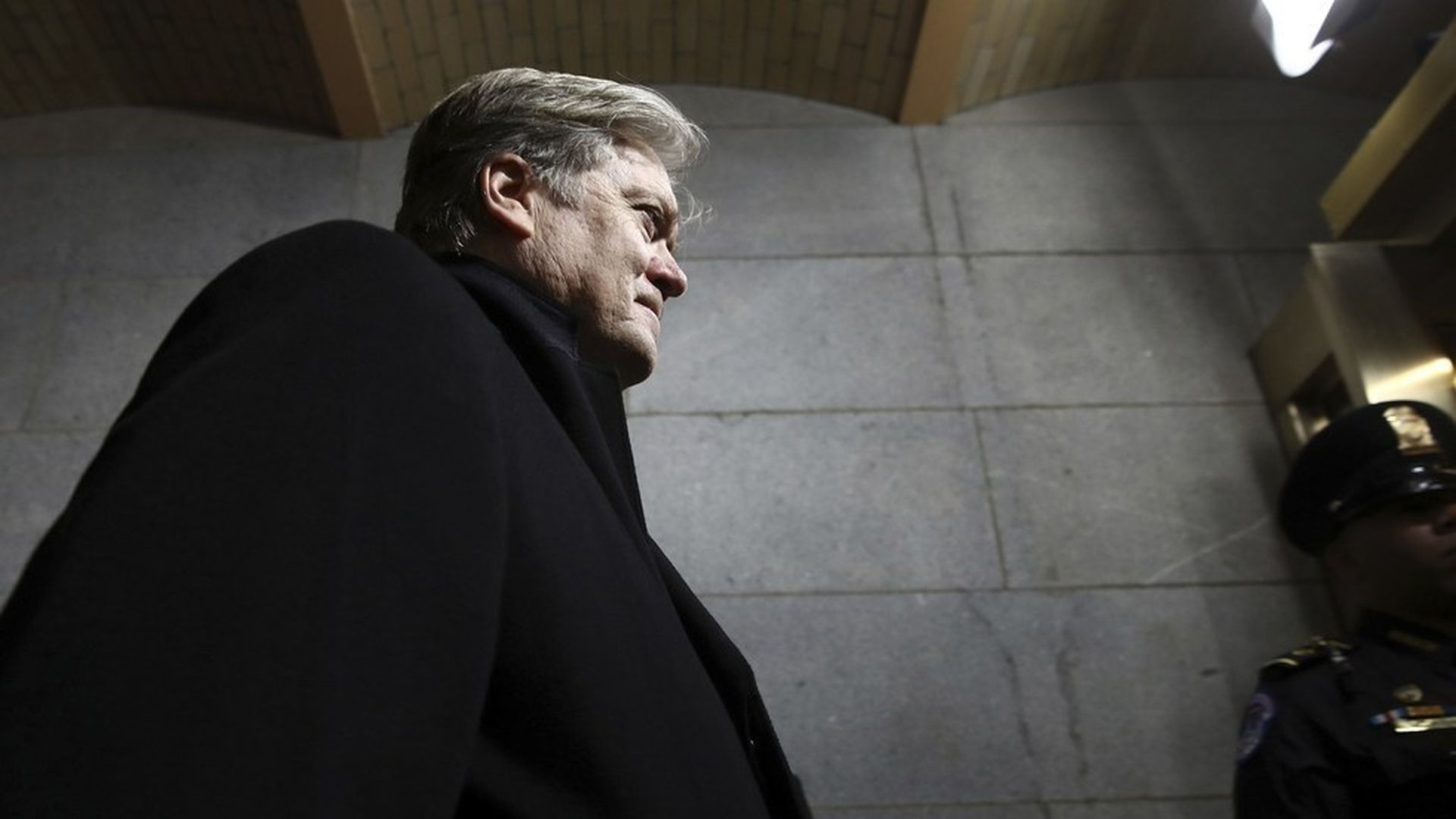
Win McNamee /Pool Photo / AP

Shortly after Breitbart's Matt Boyle published an extensive attack on White House chief of staff Reince Priebus, Boyle's former boss Steve Bannon exploded.

Far from Bannon orchestrating the leaks — as some have speculated — Trump's chief strategist was furious. And he let Boyle know about his displeasure with the story being published. Bannon got Boyle on the phone and gave the Washington editor "both barrels," according to a source familiar with the conversation.

Boyle's piece created nothing but trouble for Bannon. The chief strategist is trying to change the media narrative that he and Priebus are at war. All Boyle's piece did was stoke further speculation about anonymous sources behind this paragraph:

"Specifically, multiple sources close to President Trump with internal knowledge of White House operations told Breitbart News on Monday night that the buck stops with Priebus when it comes to the botched rollout of the executive order temporarily banning most travel to the United States from seven nations with a history of exporting terrorism and temporarily halting the refugee program. This news comes of course in the wake of the news that Flynn was pushed out, but also as more and more reports of a likely shake-up at the top loom.

What you need to know about Breitbart's attack on Priebus:

  • Boyle is reflecting a growing anger on the nationalist right at Priebus. But it's not just limited to the nationalist right. Priebus has made other enemies within the circles close to Trump.
  • The President is getting plenty of advice — both solicited and unsolicited — to drop Priebus.
  • Bannon is acutely aware that Breitbart is still viewed as his proxy. The idea that he'd arrange a hit piece against Priebus through his old publication doesn't pass the laugh test.
  • It's also telling that Bannon went on the record to The Atlantic's Rosie Gray telling her that Boyle's story was "absurd."

There are a lot of people on the nationalist right out to get Priebus, as Gray smartly narrates in her piece. They include Trump's old stomping partner Roger Stone, who tweeted this morning an image of Priebus with the caption "LEAKER." It's also true that Trump himself has sounded people out about the performance of his chief.

Boyle did not respond to a request for comment.

Featured

Waymo wants to ask its former self-driving car employee 461 questions

AP

On Friday, Waymo filed a list of 461 questions it intends to ask Anthony Levandowski — a former employee it's accusing of downloading 14,000 proprietary files and bringing those trade secrets to Uber — during trial this fall.

Note: Waymo, Alphabet's self-driving car unit, notes in the document that this is a preliminary list as it's still waiting to receive additional documents from Uber to review. It also expects Levandowski to plead the Fifth in response to many of these questions.

Waymo Uber Docket 835 (Waymo Q's to Levandowski)
Document
Pages
Text
Zoom

p. 1
Loading Loading
p. 2
Loading Loading
p. 3
Loading Loading
Waymo Uber Docket 835 (Waymo Q's to Levandowski)
Contents
Contributed by: Kia Kokalitcheva, Axios
To print the document, click the "Original Document" link to open the original PDF. At this time it is not possible to print the document with annotations.

Featured

Google, Facebook to join protest supporting net neutrality rules

Nam Y. Huh / AP

Google and Facebook are set to join a "day of action" next week opposing the proposed rollback of Obama-era net neutrality rules. Their planned activities remain unknown. The list of companies participating in the action includes Netflix and Amazon.

Why it matters: Tech companies were a major force pushing for these rules, which were approved in 2015. This is a sign that the two biggest players on the internet are willing to put their weight behind keeping them in place — at least to some extent.

Featured

FUSION relaunching as "Splinter"

Fusion Media Group

Fusion Media Group announced Friday that their digital publication FUSION will relaunch as "Splinter" (splinternews.com) on Monday, July 24. The new site will feature original reporting, including pieces from a newly launched political team, as well as content from other Gizmodo Media Group-owned sites, like Jezebel, The Root, Gizmodo and Deadspin. Fusion.net is moving to serve as the digital hub for FUSION TV, the cable channel.

The mission: In a statement, Splinter says it will be a news and politics site that aims to reach a "justice-minded, inclusive, and incisive audience." The relaunch of the digital publication will take place Monday July 24 and will focus on "amplifying underrepresented voices, shining a light on systemic inequality, and skewering politicians when necessary."

Why it matters: The rebrand effort is aimed at creating a more distinct identity for the news site as the cable network brings more of Fusion Media Group's digital brands to TV (For example: The A.V. Club launched a show on Fusion TV earlier in March.)

Here's the editor's take, which gives the name more clarity:

Featured

U.S. bomber flights challenge China over South China Sea

Bullit Marquez / AP

Two U.S. bombers flew over the South China Sea on Thursday, challenging China's claims to the waterway and "asserting the right to treat the region as international territory," Per Reuters.

The context: China has three military bases in the South China Sea that the U.S. says are intended to "extend its strategic reach." President Trump has had an up-and-down relationship with Chinese President Xi Jinping so far, and this reflects his new, more aggressive approach.

Geng Shuang, Chinese Foreign Ministry spokesman, said there was "no problem" with overflight, but that "China resolutely opposes individual countries using the banner of freedom of navigation and overflight to flaunt military force and harm China's sovereignty and security."

Featured

Online archives honor mass shooting victims

Tony Gutierrez / AP

The aftermath of national tragedies, such as the killing of five Dallas police officers one year ago today, are linked by a common act of memorialization: the creation of "spontaneous shrines." Anthropologist Sylvia Grider used this term when describing the cards, flags, wreaths and teddy bears that people bring to sites of mass shootings to the New York Times.

In the days and weeks that follow tragic events, archivists are faced with the task of preserving the mementos left at these shrines. And the best way to reach the most people is to digitize them.

  • Virginia Tech created an online condolence archive to honor the victims of the 2007 mass shooting there.
  • Tuscon's January 8th Memorial Foundation was established to digitize all of the artifacts left at the site where Rep. Gabrielle Giffords along with several constituents was shot.
  • Boston collected the items left at the marathon bombing sites and stored them in acid-free boxes. The entire collection has also been put online.
  • The shrine in Dallas was cleared out in anticipation of a summer storm. The artifacts are now being shown to the families of victims in private viewings at Dallas's central library, and archivists are working toward an online archive.
Featured

Trump administration goes on a nomination spree

Nominations sent to the Senate by the Trump administration have picked up, with 44% of the total nominations so far coming in June, according to data from Partnership for Public Service.

Why it matters: Although the administration is making progress, Trump's nominations have been delayed from the start and there are around 1,200 federal positions total to fill, per the 2016 Plumb Book, which tracks presidentially appointed positions.

Data: Partnership for Public Service; Note: Count as of July 2, includes executive branch positions, judicial branch positions (like the Sentencing Commission), legislative branch positions (like the Architect of the Capitol), and ex officio or positions that require their own hearings and/or votes (like the IMF Governor, etc.)

Featured

A drone helped a South Carolina prisoner escape

Jeff Chiu / AP

A man escaped from a maximum security prison in South Carolina for the second time on Wednesday (the first time was in 2005). But this time, authorities believe drones helped him make the escape, per AP.

The prisoner used wire cutters to slash through four different fences, and authorities say a drone likely dropped the wire cutters into the prison grounds for him. South Carolina Corrections Director Bryan Stirling said the man used a cellphone (which he would've had to smuggle into the prison) to coordinate his escape, which is likely how he contacted the drone operator.

He was arrested in Texas around 3 a.m. today, and police found him with $47,000 in cash, a rifle, and a pistol.

Go deeper: There's been an increase in prisoners' drone use as of late: In the past five years, there have been over a dozen attempts to transport things like porn, drugs, and cellphones into federal prisons via drones.


Featured

Waymo drops 3 of its 4 patent claims against Uber

AP

Alphabet's self-driving car unit, Waymo, has asked a court to dismiss three of its four patent infringement claims against Uber, according to new court documents.

Waymo is currently suing Uber, claiming that the ride-hailing company is using stolen trade secrets it acquired when it bought a company last year founded by former Waymo employees.

Note: While Waymo is permanently dropping these three claims over one of Uber's sensors, Fuji, it's not doing so for the Spider — a sensor design Uber began to work on but says it has abandoned. Waymo wants to reserve the ability to bring up this claim again should Uber decide to begin using the sensor again.

The story has been updated to clarify which sensor specific the changes apply to.

Featured

A glimpse into Uber's growing concerns over Alphabet rivalry

Heisenberg Media/Creative Commons

Alphabet chief legal officer David Drummond quietly resigned from Uber's board of directors in the summer of 2016, but concerns within Uber over a growing rivalry with Alphabet began at least at least a year and a half earlier, according to new court documents.

From Uber CEO Travis Kalanick to Drummond in a March 2015 email:

Without any dialogue we get pushed into the assumption that Google is competing in the short term and has probably been planning to do so for quite a bit longer than has been let on. I hope I'm wrong here, just need to do a meeting with Larry ASAP to get clarity and mutual understanding of how to do a proper partnership here.

Why it matters: The two companies are currently embattled in a messy lawsuit over allegations that Uber stole trade secrets from Alphabet's self-driving car unit. They initially began as partners when Alphabet's VC arm invested in Uber and Drummond took a board seat.

Timeline:

  • August 2013: GV (formerly Google Ventures) leads Uber's Series C funding round, with Drummond joining the board.
  • June 2014: GV participates in Uber's Series D funding round.
  • December 2014: Kalanick forwards a column from The Information about the companies' growing rivalry to two other Uber executives.
  • January 2015: Kalanick asks Drummond about an Alphabet executive's recent public comments about eventually debuting an "Autonomous Vehicle ridesharing service."
  • February 2015: Reports surface that Alphabet is developing its own Uber competitor. Uber announces a partnership with Carnegie Mellon University to develop self-driving car technology.
  • March 2015: Kalanick asks Drummond if rumors are true that Alphabet is planning to soon roll out a self-driving car service, and asks again to finally meet with Alphabet CEO Larry Page, adding that Page seemed to have been avoiding him for months.
  • Late 2015/early 2016: Uber begins to meet with an Alphabet self-driving car employee about potentially working with his soon-to-be founded startup (eventually named Otto).
  • February 2016: Uber drafts a term sheet in preparation to acquire Otto.
  • May 2016: Navigation app Waze, own by Alphabet, begins testing a carpooling service.
  • August 2016: Drummond resigns from Uber's board. Uber acquires self-driving truck startup Otto.
  • February 2017: Alphabet's self-driving car unit, Waymo, sues Uber over alleged trade secret theft.
Featured

UN finalizes treaty to ban nuclear weapons

Mary Altaffer / AP

The UN finalized a treaty today that would ban all nuclear weapons, destroy existing weapons, and prohibit their use forever, per NYT. Its negotiation stems in part from some nations' disappointment that the 1968 Nuclear Nonproliferation Treaty has not led to disarmament.

Although 130 countries' negotiators participated, none were from the world's nine nuclear-armed countries (U.S., Russia, North Korea, China, Britain, France, India, Pakistan, Israel.)

The U.S. has called it misguided and reckless, and U.S. Ambassador to the UN Nikki Haley noted: "We have to be realistic…Is there anyone who thinks that North Korea would ban nuclear weapons?"

What's next: Countries will be able to start signing on to the ban September 20 at the annual General Assembly. Disarmament hopefuls want to use evidence of public acceptance to pressure the nine nuclear-armed countries to eventually sign on.