The future is here — what this means for accelerating the sustainability transformation

A message from: Siemens
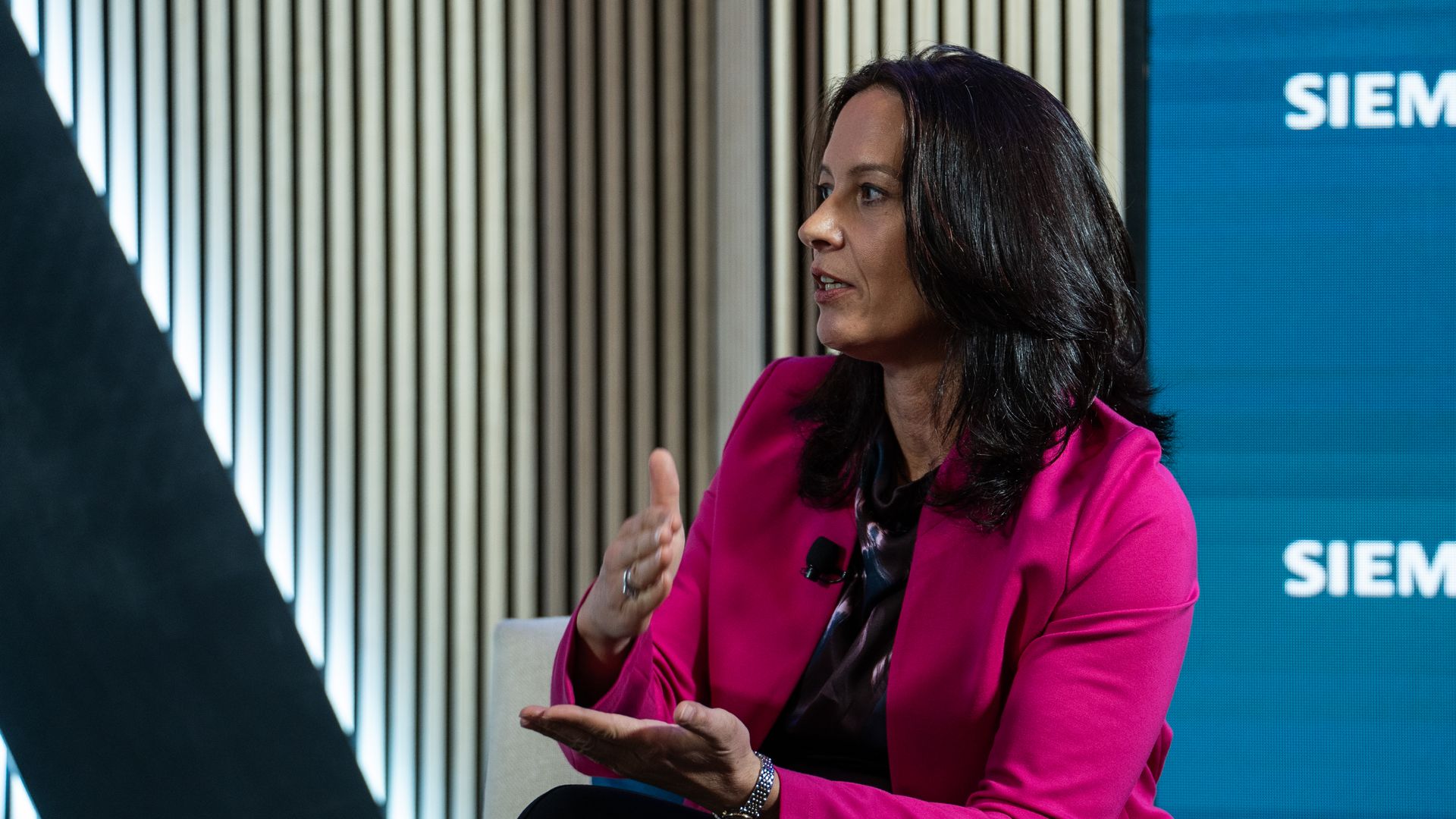
Dr. Eva Riesenhuber, Executive Vice President & Global Head of Sustainability at Siemens, recently joined Axios publisher Nicholas Johnston for a View from the Top conversation as part of Climate Week and the UN General Assembly.
The two discussed today's biggest challenges and opportunities around sustainability, how to strengthen resilience while protecting operations and how AI fits into the sustainability conversation.
1. The landscape: How has the conversation around sustainability shifted globally over the past few years?
Riesenhuber: Looking back a few years ago, we were talking about the future — navigating how to be good corporate citizens, setting targets and doing the right thing.
But now, the future is here. We're living it. We're experiencing:
- Resource scarcity.
- Extreme weather.
- Biodiversity loss.
That means, the targets today are completely different. We're focused on:
- Completing the energy transition — shifting from fossil fuels to clean, renewable energy sources.
- Completing the circularity transition.
- Navigating this disrupted world.
2. The challenge: What's the biggest obstacle for success for organizations dealing with this new framework?
Riesenhuber: We have to connect the language of revenue, cost, margins and bottom line to values. How do we shape the future we want to live in?
- At Siemens, we work in societal infrastructure, buildings, automation, electrification and transportation. That entire system has to move to be decarbonized and circular by 2050.
The question then becomes: how do we get there? The biggest obstacles are…
- Calculating return on investment.
- Figuring out how to bridge the time gap between making a sustainability investment and seeing its ROI, which is often slow-moving.
3. What you're missing: The financial component of sustainability is not something that can be ignored — how do you think about this at Siemens when talking to your customers?
Riesenhuber: We like to use our own portfolio to show customers that it's possible.
- While, ROI may not be [fully calculated] until six years out, in the in between, resilience is a great metric to consider.
Resilience means mitigating the risk of being disrupted — here's an example of resilience in action:
- The lights stay on at our sites because they are powered by renewables. Heat pumps in the ground help to manage temperature. Siemens connects smart buildings to real-time weather data.
It's a completely different game.
4. Okay, but: How do we fill that time gap you mentioned between investment and ROI?
Riesenhuber: Pace ourselves. Every business in the world can take a certain amount of long term investment every year; we really have to have to use that bucket.
- It helps to have a captive finance arm — we have Siemens Financial Services where we're helping customers bridge that time gap as they move their factories and buildings to net zero, electrify their fleets and build resilient infrastructure with microcredits.
- Energy is very much in focus. I'm [thinking a lot about] decarbonization. We're getting to the same space if we make sure we have resilient infrastructure that is powered by renewables.
5. What's in store: How does AI fit into the way you think about sustainability challenges?
Riesenhuber: We're quite excited about AI.
At Siemens, we've been building infrastructure for 178 years. We digitized that, and now we're accelerating that transformation with AI — we call this industrial AI.
- We can already save about 30% of energy in a building with an AI-powered autonomous control of a building. It's really self-optimizing.
- Plus, in times of grid congestion and long connection queues, with our AI-powered grid software, we can get 30% more load on the same grid.
This is all machine pattern on steroids, but it's industrial AI that really helps us get it all together.
6. Next steps: What message do you have for organizations thinking about these challenges?
Riesenhuber: We don't have the time anymore to afford to just optimize for the past. We need to anticipate the future.
- There are so many things to think about, and if we don't consider sustainability at the same time, we'll find ourselves in 10 years needing to redo it all again. No one has the money to do that.
Siloed thinking is over. We need to think about the big picture and take a holistic approach to sustainability.
- This can happen using software and AI. In infrastructure, we're connecting the buildings to the grids. We're thinking about the future of autonomous buildings as an energy node in the grid, so that the grid breathes through all the buildings connected to it.
That's system thinking, and finding these visions for the future is the key.