How GE Vernova is adapting to the ever-changing energy landscape
A message from: GE Vernova
GE Vernova
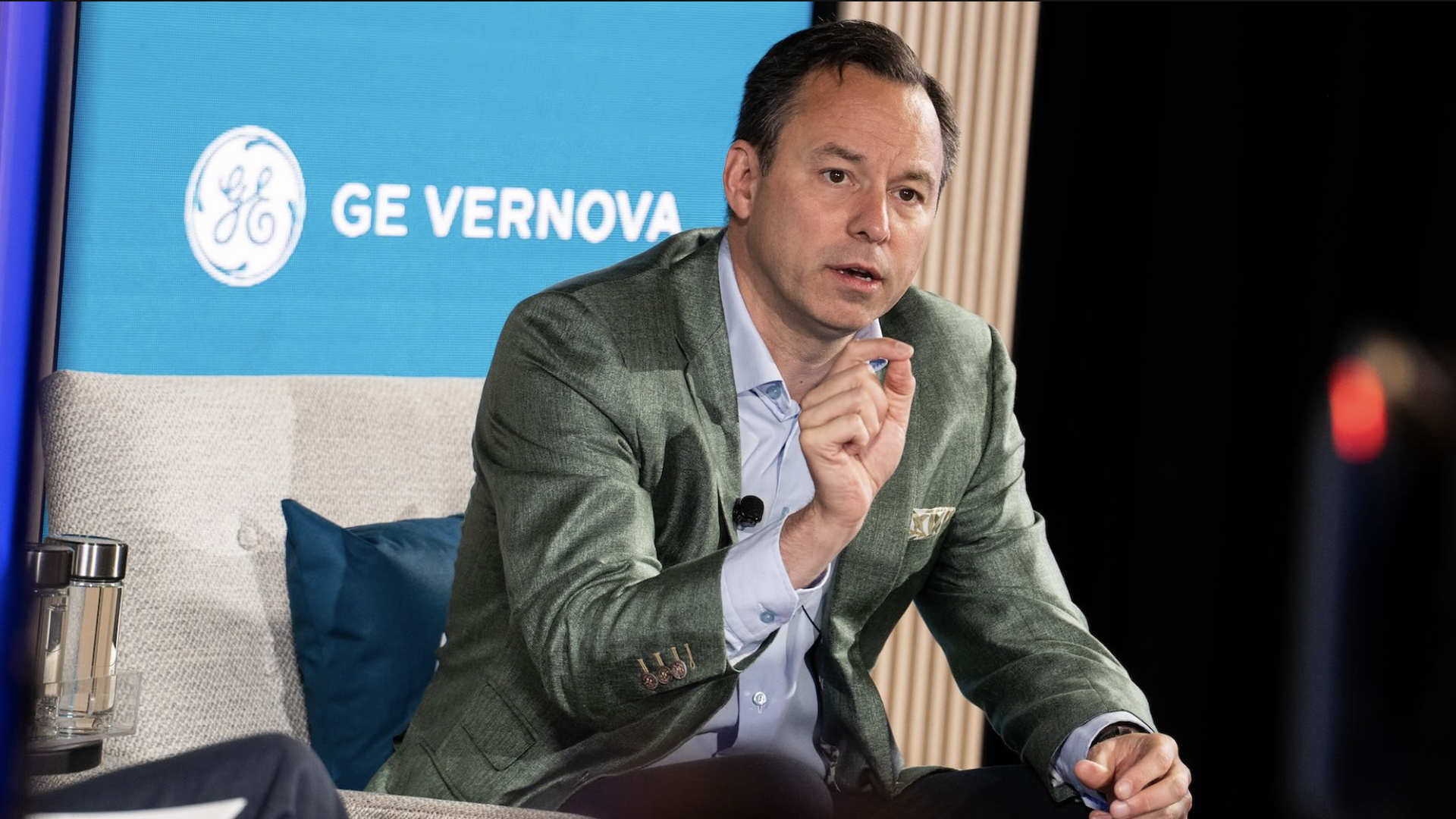
Scott Strazik, CEO of GE Vernova, sat down with Axios' Mike Allen in a View From The Top conversation to discuss the company's role in powering the grid, scaling clean energy and preparing for rising demand in the age of AI.
1. First things first: You said a significant share of the electrons flowing through the United States are passing through GE Vernova equipment? Unpack that amazing stat.
Strazik: We've built this grid over 100 years, and it's about 25% of the electrons globally are powered with our equipment through our customers every day. That's a big deal because that creates a real responsibility for us to nurture and protect that install base.
- Today, there's such a need for more energy from the existing install base — whether that's gas, where half of the global gas install base runs on our equipment, or nuclear, where 65 plants in the U.S. operate with our equipment.
And we see opportunities to upgrade that install base in different ways, just to give a few examples.
2. The highlights: Since becoming a standalone company, how has GE Vernova shaped its culture internally and externally, and how are you making an impact?
Strazik: It starts with practical, adult conversations about how to build at scale. This isn't a time for hobbies, we need investments that can move the needle substantially and quickly.
- For example, this year we've invested $700 million in new U.S. manufacturing capacity, creating 1,800 new jobs.
But we're not making gas turbines or transformers the same way we did yesterday. We're complementing those 1,800 jobs with more automation and robotics, because the opportunity to serve this country and the world is so great today.
We've got to do things differently — and that's what we're focused on, with a humble, entrepreneurial spirit.
3. Why now: What does Climate Week look like for you and your team, including Tom Reynolds, and what are you hoping to accomplish?
Strazik: Well, I think this is a great opportunity to connect with people that are swimming in the same direction as you, but also to have conversations with those that maybe have different views. So, it's a good platform for us to exchange thoughts.
- I think energy is critical today, and when you think about electric power, which is what we do, it only creates about 20% of the world's energy.
- The other 80% is still coming from liquid molecules, coal and industrial applications.
Most people think that 20% needs to double. It's not going to double if we don't bring a lot of different archetypes of people together to find ways to do business.
And that's where I find a week like this to be important — a chance to have those engaging conversations.
4. Looking ahead: When you think about breakthrough energy technologies — hydrogen, nuclear, direct air capture — which do you see advancing fastest in the decade ahead?
Strazik: Nuclear is moving very rapidly, and it's really important because one of the things we haven't talked about yet is that power density matters.
Land is going to become a challenge. You can take a 300-megawatt small modular reactor that we're constructing right now, that one football field-sized solution produces the equivalent electricity needed to power 300,000 homes in the U.S.
- We're building the first one in Ontario, Canada, and we have our first application into the Nuclear Regulatory Commission to start construction on the first plant in the U.S., which we hope will be underway by sometime in 2027.
- We're going to need zero-carbon electrons that can run at baseload, and nuclear is a great solution for that. So, we're incredibly excited about where we're going with our nuclear program.
But it's not the only area. We've got a running direct air capture site today, and this week we'll announce a 1,500-ton annual direct air capture facility that takes carbon right out of the air. That's technology we'll continue to invest in.
- And we also need good software to keep making the grid smarter, to manage the bi-directional flows of electrons, and we like our chances in that regard.
So those are different technologies in the space that we think are critical for us and for the world.
5. The challenge: How do you meet that demand for energy amid AI and still keep the grid reliable and affordable?
Strazik: I actually think the growth makes it easier. The challenge of driving toward a more affordable, more decarbonized system is much tougher in a flat or down period.
- In this case, we've got real growth, and as the CEO of the company, that gives me no excuses.
It gives me more ammunition to invest for the long term and ultimately drive the affordability curve down, because we have more confidence and conviction that the opportunities will be there at a higher level for a longer period of time.
- That's exactly why we're making the investments and announcements we are — to ultimately improve affordability and strengthen decarbonization dynamics in the country.
Nuclear is going to matter, and it's going to happen much faster than it otherwise would have, thanks to things like hyperscaler demands. So, for me, there's a lot to be excited about nuclear at this time.
6. The plan: Given the uncertainty around AI demand, how do you approach long-term planning?
Strazik: We'll all have the wrong numbers for how high this goes, but we all know the direction of travel. What we talk about every day is that it's going to be a lot higher for a lot longer.
- Exactly what that means in numbers; we're not trying to be precisionists right now.
But when we look at the role we play in the world, we know we need to show up every day with urgency and humility, knowing we may need to do things differently tomorrow than we did yesterday if we're going to meet this moment.
- From our perspective, we haven't seen this much load growth since 1945, after World War II. And when you step back and think about how much more complicated it is to build today compared to then, it really shows the scale of the challenge.
I like our chances, but it requires a combination of humility, courage and entrepreneurial spirit to make it a reality.
7. The landscape: What policy shifts or public-private partnerships are you seeing the biggest change in right now?
Strazik: From a public-private partnership perspective, something we haven't talked about is the need for the next generation to come into this industry.
- That's part of why we built our headquarters in Cambridge, Mass., because there are so many colleges there. Inspiring the next generation to join this industry is something I focus on every day.
- That's also why we launched a $50 million alliance with MIT, to pull that talent pool into the company.
Public-private partnerships are just one example, but I think they're critical for next-gen leaders. At the same time, we have a lot of work to do on permitting reform.
- That's been sitting out there too long. We clearly need more gas pipelines, carbon pipelines and transmission connections.
All of these need to be brought together and made easier to do. That doesn't mean communities shouldn't have a voice in the process, they should, but it needs to be more efficient.
And we're committed to working with communities and regulators to make that a reality.