A new wave of innovation paves the way for green shipping

A message from: Hanwha
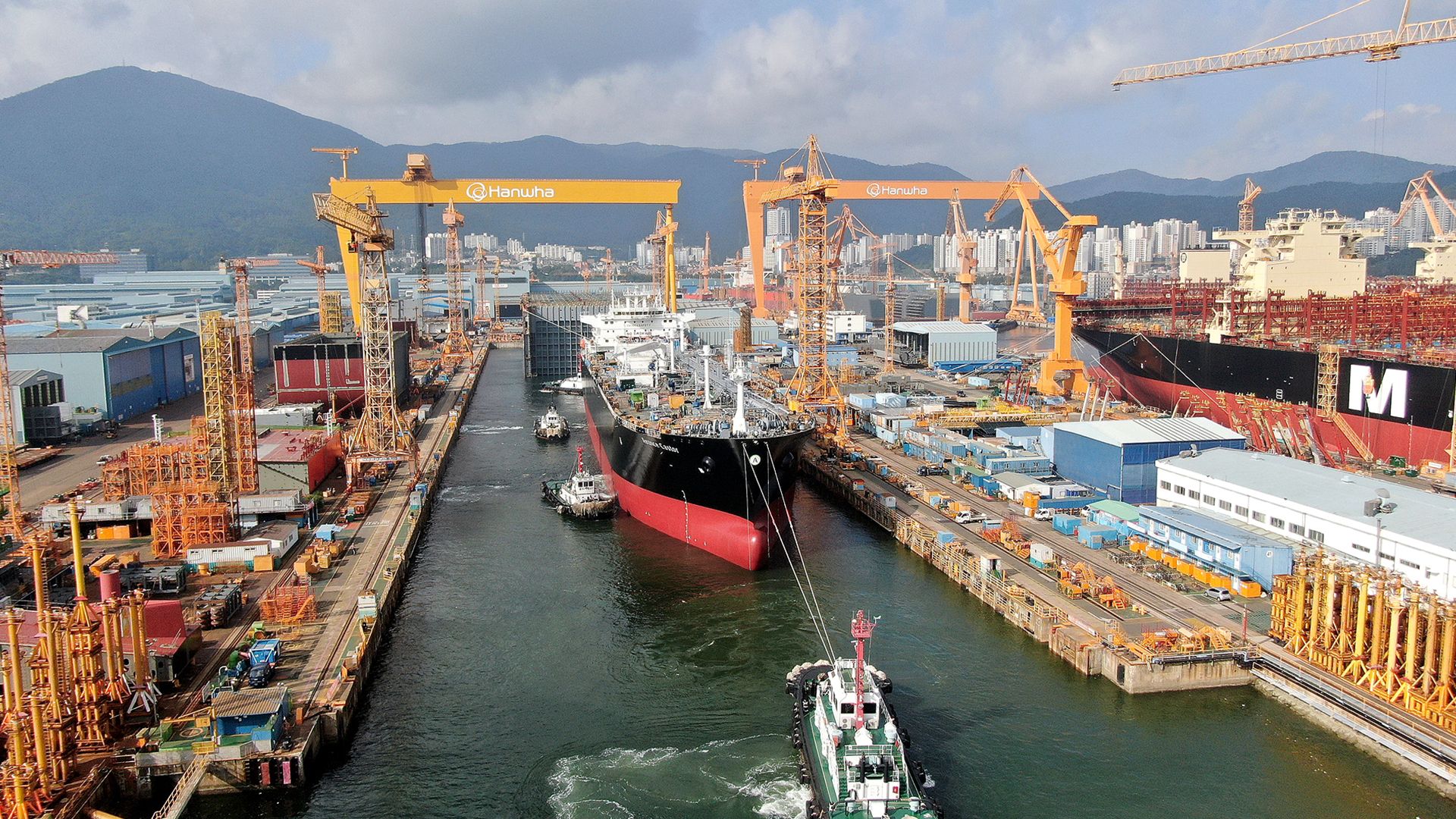
The shipping industry is at a critical juncture, poised to undergo a sustainability transformation that could redefine global trade.
Why it's important: Maritime shipping, responsible for transporting nearly 90% of globally traded goods, is a major contributor to greenhouse gas emissions due to its reliance on fossil fuels like diesel.
The challenge: A complex web of factors — including the slow development of alternative fuels, lackluster demand for green ships and regulatory uncertainties — has made shipping a hard-to-abate sector.
Finding sustainable alternatives has become imperative as maritime shipping grapples with tighter regulations and the urgent need to meet net-zero targets by 2050.
Here's the deal: Ammonia is emerging as a promising alternative fuel due to its potential to burn without producing CO2.
- However, existing ship engines that can use ammonia still rely on fossil fuels for ignition, limiting their effectiveness in achieving true carbon neutrality.
The positive news: Hanwha — a trailblazer across maritime innovation, clean energy and aerospace — is developing the world's first ammonia-fueled gas turbines to address this challenge and help the industry move beyond fossil fuel dependence.
The impact: Once available, these turbines will eliminate the need for any fossil fuels in the ignition process, making them a game-changing solution for the future of shipping.
- This revolutionary technology could eventually lead to fully electrified ships when combined with hydrogen fuel cells — part of Hanwha's long-term vision for carbon-free maritime operations.
Worth a mention: Hanwha's ammonia-powered gas turbines recently received Approval in Principle (AiP) from the American Bureau of Shipping, validating the technology and marking a significant step forward in zero-carbon shipping.
The details: The company's roadmap for the future of maritime shipping also focuses on short- to mid-term decarbonization solutions like its ammonia dual-fuel engines.
- These engines, which can run on a mixture of ammonia and LNG, offer a lower-carbon solution for the industry as it transitions toward full decarbonization.
- Plus, plus, plus: Once Hanwha's ammonia-powered gas turbines are commercially viable, the company plans to retrofit existing LNG carriers with the technology, providing a practical and scalable approach to reducing emissions.
The strategy: Hanwha's strength lies in its integrated approach, leveraging the expertise of its three businesses that specialize in maritime solutions: Hanwha Ocean, Hanwha Power Systems and Hanwha Engine.
Together, they form a synergistic ecosystem capable of developing, building and maintaining next-generation ships.
- Hanwha Ocean, a global leader in shipbuilding, is at the forefront of developing smart ship systems that will support these advanced vessels.
- Hanwha Power Systems is focused on developing and deploying ammonia-powered gas turbines.
- Hanwha Engine specializes in dual-fuel engines, ensuring that all aspects of ship propulsion are covered.
Take note: As part of its roadmap to decarbonization, Hanwha Ocean recently secured a $500 million order to build four very large ammonia carriers (VLACs) that will be outfitted with the ammonia dual-fuel engines and will transport 93,000 cubic meters of ammonia — the world's largest of their class.
Looking ahead: Hanwha has a detailed roadmap to bring carbon-free and electrified ships to scale. The company aims to bring highly efficient and autonomous vessels to market through a full suite of solutions — including carbon reduction technology, such as air lubrication, rotor sails, as well as smart ship technologies and fuel cell innovations — and tailoring them to customers' decarbonization needs.
This multi-faceted approach will help industries achieve a carbon-neutral supply chain.