

July 31, 2025
It's Thursday, Pros! Thanks for reading.
- Over the August recess, we'll deliver breaking news to you as it happens, along with weekly newsletters every Thursday at 1:30pm ET.
🔎 Have a sensitive tip? Reach out securely on Signal to Ashley at ashleyrgold.20 and Maria at mariacuri.01.
1 big thing: Tech policy bills to watch
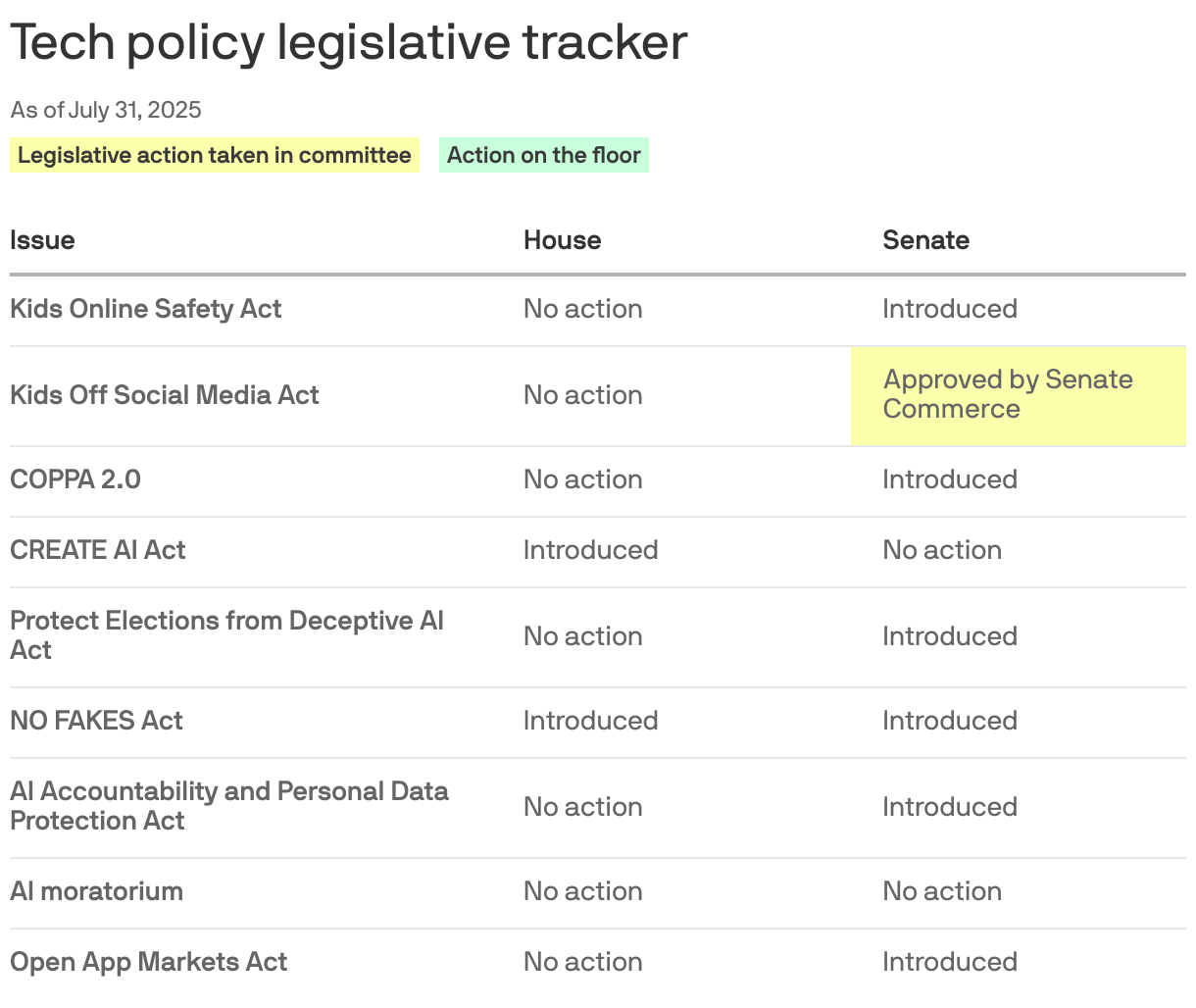
Reconciliation has dominated the last few months and budget fights are next — but along the way, we're expecting some tech bills to inch forward.
The big picture: Lawmakers are facing increasing pressure to put preemptive, federal tech guardrails in place as states race ahead on legislation.
- With Republicans largely taking their cues from President Trump, the administration's AI action plan also offers a fresh roadmap on what to watch on the Hill.
Here's a rundown of what we're tracking:
Kids' online safety bills
The issue: The Senate Commerce Committee has yet to take up the Kids Online Safety Act and COPPA 2.0.
- Chair Ted Cruz has said he remains committed to the bills despite a messy fallout with KOSA sponsor Sen. Marsha Blackburn over an AI moratorium deal.
Status: COPPA 2.0 and KOSA have been reintroduced only in the Senate. Senate Commerce has advanced the Kids Off Social Media Act, which would set a minimum age of 13 to use social media platforms.
What's next: Senate Commerce and House Energy and Commerce leaders will have more time to start scheduling markups after August recess, but political fights over the president loom large over legislative progress, particularly in the House.
CREATE AI Act
The issue: This bipartisan bill would authorize the National Artificial Intelligence Research Resource, which is currently a pilot program providing computing power, data, software and training to researchers. The legislation has stalled despite once being seen as an easy lift.
Status: Only the House has reintroduced the bill.
What's next: Trump's AI action plan offers support for the NAIRR program, which may be the green light Republican lawmakers were waiting for.
- It also calls for a new plan, led by OSTP, to guide federal AI research investments.
- With the NSF gutted and steep budget cuts on the horizon, we'll be watching how well the government can deploy the program.
Protect Elections from Deceptive AI Act
The issue: This bipartisan bill would ban the use of AI to generate "materially deceptive" content depicting federal candidates in political ads by amending the FEC Act, with exceptions for parody and satire.
Status: Reintroduced in April, it's awaiting another markup from the Senate Rules committee. (It made it out of committee in 2024, but didn't get to the floor).
What's next: Given how the federal atmosphere around AI has changed from one of caution to acceleration, we're doubtful this one makes it to a floor vote; though Congress may be the last bastion caring about AI safety in U.S. government.
NO FAKES Act
The issue: This bill would make companies and individuals liable for hosting and distributing deepfakes and replicas of people's voices and likeness without their permission.
- From children facing cyberbullying to artists and musicians, this bipartisan bill has broad appeal — and the similar TAKE IT DOWN Act has been signed into law.
Status: The bill's been introduced in both chambers.
What's next: The Senate Judiciary Committee held a hearing on deepfakes in May, but has yet to markup the bill.
- Trump's AI action plan says more action is needed after TAKE IT DOWN, with a focus on offering courts and law enforcement tools to combat fake evidence presented in legal proceedings.
Keep reading below.
2. More bills to watch

AI Accountability and Personal Data Protection Act
The issue: This bipartisan bill is meant to "protect consumers' data rights and hold Big Tech companies accountable for illegally pirating creators' copyrighted works" to train their AI models, per Sens. Josh Hawley and Richard Blumenthal.
Status: No markup yet, but there could be interest as the battles between copyright holders and AI companies heat up.
What's next: Hawley's Judiciary subcommittee held a hearing with authors and other experts to discuss tech companies scraping copyright-protected data this month.
- The AI action plan doesn't specifically address copyright, and points to Congress and the courts to figure it out.
AI moratorium
The issue: An effort led by Cruz and killed by Blackburn to stop state-level AI regulation was the tech drama to watch during reconciliation.
- The saga included moves to make some federal funding contingent on not enforcing state AI protections, convincing the parliamentarian it was a matter relevant to the budget, and potentially carving out some types of AI laws.
Status: OSTP director Michael Kratsios has acknowledged preempting state level AI regulation is in Congress' control. But the administration used the AI action plan to put the pressure on to offer the tech industry an alternative to a patchwork of state laws.
- The Federal Communications Commission is looking into how the Communications Act can be leveraged to preempt state AI laws.
What's next: Cruz, with the backing of the Trump administration and the tech industry, is not giving up and we're watching for some version of the moratorium to pop back up in a must-pass vehicle this Congress.
Open App Markets Act
The issue: Originally introduced in 2021, this bill is an attempt to break up Google and Apple's alleged smartphone and App Store monopolies by loosening restrictions on their rules and allowing app developers more flexibility.
Status: Reintroduced in the Senate by a bipartisan group in June with some new provisions.
What's next: Given how the U.S. government has pushed back against similar rules abroad, and how the U.S. vs Apple case continues at the DOJ, we don't expect a lot of movement on this one.
3. Apple to DOJ: Lawsuit threatens iPhone innovation and safety
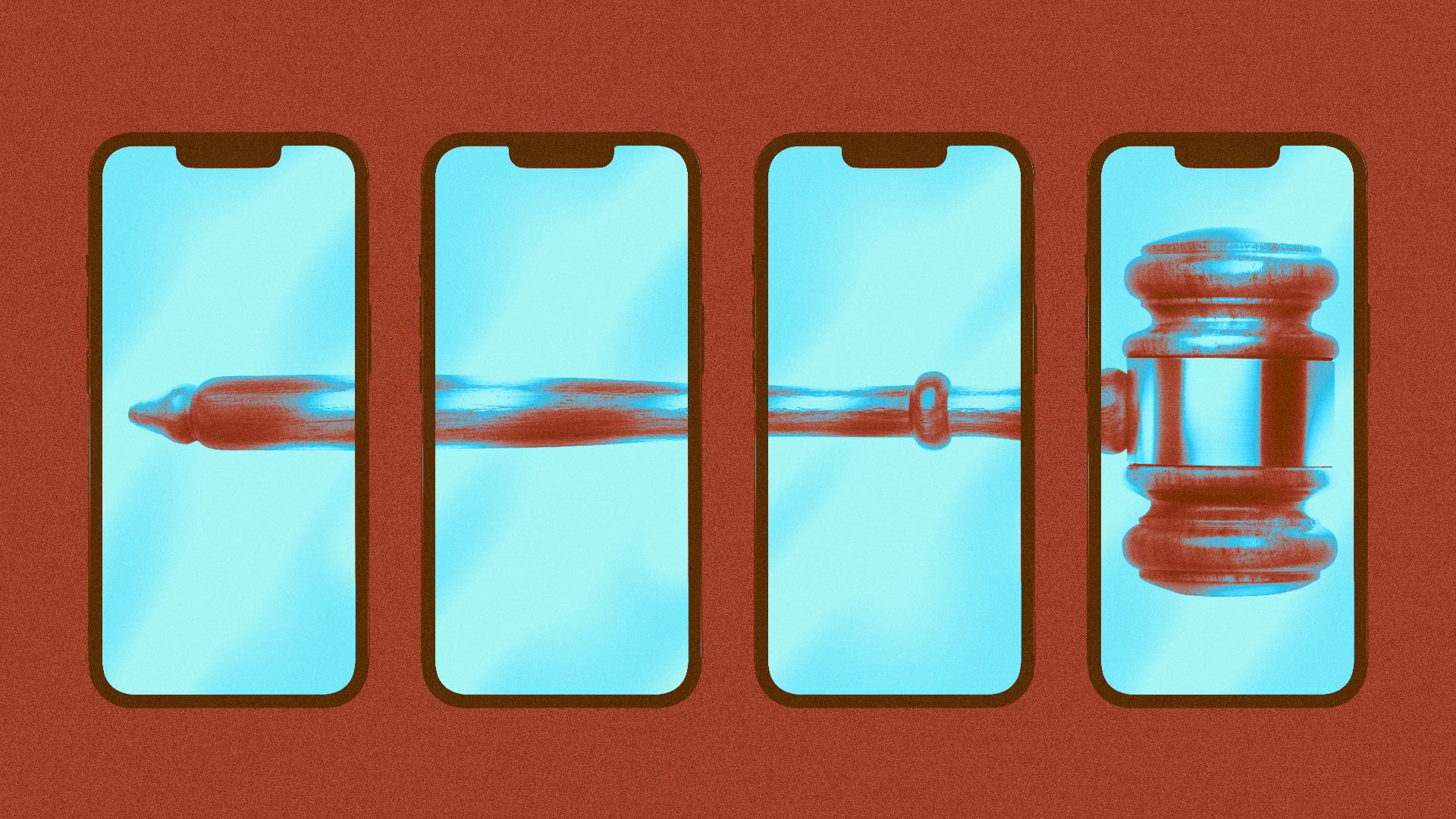
The Justice's Departments antitrust lawsuit against Apple threatens the features that make the iPhone popular and secure, the company argued in a filing this week.
Why it matters: More than a year after the DOJ filed suit against Apple alleging a smartphone monopoly, the case is moving into the next phase with Apple ready to fight.
- Apple's response comes as personnel drama brews at the DOJ, and a decision on remedies in the U.S. vs. Google case is expected imminently.
- The features in DOJ's complaint include limiting digital wallets, "diminishing the functionality" of non-Apple smartwatches and making cross-platform messaging worse.
Driving the news: DOJ's original complaint was about five design choices it said created a "monopoly playbook" to shut out competitive threats and keep people from switching to other products.
What they're saying: "The complaint's theories, if vindicated, would reduce consumer choice and erode competition. The lawsuit could set a dangerous precedent, empowering the government to take a heavy hand in designing people's technology," the response reads.
- "Apple has made careful and deliberate decisions in each of those five areas, all of which are focused on optimizing customer experience and not destroying competitors or making it more difficult for customers to buy another smartphone if they so choose."
- "DOJ posits Apple should have made other choices, but that is not an antitrust violation and, in fact, would restrict Apple's ability to compete and give users the differentiated products they value."
What's next: The case moves into the discovery phase.
4. What they're saying: Kratsios on the Hill's AI role
OSTP director Michael Kratsios spoke at CISIS yesterday on the recently released AI action plan and laid out four specific areas where the Trump administration is looking to Congress for help on its tech agenda.
Here's Kratsios' breakdown of the categories that the White House believes the Hill needs to be involved in:
1. Preemption: "Anything related to preemption is something that's going to be mostly in their court instead of ours, and we look forward to working with them to kind of think through some of those preemption issues."
2. Copyright: "Obviously the fair use issue of copyrighted materials and the training of large language models was something the president brought up in the speech. There's not a lot the executive branch can do on that."
- "Understanding and interpreting what fair use is is now sitting in the courts, but that's obviously something that if the Hill wants to think about, that's an area that they, although quite controversial ... could potentially try to tackle."
3. AI standards: "With the reforms we've made to [the Center for AI Standards and Innovation], there is obviously an opportunity for the Hill to think about how to legislate on the standards institute and give it sort of statutory cover for some of the actions that we want to be doing long term."
4. Appropriations: "I continue to always think about R&D funding and the way that we can prioritize AI-related funding across NSF and a bunch of other agencies."
✅ Thank you for reading Axios Pro Policy, and thanks to editors Mackenzie Weinger and David Nather and copy editor Bryan McBournie.
- Do you know someone who needs this newsletter? Have them sign up here.
View archive


