December 05, 2024


Good afternoon ... We'll be back in your inbox tomorrow with our monthly newsletter tracking who's working where, or earlier if there's breaking news you need to know.
- Click here if you have a new job and want to be featured!
1 big thing: Q&A with NSF director Panchanathan
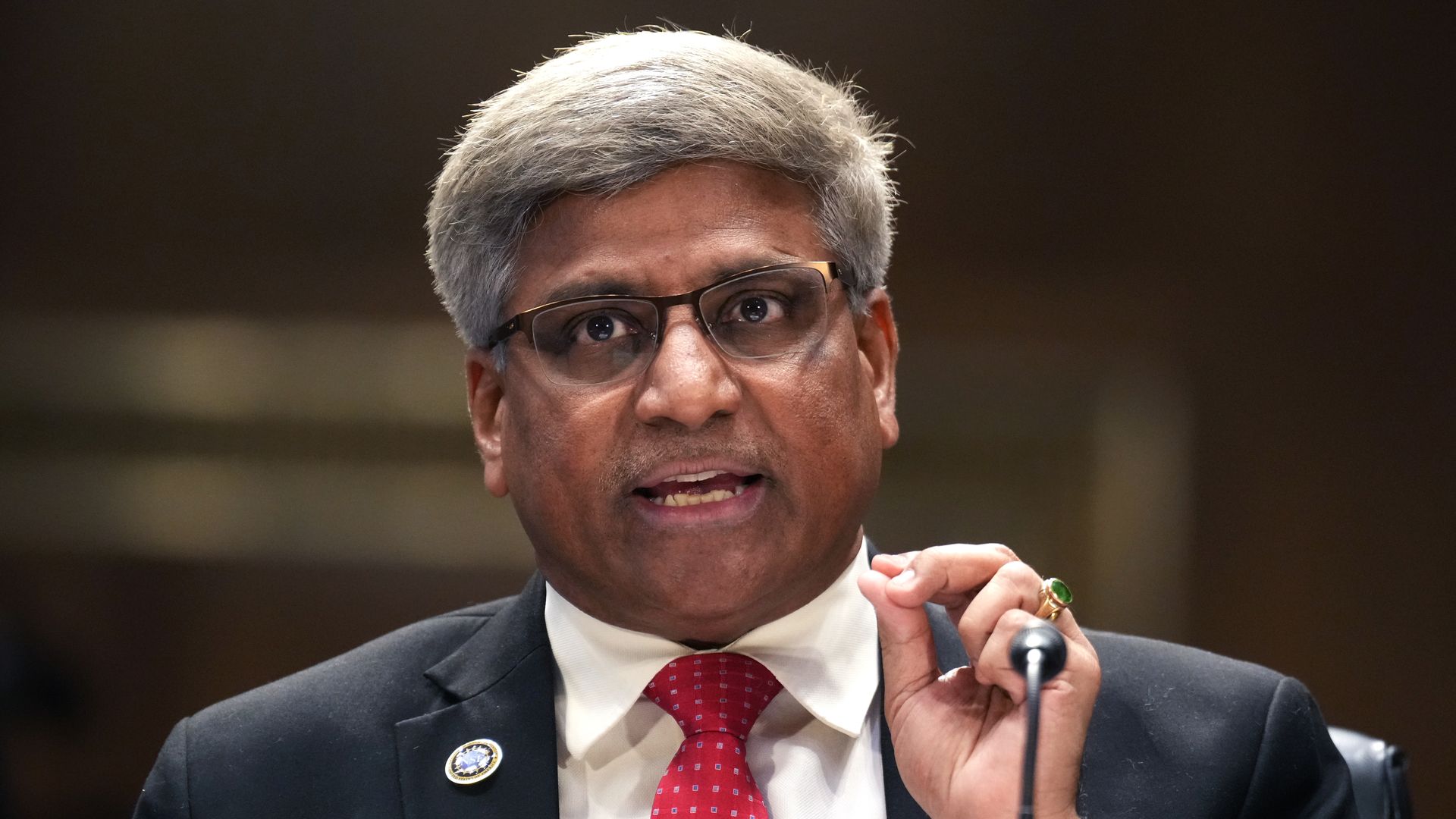
National Science Foundation director Sethuraman Panchanathan this week sat down with reporters to talk about the future of key programs the agency is spearheading.
Why it matters: NSF is at the center of many programs to spur AI, quantum and other cutting edge technology research and development, but it's facing funding shortfalls.
- Lawmakers are poised to pass a continuing resolution and wait until a new Congress and administration takes over to deal with FY25 funding.
- Panchanathan, who was nominated to his position during President-elect Trump's first term, describes government science and technology efforts as "post-partisan."
This conversation has been edited and condensed for clarity.
Your term ends in 2026. Do you plan to stick around?
It is left up to the incoming administration in terms of how they want to move forward and I'm very respectful of that.
- I came here knowing that I have a six-year term, and I wanted to see what we could do in the six-year term to unleash innovation all across our nation.
We've seen that Trump is very hostile toward immigration. Do you think that is going to require an increased emphasis on training and retraining?
Our domestic talent has to be unleashed at full force and full scale. That's the first thing that we need to focus on because it has not been achieved in my view.
- Then, I'm a firm believer in welcoming global talent and giving them the opportunities to be able to come here.
- The jointness of the domestic talent at full force and the global talent at full force is what is necessary at this important point to out compete any nation on Earth.
- I don't see any of that changing in any way because that's what America is. And I don't see anything that is being said by anybody that is different from what this spirit is.
What is the status of funding for the National AI Research Resource?
- I'm very gratified to see bills in Congress, particularly the CREATE AI Act, which specifically calls for NAIRR full scale development and deployment.
- I'm looking forward to working with Congress and the incoming administration. I think there is clearly a lot of interest in AI.
How are you making the case specifically to Republicans to continue providing appropriations for programs? Have you made that case directly to the appropriators?
- Yes, I have made the case directly to appropriators. Even better, I travel around the country with congressmen, congresswomen as well as senators of both parties to the places where these projects are in action.
- I can go on and on about the journeys, which really makes the impact much more tangible and the effects of it in real terms.
2. VAST unveils science and tech proposals

The Vision for American Science and Technology (VAST) task force offered up its transition recommendations to advance science and innovation policy in President Trump's second term.
Why it matters: This new group is advocating for the U.S. to make major policy changes to maintain and boost the country's position as a scientific powerhouse.
At the National Science Board meeting yesterday, VAST proposed four "strategic actions" to the next administration:
- Empower local leaders to align American resources through regionally-based science and technology economic generators
- Keep U.S. educated international talent here and proactively recruit top talent from overseas
- Optimize tax codes to enhance competitiveness, strengthen national security and create more good-paying jobs
- Invest in critical infrastructure
What they're saying: "We need to do bigger things," said Science Philanthropy Alliance president and former NSF director France Córdova.
- "Our big hope is that government leadership can foster such partnerships on projects on a large scale."
On the problem of recruiting, training and retaining tech talent, VAST member Monica Dus of the University of Michigan said that most scientists and people within the Beltway agree "there is a very strong sense that this is an existential threat."
- "The reason why the U.S. is a science leader is immigration," said task force member and National Academy of Sciences president Marcia McNutt.
On AI, Dus said VAST is advocating that this "is not a topic we want to cede all of the activity to industry."
- "There are whole applications of AI for public good that likely don't have a profit motive in them, and therefore it's less likely industry will invest in those."
What's next: The task force is set to release its full set of recommendations in February, said Sudip Parikh, CEO of the American Association for the Advancement of Science and chair of VAST.
- But he added that "this is not ending in February" and there is a "sustained effort" on Capitol Hill to change policy.
3. Tech groups back bills against harmful AI images

Dozens of tech non-profits and advocacy groups are calling on Congress to strike back against image-based sexual abuse online this year, per a letter shared first with Maria.
Why it matters: Generative AI has supercharged the proliferation of child sexual abuse material (CSAM) and non-consensual intimate images (NCII) of adults.
- Companies have signed on to voluntary commitments laid out by the White House to combat the abuse but advocates say that's not enough.
State of play: The 27 groups organized by Encode and Americans for Responsible Innovation sent a letter to House Speaker Mike Johnson and Minority Leader Hakeem Jeffries calling on them to pass the DEFIANCE Act and the TAKE IT DOWN Act.
- The TAKE IT DOWN Act requires tech and social media platforms to take down deepfake pornography of children within 48 hours of being notified by the victim and criminalizes posting such content.
- The DEFIANCE Act creates a federal civil right of action for people who are victims of intimate digital forgeries and more than doubles the statute of limitations to 10 years.
- The Senate has passed both bills.
What they're saying: "Looking back on Congress's inaction on social media, many lawmakers and the public at large regret policymakers' delay in addressing the harms of emerging technology before it impacted our youngest generation," groups wrote in the letter.
- "As AI tools, including deepfake tools, grow in use, the clock is ticking for our elected leaders to protect our children from this emerging technology's worst harms."
- Signatories include Educate and Empower Kids, #HalfTheStory, Lynn's Warriors, and Parents Who Fight.
Our thought bubble: Unlike other bills aimed at protecting kids online, the TAKE IT DOWN Act and the DEFIANCE Act have a better shot at passage because they don't go after tech company behavior or legal shields.
4. Catch me up: Antitrust, AI and more

⚖️ Antitrust pick: President-elect Trump yesterday tapped Gail Slater to lead the Department of Justice's antitrust division, our Axios colleague Dan Primack reported.
- Slater has advised Vice President-elect JD Vance on economic policy and previously spent a decade with the FTC.
- She'll inherit a number of big cases, including one that seeks to break up Google.
- "Big Tech has run wild for years, stifling competition in our most innovative sector and, as we all know, using its market power to crack down on the rights of so many Americans, as well as those of Little Tech!" Trump posted.
🗓 Bookmark this: House Majority Leader Steve Scalise released the 2025 House calendar.
✍️ Exports insights: CSIS is out today with an analysis of China's new critical minerals exports restrictions.
- "China has dominance in a much larger number of commodities than these four minerals. Additional export controls — including bans — are likely as a new administration takes office with ambitious tariff policies and a history of trade wars."
🤖 New AI roadmap: INCOMPAS yesterday released an AI policy roadmap on the Hill that calls for regional tech hubs, mitigating bias and civil rights, and an energy strategy that pairs fiber networks with data center capacity.
🗣 Google observation: "He's definitely very focused on American competitiveness, including technology, including AI," Google CEO Sundar Pichai said about his conversations with Trump during yesterday's New York Times DealBook summit.
✅ Thank you for reading Axios Pro Policy, and thanks to editors Mackenzie Weinger and David Nather and copy editor Bryan McBournie.
- Do you know someone who needs this newsletter? Have them sign up here.
View archive