December 07, 2023

Good afternoon ... We'll see you in a few hours!
1 big thing: Eshoo exit interview
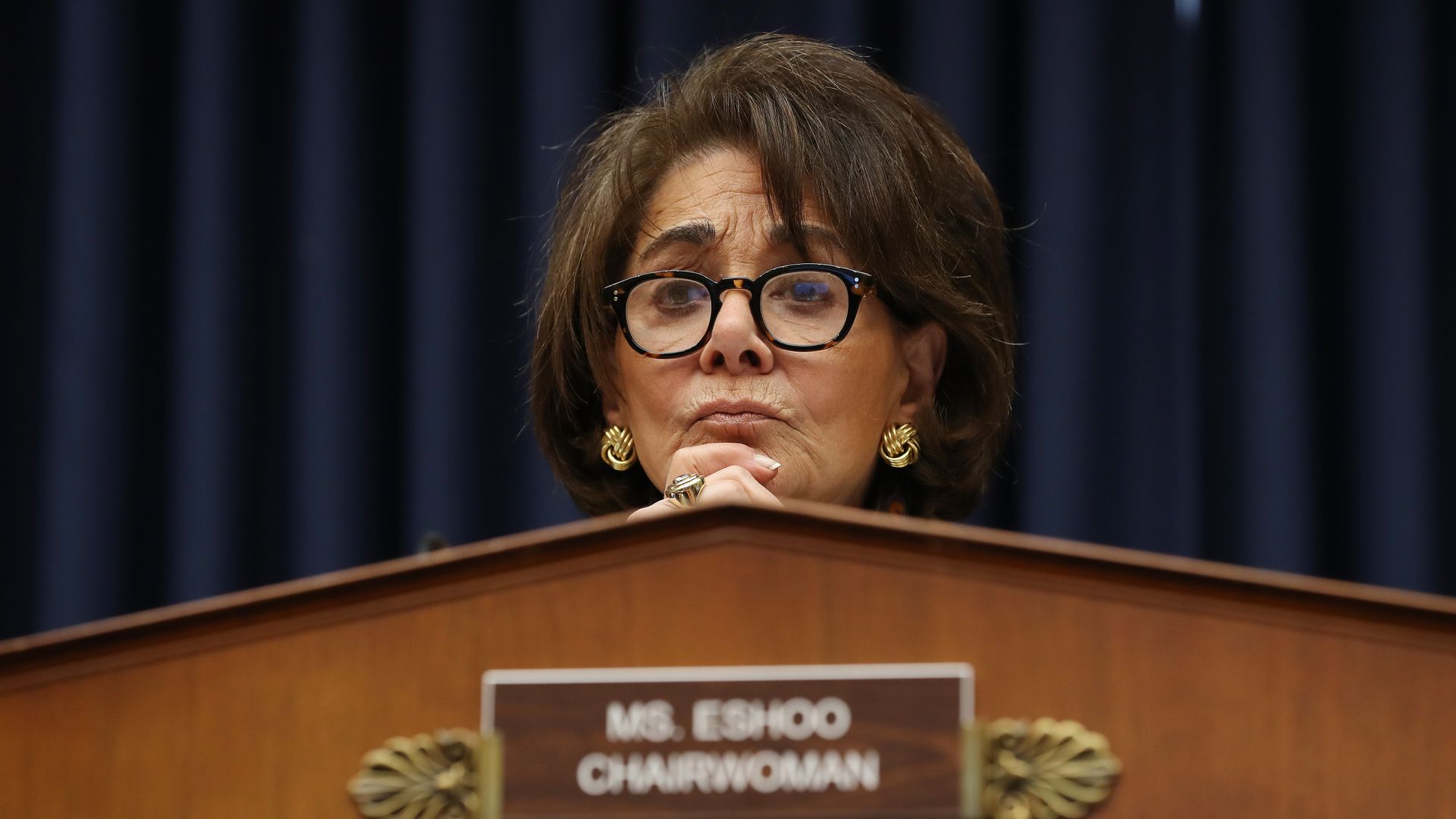
Eshoo in February 2020. Photo: Chip Somodevilla/Getty Images
California Rep. Anna Eshoo will retire at the end of this term, and her outgoing tech to-do list is ambitious, Maria reports.
Why it matters: In representing Silicon Valley's Big Tech players and startups — and witnessing startups become some of the largest global tech companies — Eshoo has navigated key debates on privacy, net neutrality and more.
- She's served in Congress for three decades, beginning in 1993 when the internet was nascent and the popular sentiment was to embrace light-touch regulation to not hamper innovation.
- But Eshoo, reflecting in a Friday interview with Maria and looking ahead to her final year on the Hill, said mistakes were made by lawmakers that need correcting, including Section 230 immunity for tech companies.
- "While I understand why we did what we did when we did it, it allowed for a wild west."
The conversation has been edited and condensed for clarity.
What is your top AI priority before you head out the door in a year?
I'd like to see the president sign the CREATE AI Act into law. It's bicameral, bipartisan and I worked very closely with Stanford University's Human-Centered AI institute.
- Essentially what it does is it democratizes artificial intelligence. The huge tech companies today, it's really for all intents and purposes in their hands.
- The president put a policy that's in my legislation in his executive order, but of course an executive order can be done away with by future administrations.
What is your response to people who say federal privacy efforts break down because of California's preemption concerns?
I would agree with that. Californians responded heartily to the statewide effort to bring about a state law, and Congresswoman Lofgren and I wrote a highly comprehensive bill.
- We worked on it for a year before we actually dropped the bill. We sent it out to hundreds of stakeholders.
- It's the floor, not the ceiling. But that's not how the House effort was constructed. And to eradicate or bring the California law to its knees, I couldn't vote for that.
Do you see net neutrality running into the same preemption issue now that states have passed laws and the FCC is taking it on with this in mind?
My Republican colleagues are dead set against it, so it's not gonna go anywhere in this Congress, sadly.
- But I did speak to it when the FCC was at our subcommittee. I said: I've listened very carefully to opening statements, and what you're leaving out of this is the California experience. California has done this and done it very successfully, and it can be done nationally.
How do you maintain a balance of appreciating the contributions that tech entrepreneurs have made to society without being beholden to them?
I remember stopping by some little reception at the end of my days in the district of Palo Alto, and I saw Eric Schmidt. I've known Eric well for decades now, and at the time he was at Sun Microsystems.
- I was very happy to see him, and I said, Eric, what's new? And he said he's just actually signed up with a new company today — Google. I said that's terrific.
- So you know, I've worked well with the companies but when I didn't agree with them, I told them I didn't and it's not personal, it's business.
Do you think the primary reason we haven't seen tech legislation pass into law is because of lobbying?
It sounds like a simple question, but I think it's rather complex. Now the big tech companies have been around for a while, and their products, their business models are in so many ways embedded in our society. And they, too, are caught up in the whims of politics.
- And there are things that deeply concern not only my constituents but the American people, like social media and what children are looking at. Those are legitimate concerns.
- So I've enjoyed the many friendships that have been formed over the years, but I've never done anything out of fear. It's been fair and I'm honest with them.
What advice do you have for the incoming representative?
Never vote out of fear, or your convictions are just going to wash away.
2. Social media litigation heats up with focus on minorities
Illustration: Aïda Amer/Axios
More people are speaking up in a social media content moderation case before the Supreme Court, including a key Democratic senator, Maria and Ashley report.
State of play: Sen. Ben Ray Luján filed an amicus brief in NetChoice, LLC v. Paxton concerning Florida and Texas social media laws.
- The court is considering whether the First Amendment prohibits companies from making editorial choices about whether and how to disseminate content.
- Luján, who leads the Commerce Committee's communications panel, argues in his brief that the state laws are unconstitutional and social media companies can moderate content.
Why it matters: When it comes to social media companies' role in public discourse, lasting change can come only from Congress. Luján filed the brief for three reasons, his office told Axios.
- To underscore that internet regulation is primarily a federal matter
- To emphasize the important role social media has in the lives of constituents, particularly marginalized communities
- To highlight the legislative branch's role in evaluating the constitutionality of legislation
Yes, but: Lawmakers are entrenched in their ideological views about what social media companies should be able to do, and hopes of breaking the impasse are low.
What they're saying: Luján in a statement stressed that many historically silenced groups now have a voice in a variety of spaces, including social media.
- "Increasing online violence, harassment, and hate speech threaten to drive Hispanic, Black, Native and LGBTQ+ communities offline and back into the fringes of public debate."
- "As I argue in my amicus, social media companies have their own free speech rights, and that includes the right to create spaces for the voices of traditionally marginalized and silenced communities."
Read the full brief here.
Meanwhile, various groups have been filing briefs before the court. The Wikimedia Foundation writes in a release that "the laws are written so broadly that they could potentially be applied to volunteer-run projects like Wikipedia.… This means they could restrict volunteers' ability to moderate Wikipedia content."
- The Reporters Committee for Freedom of the Press writes in a release that the "First Amendment forbids both direct interference with a private speaker's exercise of editorial judgment and disclosure mandates that target the exercise of editorial judgment."
- Former Rep. Chris Cox and Sen. Ron Wyden, who wrote Section 230, wrote in their brief that platforms have a First Amendment right to editorial control.
3. Catch me up: NDAA, AI and more
Illustration: Tiffany Herring/Axios
🤝 NDAA progress: Lawmakers last night unveiled the compromise defense policy bill, which includes some AI provisions.
🧐 AI EO input: The deadline to submit comments to the Office of Management and Budget was this week, and myriad issues were raised, including how to define "rights-impacting AI" and streamlining procurement practices.
🔬 Science research: The House Science Committee on Tuesday advanced three bills to leverage the Energy Department's research resources with three other agencies: the Agriculture Department, the National Science Foundation and NASA.
🇨🇳 BIS review: House Foreign Affairs Committee Chair Michael McCaul released a 90-Day Review Report of the Commerce Department's Bureau of Industry and Security, criticizing its enforcement of tech export controls on China.
🤖 California AI: The California Privacy Protection Agency board convenes tomorrow to discuss new AI draft regulations, with industry lobbyists and advocates getting a chance to weigh in.
✅ Thank you for reading Axios Pro Policy, and thanks to editor Mackenzie Weinger and copy editor Brad Bonhall.
- Do you know someone who needs this newsletter? Have them sign up here.
View archive