October 31, 2023

Good afternoon ... Ready for two more Senate AI forums tomorrow?
1 big thing: Inside Schumer's workforce and high-impact AI forums
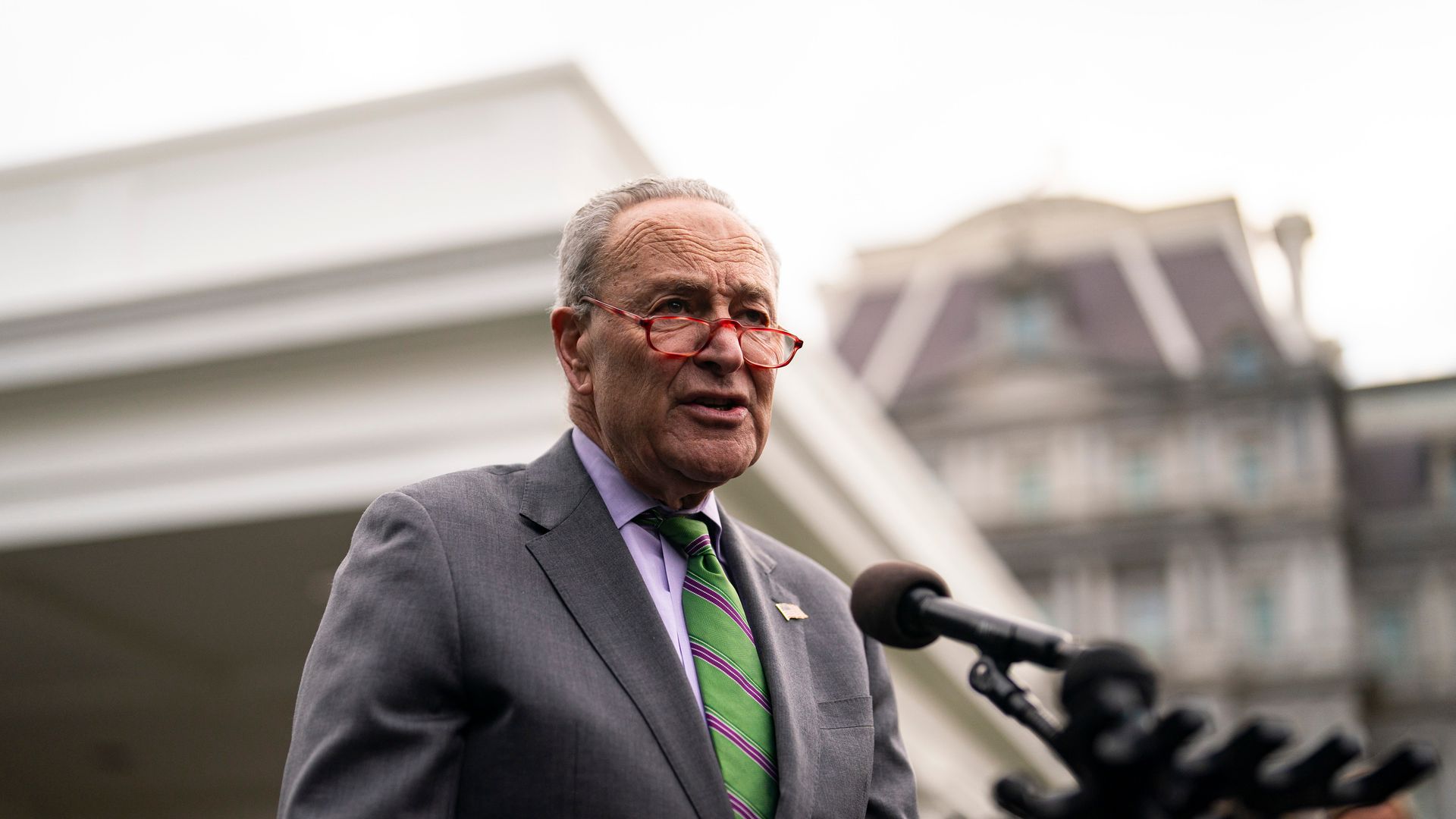
Schumer speaks to the media outside the West Wing yesterday. Photo: Al Drago/Bloomberg via Getty Images
Senate Majority Leader Chuck Schumer tomorrow will convene AI experts to brainstorm how to address the technology's highest societal impacts, Maria reports.
Driving the news: President Biden's AI executive order unveiled yesterday is turbocharging legislative efforts on the Hill.
- Schumer's AI insight forums are meant to keep the momentum going and inform legislation.
- Schumer and the colleagues he's tapped to keep work bipartisan — Sens. Todd Young, Mike Rounds and Martin Heinrich — went to meet with Biden today at the White House to discuss the path forward for an AI bill.
- "Everyone knows the executive order was a good first start, very good. But we also need to do the job with legislation. You can't solve this problem without legislation," Schumer said, noting that they discussed the importance of working on a bipartisan basis and boosting funding for research.
State of play: The pace of the forums is picking up as the sense of urgency, particularly ahead of an election year, mounts.
- Schumer is going from holding one forum a month to two in one day.
- The third Senate AI forum will run from 10:30am to 12:30pm ET and will focus on workforce.
- The fourth will run from 3 to 5pm ET and will center on high-impact AI.
The workforce session will focus on various economic sectors, including medicine, manufacturing, transportation, energy, entertainment and hospitality, Schumer's office said.
- Company speakers will include Microsoft's Allyson Knox, Accenture's Arnab Chakraborty, Indeed's Chris Hyams and Mastercard's Michael Fraccaro.
- Labor organization speakers will include Communication Workers of America's Ameenah Salaam, International Brotherhood of Electrical Workers' Austin Keyser, National Nurses United's Bonnie Castillo, Unite Here DC Local 25's Paul Schwalb, and United Food and Commercial Workers International Union's Rachel Lyons.
- Academic speakers will include University of Virginia's Anton Korinek, MIT's Daron Acemoglu and Dakota State University's José-Marie Griffiths.
- Outside group speakers will include American Enterprise Institute's Michael Strain, Center for American Progress' Patrick Gaspard and Information Technology and Innovation Foundation's Rob Atkinson.
Zoom in: Knox will offer a policy framework based on three pillars, Microsoft spokesperson Kate Frischmann said.
- They include developing AI and basic digital literacy skills, investing in workforce programs (think tech hubs), and providing employers — particularly small- and medium-sized businesses — resources to train workers.
Meanwhile, CAP's Gaspard will say that protecting workers will entail reducing their hours instead of resorting to layoffs, implementing a targeted job guarantee and creating a safety net through the unemployment insurance system.
The other side: Many lawmakers and outside groups say AI will hit the workforce hard, but ITIF's Atkison will offer a different take.
- "I am looking forward to discussing why it's unlikely AI will have major employment impacts and why any AI policies should support both AI that complements workers as well as AI that replaces workers, as the latter is critical to boosting needed productivity growth rates," he said in an email.
The high-impact sectors to be examined include health care, financial services and the country's justice system, Schumer said yesterday.
- Academic speakers will include Princeton's Arvind Narayanan and Surya Mattu, and NYU's Julia Stoyanovich.
- Company speakers will include ORCAA's Cathy O'Neil, Upstart's Dave Girouard, Clearview AI's Hoan Ton-That, Hugging Face's Margaret Mitchell, Capital One's Prem Natarajan, SAS Institute's Reggie Townsend, Epic's Seth Hain and Google's Tulsee Doshi.
- Outside group speakers will include Joint Center for Political and Economic Studies' Dominique Harrison, Information Technology Industry Council's Jason Oxman, National Fair Housing Alliance's Lisa Rice and Urban League's Yvette Badu-Nimako.
- Service Employees International Union's Janelle Jones will represent labor.
Catch up fast: Schumer's first AI insight forum served as a spectacle of the biggest names in tech, and the second focused on innovation.
2. Exclusive: House GOP investigates NSF research security

Illustration: Sarah Grillo/Axios
House Republicans are investigating the security of research taking place at the National Science Foundation, per a letter shared exclusively with Ashley and Maria.
Driving the news: The House Science and Oversight and Accountability committees are pushing forward with an investigation after the FBI found that U.S. research labs are "susceptible to undisclosed and illegal transfers of information, technology and intellectual property."
- In 2021, NSF's Office of the Inspector General testified before Congress that cases involving foreign influence "represented 63% of the OIG's workload," per the letter.
- The letter from House Oversight Chair James Comer and House Science Chair Frank Lucas outlines other examples of the NSF having affiliations with foreign governments and other alleged conflicts of interest.
What they're saying: "The CHIPS and Science Act authorized $81 billion over a span of five years to NSF, doubling the size of the agency," Comer and Lucas wrote in the letter, which includes eight questions for NSF director Sethuraman Panchanathan to reply to by Nov. 14.
- "Given this increase, it is important that the agency ensures that American taxpayer-funded research is protected against theft and exploitation by foreign interests."
- "Defending American research is essential to maintaining U.S. scientific competitiveness and safeguarding economic and national security. This will require proactive oversight and NSF should be an active participant with research institutions to protect American science."
The other side: "NSF takes research security extremely seriously, and the agency has taken a leading role to safeguard taxpayer investments in research," NSF spokesperson Joshua Chamot said.
- "We appreciate the actions from Congress in the CHIPS and Science Act, and NSF will continue to work with Congress on this critical issue."
3. What we're hearing: Human-centered AI

Illustration: Allie Carl/Axios
The tech industry's talent shortage offers Black communities an opportunity to build generational wealth, Black Tech Street founder Tyrance Billingsley said at a Senate HELP subcommittee hearing today.
- "If the systems for AI in the workforce are designed in a human-centered way, AI could be a tool to fundamentally alter the socioeconomic position of marginalized communities in this country," Billingsley said.
- "Or it can exacerbate preexisting inequities that are almost irreparable."
✅ Thank you for reading Axios Pro Policy, and thanks to editors Mackenzie Weinger and David Nather and copy editor Brad Bonhall.
- Do you know someone who needs this newsletter? Have them sign up here.
View archive